
* The article is especially relevant in the era of offline market capture by marketplaces.
The first thing marketing of any business starts with is the name. And contrary to the common tradition of coming up with a name off the cuff, it needs to be thought out for the task.
Naming, positioning, creative strategy for a local brand — it's not about beautiful words. It's about making the business remembered, talked about, and chosen among identical competitors.
The first rule of marketing: “YOU ARE NOT YOUR CLIENT.”
This means the name should appeal not to you, but to your clients. And even more than that — it should work, not just be convenient, beautiful, or correct.
From my practice, I'll say this: a crooked name = expensive marketing.
FOR EXAMPLE:
I have an acquaintance who does carpet cleaning and came up with a “brilliant” name for his business, supposedly creating an association with the famous cartoon — Aladdin!
All would be fine — a creative approach and an attempt to ride on childhood associations, but Aladdin… come on… That name is more suitable for a magic goods store, Turkish cosmetics, carpet sales… But not a laundry!
Carpet cleaning is a specific service, and no one searches for it on Yandex with the query “Aladdin.” This service is searched for with the query “carpet cleaning Lipetsk” — in this search variant, 90% of warm traffic and simple sales come. The remaining 10% is word-of-mouth, where the name has no weight at all, so Aladdin loses again.
If I were the marketing director of Aladdin, I would rename it to “Carpet Cleaning Lipetsk” (the city could be any). The renaming would affect signs, website, advertising, and everything else.
What will this give?
This will give 90% of traffic from search engines WITHOUT ADVERTISING INVESTMENT + differentiation from competitors, because the principle of “first come, first served” hasn't been canceled. There cannot be two identical names in a city. And this is a very strong move!
Conclusion number 1. Change the name before it's too late. In the conditions of 2026, this could be the best investment in your business, instead of spending on advertising, which has become more expensive and stopped working.
* That was a remark, and now let's get to the topic of fishing tackle…
Of course, I'll start with the name))
“RYBALOKH” — a store name that sells itself
There are names that hang on a sign. And there are names that live in conversation.
“I'll stop by Rybalokh” — try saying that out loud and not smile. It doesn't work. That's exactly how strong naming for a local business works.
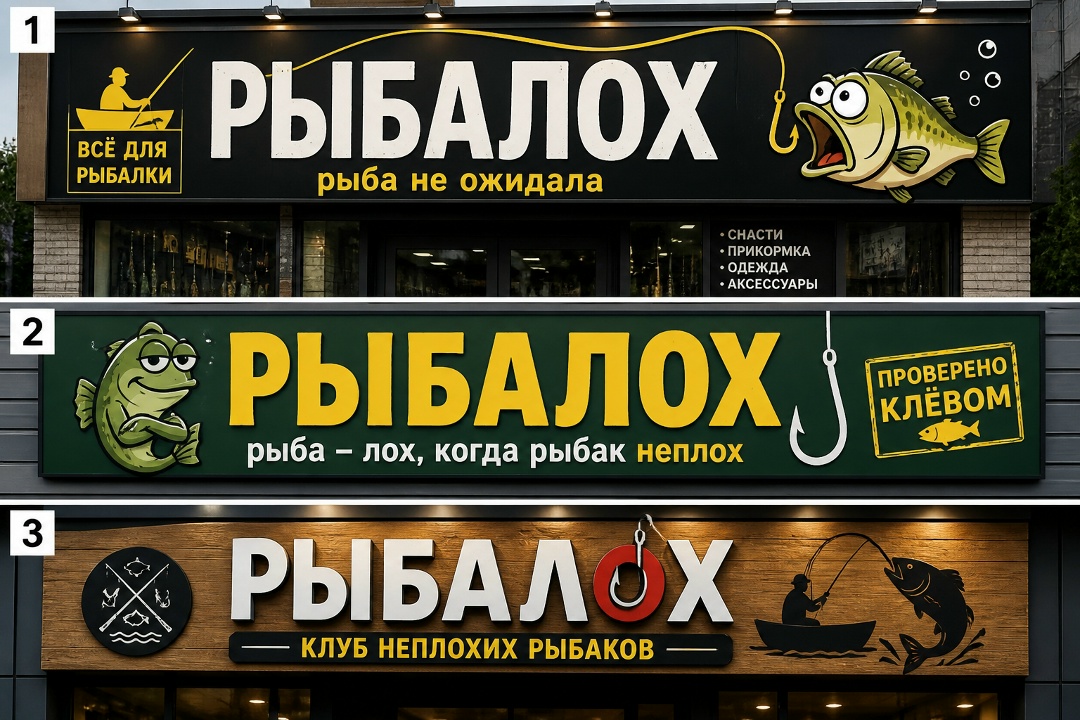
Why “Rybalokh” is not just a funny name
Most fishing stores are named the same and primitively, and worst of all, such names are often forgotten: “Fisherman,” “Bite,” “Trophy,” “Luck.” Sounds so-so… for the 90s it might have been acceptable, the market was empty then. But today such a name is suicide.
“Rybalokh” is a completely different story. The devil is always in the details and subtle nuances… and any fisherman knows that. In fishing, little things matter just as much as in space.
Strengths of such a name:
There is a double bottom of meanings at play here. A person hears the word, the brain instantly breaks it down into parts: fish and sucker. It's not an insult — it's a game. A flip. And it is in this flip that all the power of positioning lives.
The sucker in this story is not the fisherman. The sucker is the fish.
A fisherman with the right gear is always ahead. The fish is always behind. The store is the place where this balance of power shifts in favor of the fisherman.
That's the whole brand philosophy. Simple, precise, memorable.
Mechanics: why it will go viral
A strong name for a store is not one that looks beautiful on a logo. It's one that people want to pass on.
“Rybalokh” spreads itself. Without targeting, without budget, without an agency.
A person hears it — smiles — tells another. The other tells a third. In a small town where everyone knows each other, such a brand becomes a local legend faster than any advertising campaign.
This is word-of-mouth marketing in its purest form — when the product itself creates reasons for conversation.
Plus, the name fits perfectly into short content. Fishing ditties, stickers, signs, bags — all these are brand carriers that people distribute naturally.
“The fish is a sucker when the fisherman is not bad”
“The fish is a sucker — didn't expect such a twist”
One sticker on the rear window of a car is already an advertising medium that travels around the entire city.
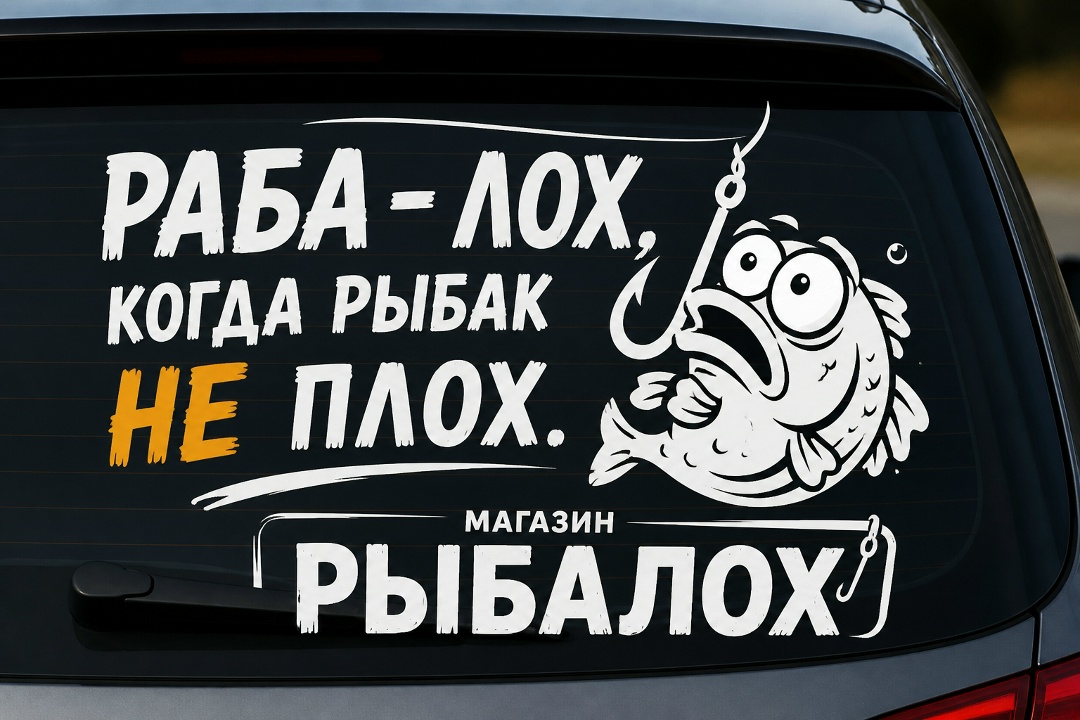
Positioning: a formula that works
Good positioning for a fishing store is not about assortment or prices. It's about the feeling a person gets when they walk inside.
“Rybalokh” gives a clear feeling: here you are accepted into a club of people who are in the know. They don't sell gear — they give an advantage.
A store for those who catch, not just sit by the water.
Rybalokh — the place where the fish loses.
This phrase doesn't work as an insult. It works as a wink to the initiated 😉
It's the language of the yard, the garage, the shore. Not corporate marketing. Not a sterile brand. But “one of us.” With this approach, people will buy because they trust — and trust is currency number one.
“Rybalokh — when the bite is on your side”
Both formulas work because they shift the focus from the store to the client's result. A person doesn't buy a hook — they buy a catch. Not fishing line — they buy victory over the fish.
This is classic jobs-to-be-done in marketing: people don't buy a drill, they buy a hole in the wall. A fisherman doesn't buy gear. He buys a full bucket of fish and the feeling of victory associated with it.
Strong hidden sides of this naming
First — memorability. The name is unusual, bold, colloquial. Hear it once — you won't forget. No need to spend budget on repeated touches. A playful name becomes part of culture, a meme, a catchphrase.
Second — word-of-mouth potential. People themselves talk about such brands — because it's funny and accurate. And laughter is the best currency of attention in local marketing.
Third — character. Most local stores have no character at all. “Rybalokh” is already a character. With intonation, humor, and a stance.
Fourth — scalability. The name works equally well on a sign, in social media, on merch, in advertising, and in word-of-mouth. It can be played with in a hundred creative and cheap ways that will yield strong results. This is rare.
Where this approach will work best
Small towns are the ideal environment. Information spreads quickly there, people trust local businesses, and one bright spot on the map quickly becomes a landmark.
In small towns, radio advertising is quite affordable, and the chances of catchphrases spreading among the target audience are huge.
Examples of catchphrases for radio ads:
- If the gear is from “Rybalokh” — the bite will be without extra words.
- Got bait at “Rybalokh” and the catch is ready.
Or a ditty:
They'll tell you without fuss — how to catch any whales.
* This article describes 80% of the strategy. Take it and implement it, and if you need help with unclear nuances to avoid wasting budget and having to redo things, contact me — master of creative solutions Stas Yesenin.
What to do if you have a different business
If you have a business and you're reading this thinking “cool, but I have a different niche, what should I do?” — that's exactly the task I solve in consultations: finding creative and non-standard solutions for small businesses.
Write to me — we'll analyze your brand, find its character, and package it so that the name itself sells.
I have another interesting story about proper naming in my TG channel, read it here t.me/esenin_mind/2018
Comments
0No comments yet.