
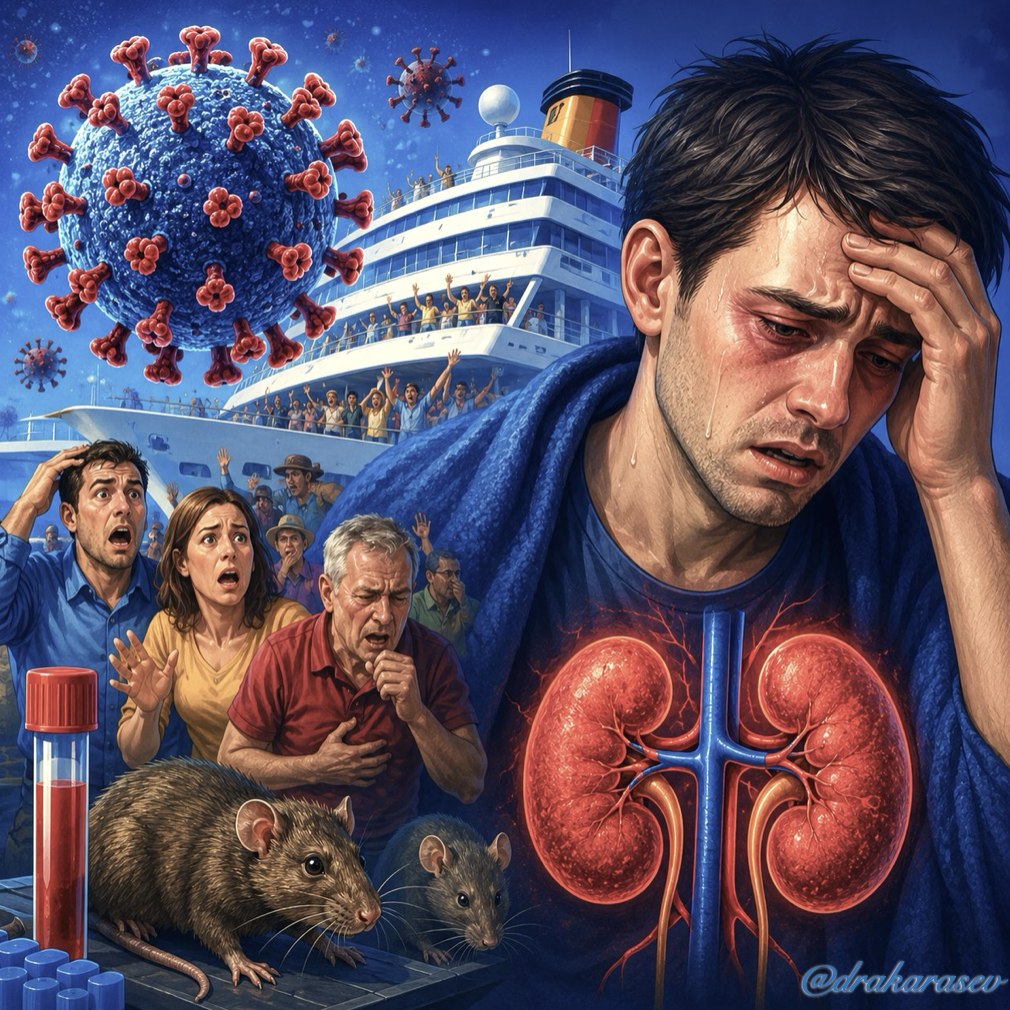
On April 6, 2026, an adult male on board a ship developed symptoms of fever, headache, and mild diarrhea. By April 11, he developed respiratory failure and died on board the same day.
Hantavirus can be very dangerous for an individual patient, but this does not automatically mean it can cause a new pandemic. According to WHO, hantaviruses cause rare but severe diseases; lethality varies by virus type and region: in Europe and Asia it is usually less than 1–15%, and in the Americas, when hantavirus cardiopulmonary syndrome develops, it can reach 50%.
How dangerous is it
The danger of hantavirus is real, but it depends on the specific virus type and clinical syndrome. WHO indicates that hantaviruses can cause severe disease and death, with European cases more often associated with hemorrhagic fever with renal syndrome (HFRS), while in the Americas it is hantavirus cardiopulmonary syndrome (HCPS). For HCPS, WHO reports a lethality of up to 50%, and for HFRS in Europe and Asia, in the range of less than 1–15%.
Lethality and pandemic
High lethality and high transmissibility are not the same thing. In the case of hantaviruses, the main route of transmission is from rodents to humans through their urine, feces, or saliva, not mass human-to-human transmission. WHO specifically notes that limited human-to-human transmission has only been documented for the Andes virus in isolated outbreaks in South America. Human-to-human transmission requires very close contact. On the ship, this is that strain.
From an epidemiological perspective, for a virus to cause a pandemic, it needs not only disease severity but also efficient, sustained human-to-human transmission. Hantaviruses typically lack this key mechanism, so they more often cause local or regional outbreaks rather than global spread. So the intuitive feeling that "if a virus kills quickly, it cannot spread widely" is not entirely correct. The real picture is more complex: what matters is not only mortality and "speed," but primarily the route of transmission, incubation period, number of contacts, and the presence of a simple mass transmission route.
We are monitoring reports to see if human-to-group transmission is proven and by what route... For hantaviruses, no antiviral drugs have been created, there are no vaccines, and immunomodulators are as effective as mineral water.
@drakarasev
Comments
0No comments yet.
Sign in to join the discussion.