
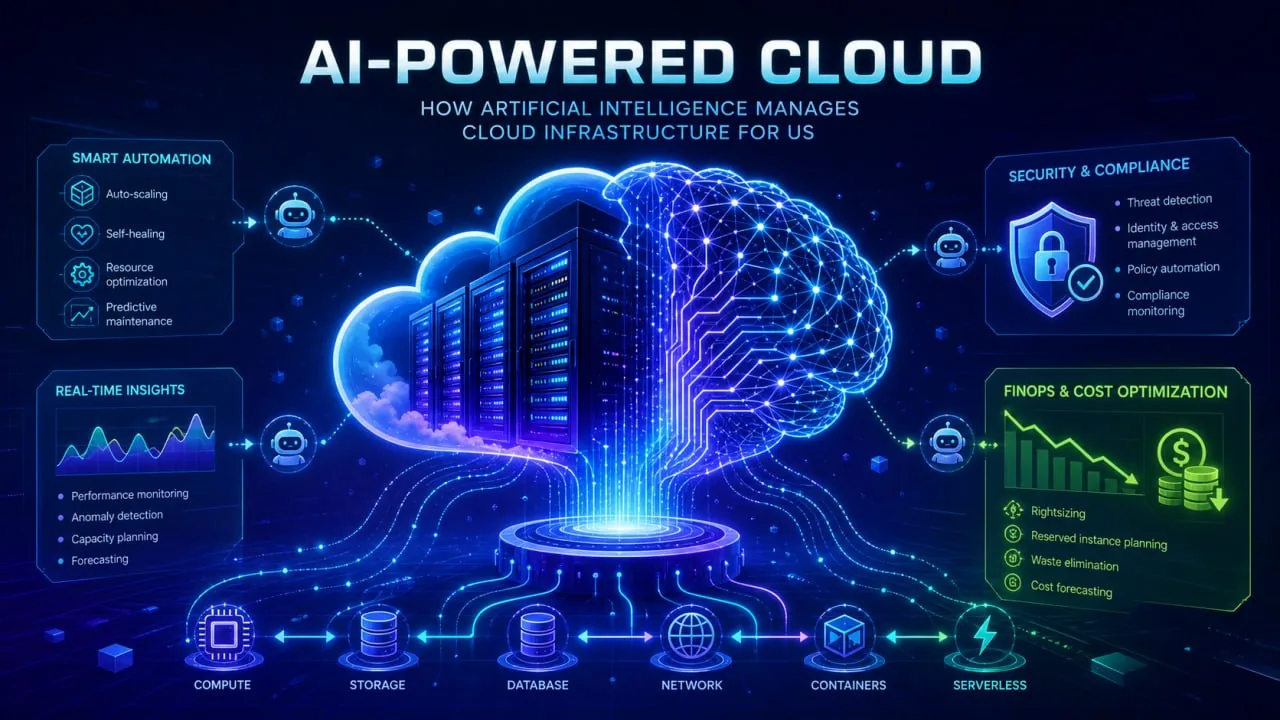
In 2026, the cloud is no longer just "hardware by subscription" — AI has become its management layer. Now, intelligent cloud platforms predict failures, automatically scale resources, analyze customer behavior, and enhance cybersecurity monitoring, while engineers focus on the product rather than "firefighting."
What does this mean in practice?
1️⃣Predictive maintenance and auto-self-healing. Machine learning models are embedded directly into monitoring and APM: they detect anomalies in metrics and logs, predict overload or service degradation, and proactively change configurations, restart containers, or shift load to other availability zones. As a result, incidents either never escalate into production outages or go unnoticed by users.
2️⃣AI cybersecurity monitoring. Cloud SOC solutions already use AI to detect complex attacks: they analyze network traffic, authentication logs, and service behavior, raising alerts for unusual patterns and automatically blocking suspicious activities. In Yandex Cloud, for example, the case of the company "Enjoy Research" shows how Smart Web Security helps stop attacks and reduce backend load through intelligent traffic filtering.
3️⃣Generative AI and AI agents in the cloud. Russian providers are no longer just offering "Kubernetes and databases" but embedding LLMs and agents directly into the platform. In Yandex Cloud, this includes DataSphere and YandexGPT/YandexART: you can use ready-made foundation models (YandexGPT Pro, classifiers, Mistral/Saiga models) for chatbots, analytics, text processing, and customer data — without managing your own ML infrastructure. Sber, on the other hand, deploys AI agents and assistants based on GigaChat to automate internal IT processes and customer scenarios: request orchestration, data retrieval in CRM, response verification and generation.
4️⃣Russian AI cloud market. Yandex Cloud, SberCloud/Cloud.ru, VK Cloud, M1Cloud, and other players are joining the trend: demand for specialized AI infrastructure and GPU-as-a-Service is growing, with 50–60% of new projects focused on AI workloads. Providers are already building ecosystems around this: conferences like GoCloud 2026 are entirely dedicated to AI services and agents, and managed services for working with LLMs allow launching agents "in a few clicks."
5️⃣FinOps synergy: AI against cloud bloat. When resources are managed by models, FinOps transforms from manual Excel control into continuous automatic optimization. Algorithms analyze load history, application profiles, and pricing: they select optimal instance types, suggest switching to spot/preemptible resources for background tasks, shut down idle environments during non-working hours, and redistribute load across zones and regions. The result — fewer overpayments for "just in case" resources and a more transparent cloud economy at the product level, not just the IT budget.
Examples of real cases worth checking out:
- Yandex Cloud customer stories (from accelerating analytics in retail to enhancing infrastructure security with YCDR and Smart Web Security)
- Cases of AI assistants and agents in Sber's ecosystem (business process automation based on GigaChat)
- General collection of real AI business cases (from sales analytics to RPA)
Question for you: Are you already using AI features from your cloud provider (LLMs, agents, auto-scaling, AI security monitoring)? Or is your cloud still living "the old way"?
#AICloud #YandexCloud #AIinfrastructure #ITransform #digitaltransformation
Comments
0No comments yet.
Sign in to join the discussion.