

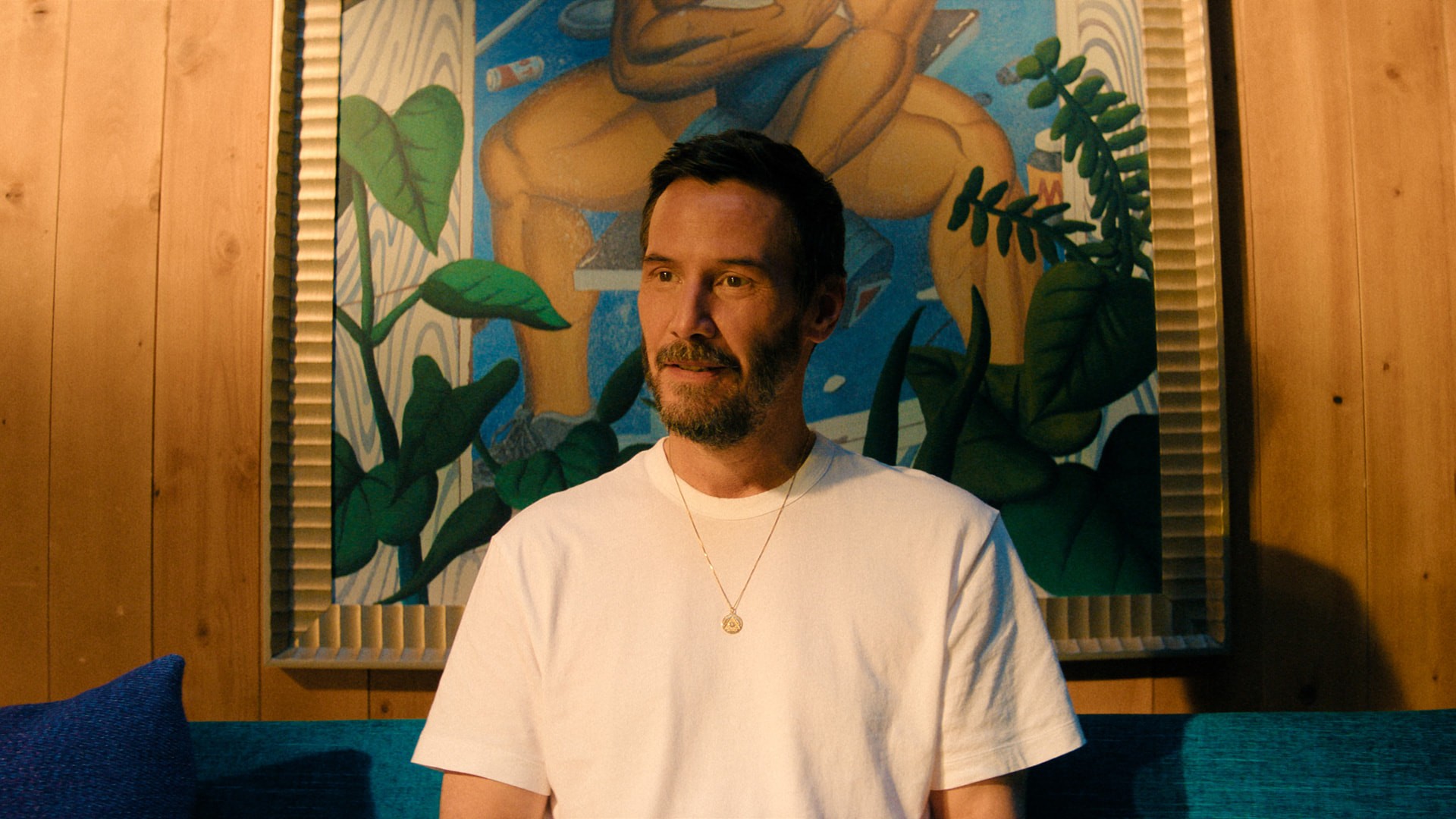
Keanu Reeves not in an action movie — sounds intriguing. 'Outcome' is out on Apple TV: Jonah Hill directed a Hollywood satire where everything is in place except the main thing — humor.
There's a reflex: when you see Keanu Reeves on screen, expect a fight. 'John Wick' made sure of it: as soon as the actor appears, the audience is mentally ready to count the fallen bodies. But 'Outcome' is a film that announces from the first minutes: there will be no fights. Reeves here doesn't kill, doesn't avenge his beloved dog, and doesn't reload guns in balletic études. He apologizes. Literally to everyone in a row: from his mother to his first manager. And this is perhaps the most unexpected role of his career.
Riff Hawk (Reeves) is a Hollywood superstar whom the whole world considers the epitome of good nature. During five years away from the screen, supposedly 'recharging,' he was actually battling heroin addiction. Now that sobriety seems to have won, a blackmailer appears on the horizon with compromising material. Crisis lawyer Ira (an unrecognizable Jonah Hill) advises a simple solution: visit everyone Riff has ever wronged and apologize — maybe the blackmailer is among them. The list turns out to be surprisingly long.

Credit where due: Reeves really tries to play something not exactly unfamiliar, but unusual for the recent years of his career. His Riff is a man with a dull gaze, carrying the burden of others' disappointment. At certain moments, this weary sincerity works — especially when the actor simply remains silent and listens to another offended person. The problem is that the film asks us to believe that this soft, humble Riff once 'trampled' people like a lawn. And Reeves' face categorically refuses to let us believe that.
Jonah Hill (who is both screenwriter and director here) positioned 'Outcome' as a black comedy about Hollywood cancel culture and star narcissism. On paper, it sounded promising. On screen, it's significantly more modest. Humor appears rarely and cautiously, as if the director feared harming the seriousness of the topic.
In the end, we get a film that is too gloomy for a comedy and too inconsequential for a drama. Dialogues disguised as jokes mainly serve as exposition — dutifully recounting backstory without allowing us to laugh properly or become emotionally invested. Hill himself, in the role of lawyer Ira, seems to be trying to channel the energy of Tom Cruise in 'Tropic Thunder' — but in vain.
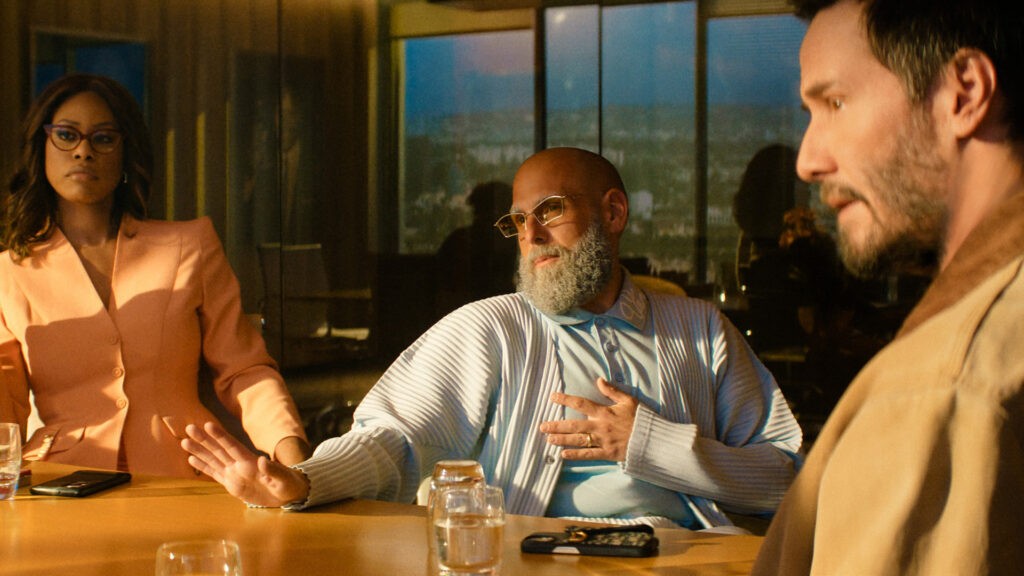
A separate discussion is the visual solution. Cinematographer Benoît Debie is known for his unconventional approach to lighting (his work in 'Irreversible' and 'Only God Forgives' has become almost canonical), but here his experiments are more puzzling than impressive. Some scenes are bathed in an acidic pseudo-sunset — as if someone cranked up the saturation to maximum without explaining why. Malibu in the finale looks like blatant chroma key, which for a film about Hollywood fakery would sound like a subtle and witty technique — if it were clearly emphasized. But no: it seems to be simply a production decision revealing budget constraints.

'Outcome' neither irritates nor captivates: it simply exists. Cameron Diaz returns from yet another hiatus with minimal material to work with (incidentally, she and Reeves reunite 30 years after 'Feeling Minnesota'), Martin Scorsese in a modest role as Hawk's first manager looks like the only one who understood what kind of film was being made and played it honestly.
Reeves, with all reservations, remains the most interesting object of observation — simply because watching him not fight is still unusual. If you're a fan of the actor and ready for a meditative pace, one viewing will suffice. Rewatching, looking for a second layer — you're unlikely to want to.
Comments
0No comments yet.
Sign in to join the discussion.