
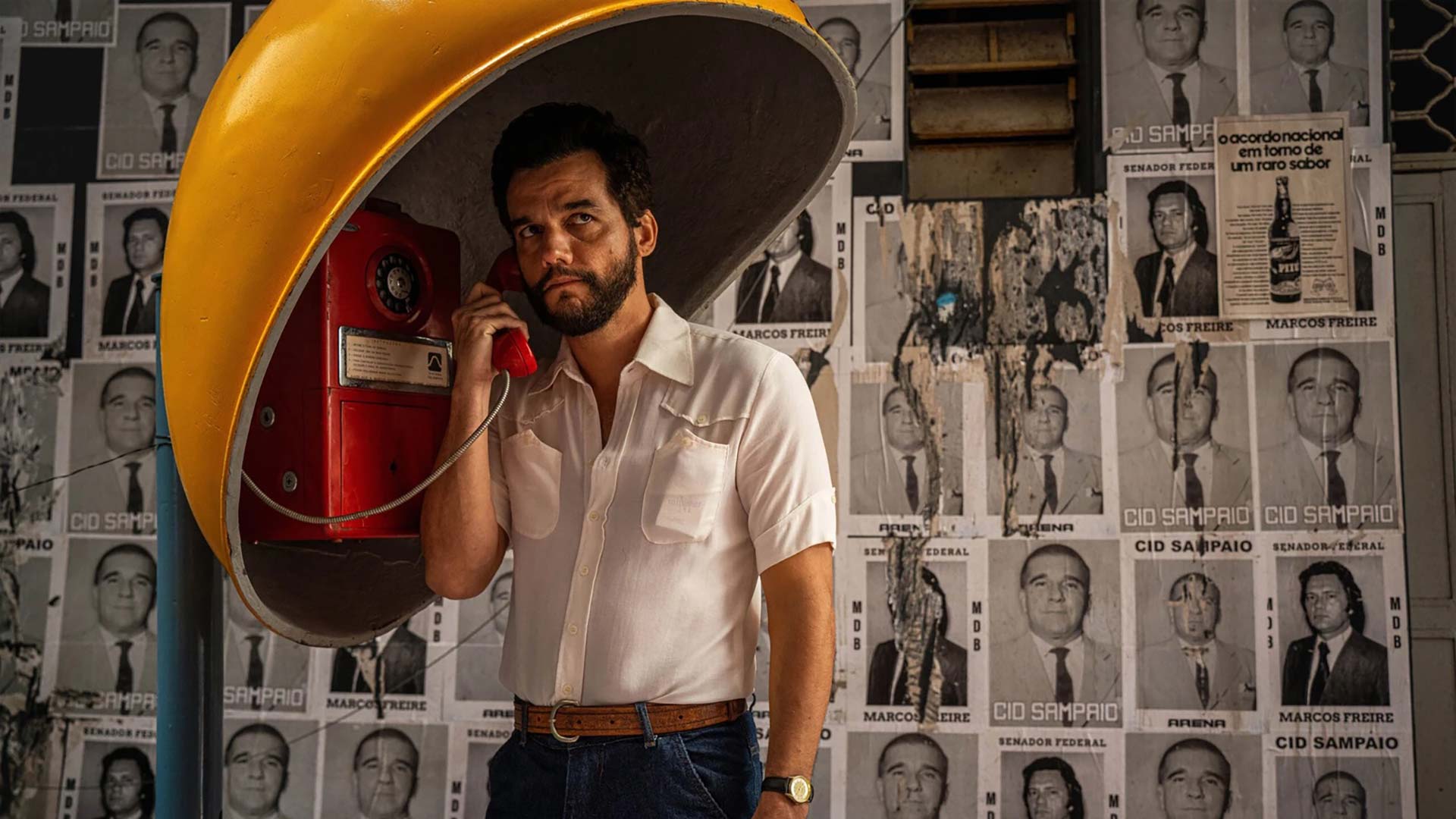
On March 16, the Brazilian film 'The Secret Agent' will compete in the main categories of the 2026 Academy Awards, and on March 26 it will be released in official Russian distribution. We tell about the transformation of European experience in the La...
The cinema of 2025 resembles a time machine that not only transports the viewer a decade back but also allows skipping several more eras, then returning unimpeded to the anxious yet familiar 21st century. Such is the pure duration of 'The Sound of Falling' by Masha Shilinski about historical continuity and pensive Mädchen, equally strange and silent in the 1910s, 1940s, and 2020s. Such is also 'Resurrection' by Bi Gan, which managed to fit 100 years of Chinese history into a two-hour nonlinear novella in the language of European arthouse. Similar to them is 'The Secret Agent' by Kleber Mendonça Filho, though it sufficed with just two temporal layers.
In the present day, history student Flávia (Laura Lufesi) studies archives of the Brazilian underground resistance against the military dictatorship of the late 1970s and discovers numerous newspaper clippings and audio recordings that captivate her. The key source of charm becomes the voice of widowed professor Armando Solimoes (Wagner Moura), but above all, a dissident and victim of multiple assassination attempts. Kleber Mendonça unfolds a leisurely narrative about him, equalizing the viewer and the insinuating, curious Flávia.
Every Family Has Its...
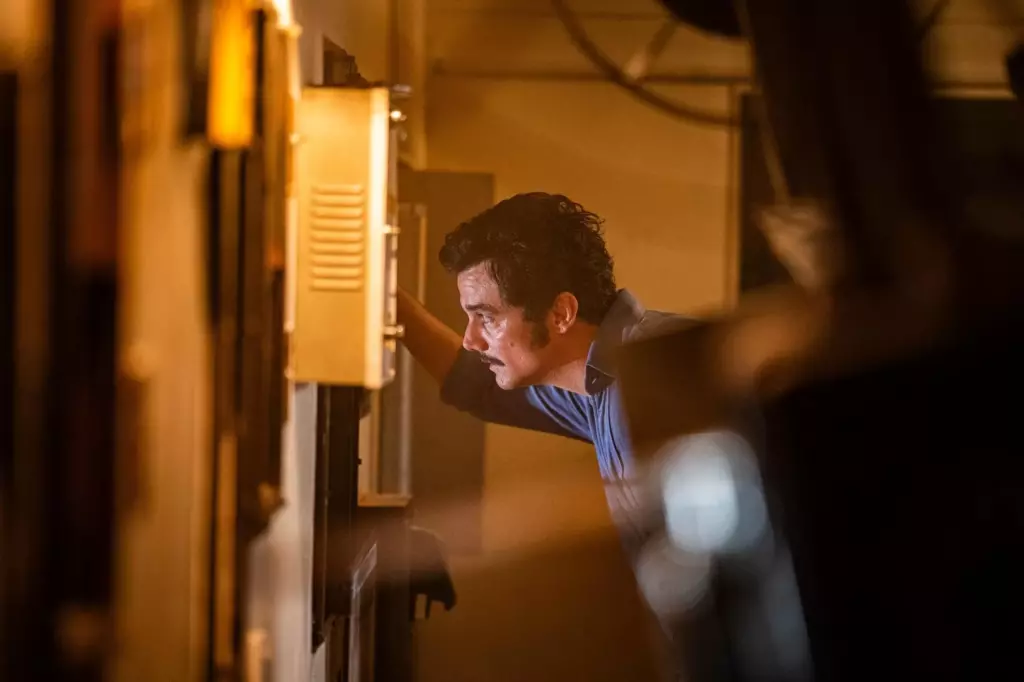
'The Secret Agent' is not a painting or canvas but a web of human connections where good and evil are born in backroom depths, family contracts, chance acquaintances, disgraced groups—in other words, no one ever walks alone. Even the most utter scoundrel, such as official Henrique Gerotti (Luciano Chirolli), who hired killers for Armando's soul, can fully rely on the dull banality of evil—his son Salvatore (Gregorio Graziosi). Even the killers Bobby (Gabriel Leone) and Augusto (Roni Villela), firstly related to each other, secondly find an even more terrifying person to delegate their 'authority.'
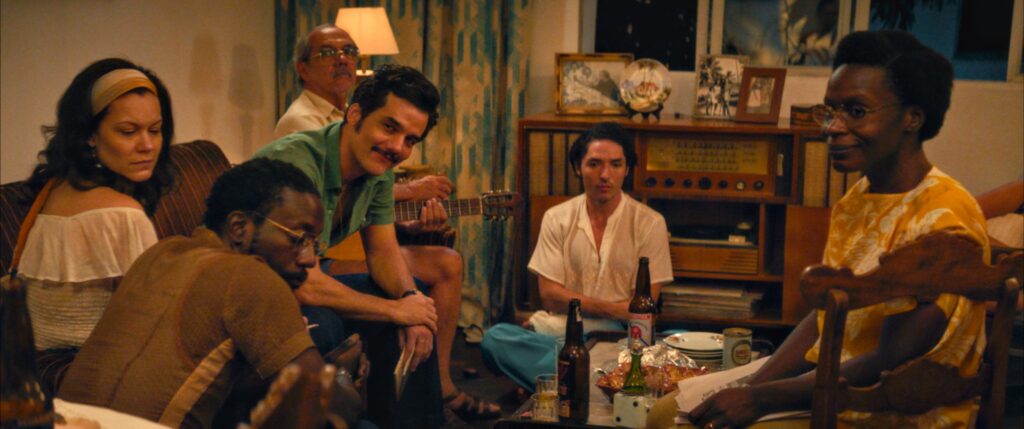
The team of good is strong (the film is unambiguous in role distribution)—the guerrilla anarchist Dona Sebastiana (Tânia Maria), who sheltered the Brazilian opposition, including our professor Armando and refugees from Angola, but the bribe-takers, liars, and murderers are no less united, so defeat and despair are the leitmotifs of 'The Secret Agent.'
'Here the Law Ends, and I Begin'
Much about the life of the Brazilian spirit of that time is conveyed by the main national holiday, the famous Brazilian carnival, or rather its absence on screen. The phantasm of vital energy is replaced by newspaper crime chronicles: the country does not dress in feathers but counts the number of victims, balances life and death. Hence the dreary and mocking soundtrack by Tomás Alves with inclusions of leisurely and warm bossa nova. Not a trace remains of this warmth, of hot ecstasy, except for zombie-like humanoid creatures in masks and drunken police.
The carnival in the film is a diversionary maneuver to conceal state crimes and blood, or a military operation of which even its direct participants are unaware. In this, 'The Secret Agent' recalls the films of Gillo Pontecorvo, his 'The Battle of Algiers' and, to a lesser extent, 'Operation 'Monster'—paranoid films about an enemy behind one's back, about the instability of society.
However, even Gillo Pontecorvo is too little and imprecise. One must look broader: 'The Secret Agent' is a reproduction of the ethical and aesthetic aspects of the Italian Years of Lead, where political violence became everyday. The difference is only that Italy had the opportunity to talk about it, while Brazil only recently gained that chance. It is no coincidence that Kleber Mendonça's film is more of a genre picture, like 'The Cobra's Day' by Enzo Castellari or 'Illustrious Corpses' by Francesco Rosi.
Legs and Jaws
The star of the second-rate Italian era was proudly Gian Maria Volontè, who successfully embodied all types of obsession: from the people's chosen one Enrico Mattei to the corrupt police officer Dottore. A talent of no lesser caliber ended up in Mendonça's lens; of course, we speak of Wagner Moura. His manner is not to spread his fingers and fill his eyes with blood, not to sweat and throw lightning as Volontè did. Moura is sedate and therefore reacts restrainedly to stimuli even when he needs to play Pablo Escobar ('Narcos'). He seems to express the idea of God, who manifests in everything, and therefore allows himself to achieve more with less effort.
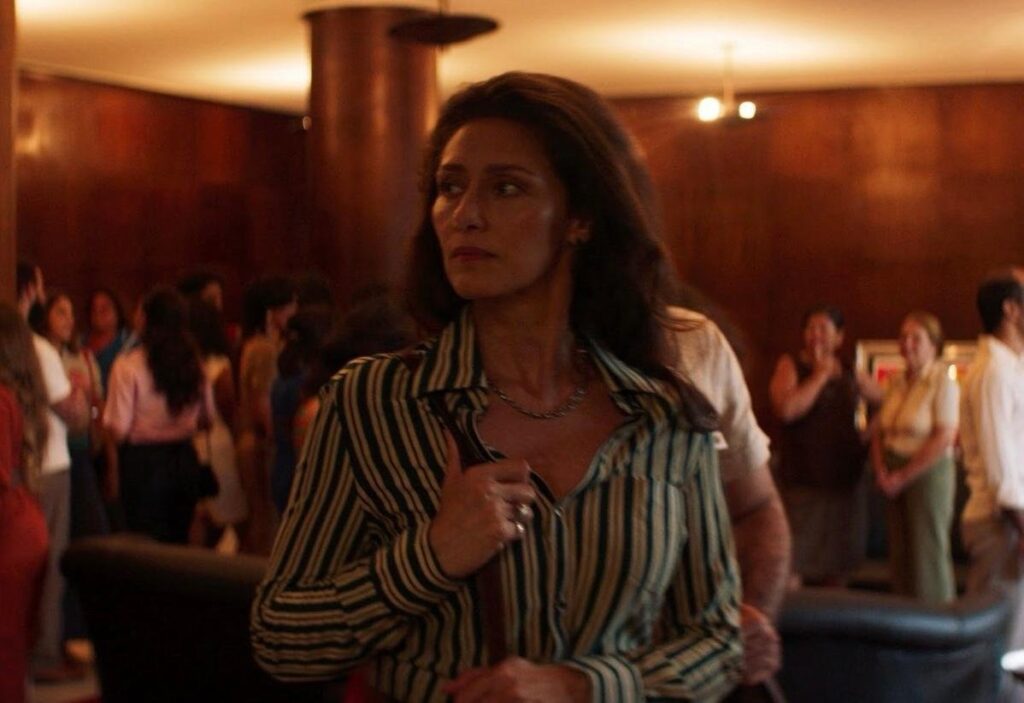
Such a core actor, his power of monotony, is necessary for the 'underground' team of 'The Secret Agent.' Most of these names we hear for the first and last time, but there are exceptions—Udo Kier and Evgenia Alexandrova. For Udo, 'The Secret Agent' turned out to be his last film in life, in which the German again ran in the background, and again everyone noticed and recognized him. For Evgenia, working with Kleber Mendonça, one hopes, opened new opportunities after Lebanese wanderings and cheap French crafts. Her choice in favor of an anamorphic lens, those oval flares, the overall softness of the frame, bursts of saturated palette, and chromatic aberrations—she did a lot to make the viewer watch a cruel, absurd, but charming retro.
A retro where children do not put teeth under the pillow but watch 'Jaws,' where a severed leg comes to life to stop same-sex love (better to watch than explain), where a city hospital grows on the site of a cinema, and the carnival does not deserve airtime. Such is the subtle and rough beauty of Kleber Mendonça Filho's creation, his best film to date.
Comments
0No comments yet.
Sign in to join the discussion.