

Chalamet is racing at full speed toward his first Oscar, and Josh Safdie has shown which of the brothers turned out to be the stronger director — in theaters, “Marty Supreme,” a film that refreshes the ossified genre of biographical cinema.
On January 15, “Marty Supreme” hit Russian theaters. The first solo film by Josh Safdie of the former Safdie brothers duo turned out to be a wildly adrenaline-fueled ride of ambition, obsession, and questions of national trauma. How the director half-jokingly tackles serious themes, reimagines a familiar genre, continues to build a genealogy of his native New York, and why Chalamet truly surprised — we’ll tell you in our article.
Shoe Salesman — World Champion
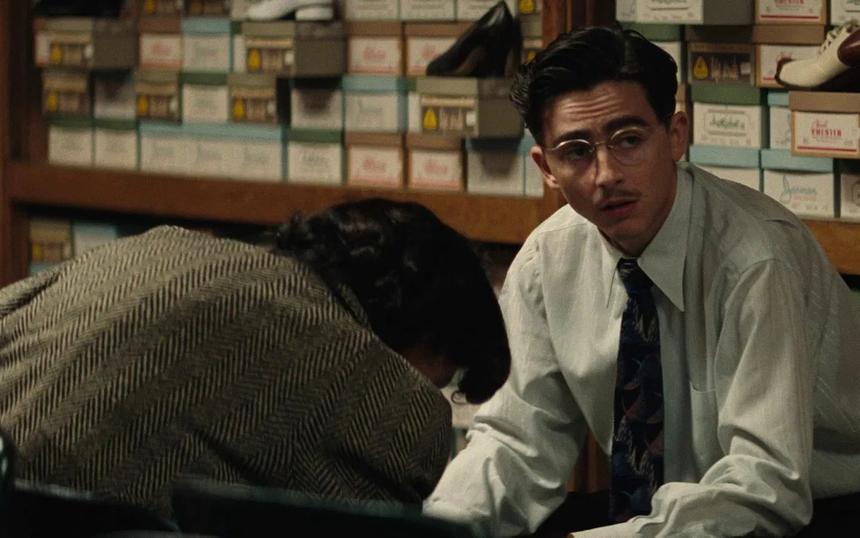
The 1950s, New York. A shoe store employee, 23-year-old Brooklyn Jew Marty Mauser (a fictional character based on parts of the biography of real athlete Marty Reisman), furiously and obsessively prepares for an upcoming table tennis championship between sales of new pairs of shoes. The sharp sound of rackets hitting a small ball is sweeter to him than a quiet, peaceful life in a safe place far from his dream. But a sudden defeat at the hands of a Japanese player and a hefty fine incurred during the match force the hero to embark on an odyssey through the cold and gloomy metropolis, using every means fair and foul to claw his way to victory.
A Sports Drama Not What It Seems
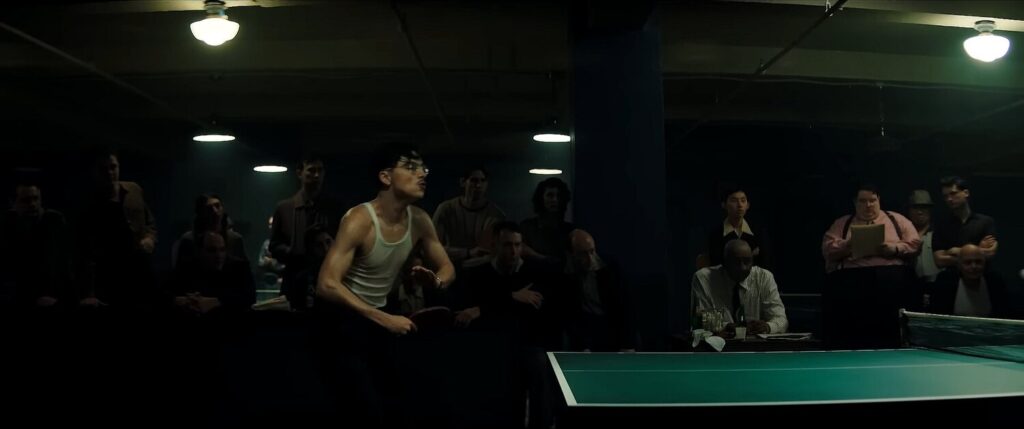
Based on synopses and first trailers, “Marty Supreme” might have seemed like a classic drama about the tough road to the sports Olympus, showing the forging of champions and inevitable hardships for a winning belt. Something similar was directed by Benny Safdie in [film], where beneath the weight of muscles and Dwayne “The Rock” Johnson’s dramatic performance lay a sluggish, bloated two-hour behemoth that fancied itself “Raging Bull.”

Biographical films most often tell stories of success—in career, sports, or life situations. But life isn’t always about achievements; there’s plenty of room for...
Open materialJosh Safdie’s film is molded from a different, more pliable dough and refuses to be a hostage to one genre. The table tennis matches themselves take up no more than 10 percent of the film’s runtime. And although they are staged masterfully, with some battles of flying balls literally gluing you to the screen with adrenaline-pumping editing cuts that even make sweat break out on your body, that’s not the main thing.
In essence, “Marty Supreme” is a dramedy about the misadventures of Ostap Bender, well-known to all Soviet and Russian viewers—or rather, his American distant relative. Marty, like the great schemer, manages to deceive a wide variety of city dwellers left and right: from childhood friends and a once-popular film diva to a small but terrifying dog-loving gangster Mishkin.
But unlike the “son of a Turkish citizen,” the pretty boy Marty commits ugly deeds with a fair share of failure. None of his “magnificent scams” bring the desired result. But that makes it all the more interesting to watch the filigree failures of this obsessed petty rogue and charming scoundrel. Whether it’s the scene with a bathtub floating between floors—the reason for an unexpected acquaintance with a mafia dog-lover—or the theft of a jewel from the neck of a theatrical prima donna that turns out to be mere costume jewelry. Marty is the king of failures of all calibers, and in that, he’s a champion in his weight class.
Honey, Balls, and Holocaust Jokes
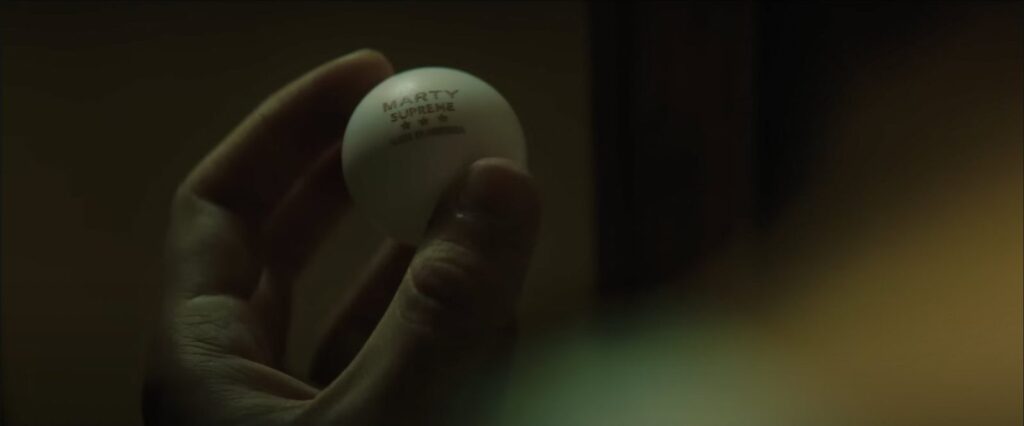
Ping-pong in Safdie’s film is not just a sport at which the Brooklyn Mr. Ripley excels, but also a precise, cruel metaphor for the place of an outsider in the system of the American Dream. Marty, like a ball forever bouncing off the table, jumps from one adventure to another in search of his place in the sun. In this, he repeats the fate of many emigrants who, before him, tried to grab their piece of happiness on new soil, sometimes resorting to less than “clean” methods.
But the director doesn’t stop there and deepens the national theme, openly addressing the heavy lot of the Jewish people in the struggle for life. This is hinted at by Marty’s endless obstacle course on the path to happiness, his endurance of many physical and moral humiliations for the sake of victory—like a “fatherly” spanking, a possible kiss with a pig in front of TV cameras, and his friend’s phantasmagoric story about honey and hungry convicts. A scene that will long be etched in viewers’ memories.
Moreover, Chalamet’s character has truly been through terrible times of war and is familiar with the horrors of concentration camps firsthand. This is evidenced by his extremely resilient, unyielding will in the face of various adversities and a cynical joke that he will become “Hitler’s worst nightmare.”
New York, New York
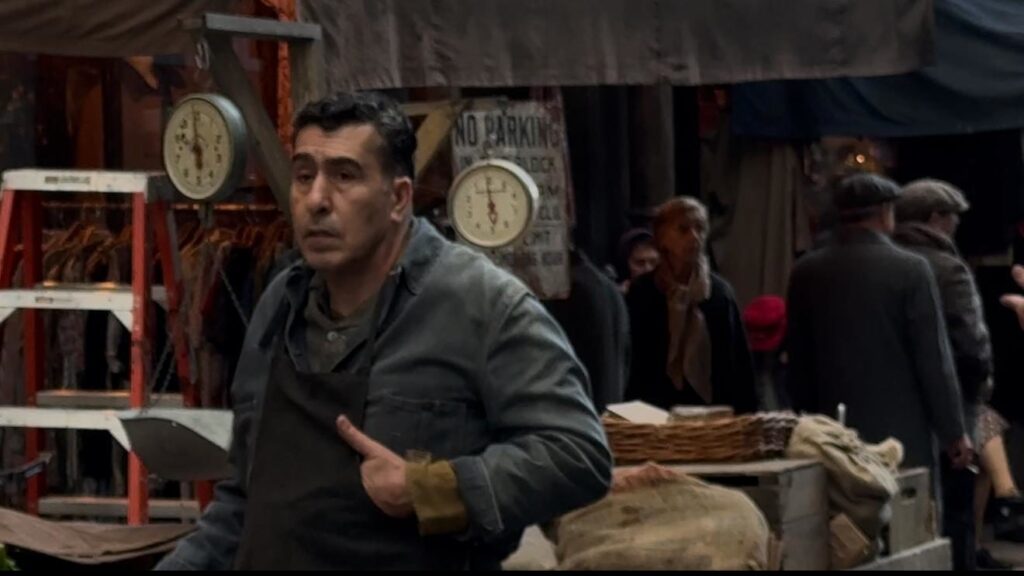
“Marty Supreme” continues to build a living alphabet of the metropolis, which significantly shatters ideas about the place of dreams. Instead of the city’s ceremonial portrait from the eponymous song by Sinatra, we see its most unsightly, dark side. Safdie continues the traditions of other chroniclers of this place’s underbelly and depths, like Scorsese and Ferrara.
Safdie’s New York, even in his early works, is a cruel, cold place where, on one neon-lit, ever-bustling street, insane showdowns between small racial groups and a jeweler-gambler over a priceless lucky stone take place, while on the opposite side, an infernal vagrant with discs tries to rob a disheveled passerby rushing to pick up his children.
Thanks to the work of production designer Jack Fisk, the creator of the late worlds of dream master David Lynch, in Safdie’s new film, the gloomy, crime-ridden city becomes an endless, seething labyrinth beyond good and evil. It sucks the small-time hustler Mauser into its networks of dangerous neighborhoods and “mean streets,” not letting him catch his breath for a minute, forcing him to run a marathon until the final credits. New York is a test of endurance. It squeezes you dry, crushes and grinds you simultaneously if you try to pause for breath. The stakes in it are higher than ever, so it’s every man for himself, and if you don’t get it, you have only yourself to blame.
Timothée Magnificent and the Team
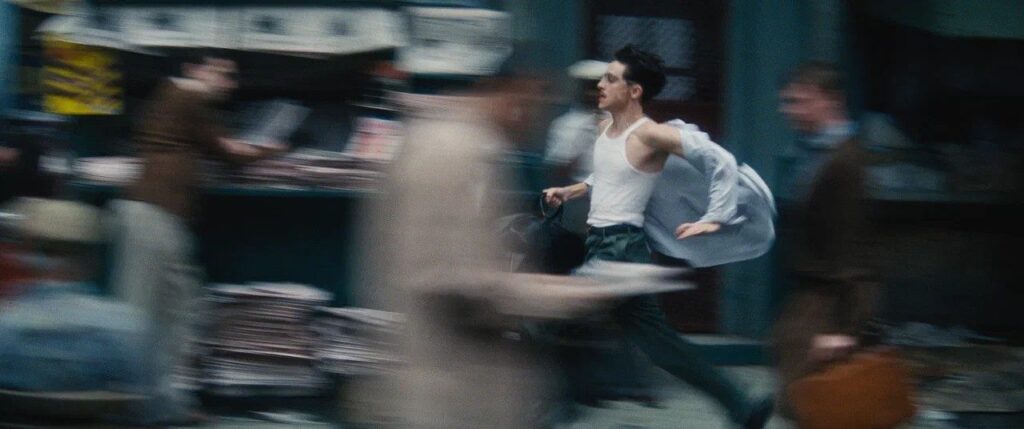
Chalamet was long considered a teenage idol and broke many a girl’s heart. The pretty boy with blue eyes seemed forever stuck in the image of a poster from an American teenager’s bedroom. But the situation changed with his role as music legend Bob Dylan in James Mangold’s biopic “A Complete Unknown.”
The actor studied all of Stanislavsky, Chekhov, and Strasberg and delivered a brilliant performance that, in terms of immersion, rivals the best representatives of the acting craft, such as De Niro, Hoffman, Nicholson, and Pacino. His Dylan, like the real one, had a raspy “sandpaper” voice, was unbearable in communication with loved ones, and wrote brilliant poetry. A biography in its best form.
In Safdie’s adrenaline-fueled work, Chalamet lets loose completely, immersing himself in the character. The level of discipline is extreme. Almost 7 years of daily table tennis training with an Olympic champion. Training didn’t stop even during shoots for other projects. Wearing glasses with diopters ranging from +10 to -10 for authenticity, and endlessly bombarding the director with questions about the life of the real Marty Reisman.
As a result, Timothée managed to portray a nervous, anxious man who constantly lies and deceives everyone in his path but cannot stop this frantic race. His speed in trampling over others’ feelings is simply astonishing. He is a clot of sparkling life energy, sweeping away everything around him.
The company for the potential future Oscar winner is an interesting team. The charming Gwyneth Paltrow. Her role as a bird in a gilded cage hints at Marty’s possible fate if he ever compromises with himself.
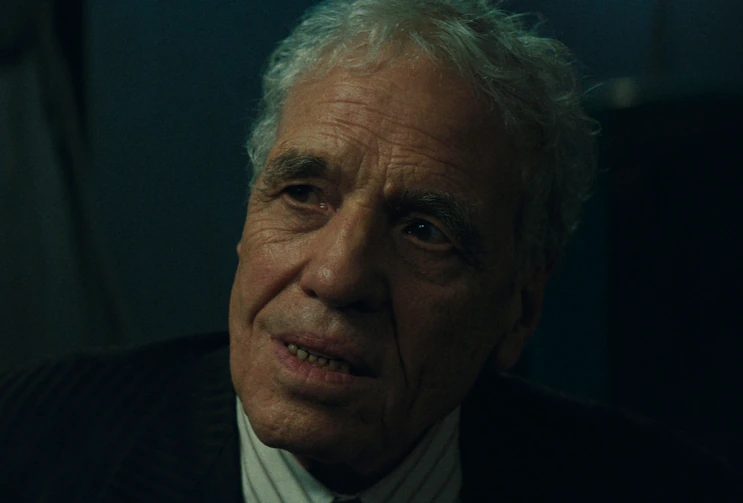
Kevin O’Leary, not an actor but a real financial predator and millionaire, takes on the role of the main antagonist, literally an ancient vampire who tries to suck the energy out of the protagonist through a straw for his “eternal” life.
And of course, the inimitable Abel Ferrara. One of the main independent New York auteurs, an artist of darkness and fall, plays a terrifying and dangerous small-time mobster. He seems like a twisted incarnation of “Umberto D,” ready to do anything for his dog.
Match Point
“Marty Supreme” accelerates to unprecedented speeds from the first minutes and never lets the film’s dynamics sag. Scenes fly off each other with the crazy speed of tennis balls at the best championships in the sport, and the hero, with a flying gait, jumps over the heads of loved ones and strangers alike, creating a new physical discipline.
Josh Safdie managed to shed the excess weight of a genre bloated with clichés and run it through the treadmills of nervous, jittery editing and first-class dramaturgy. The result is an adventure novel of re-education that forces you to watch unblinkingly and just manage to return the serves flying off the screen.
Comments
0No comments yet.
Sign in to join the discussion.