


Paul Feig has again directed a thriller about rich people with dark secrets. 'The Housemaid' starring Sydney Sweeney is an erotic thriller in the spirit of the 90s, where Amanda Seyfried steals the show from everyone. Glossy trash that you're ashamed...
Do you know what A Simple Favor and the new film by Paul Feig, The Housemaid, have in common? In both, a simple girl ends up in the home of a wealthy couple with so many skeletons in the closet that it would fill a whole cabinet of curiosities. Feig has struck gold (the film has already grossed over $100 million at the box office) and is mining it with the enthusiasm of a gold rush prospector. Only this time, the director decided to add more eroticism, suspense, and that very atmosphere of 90s thrillers when Michael Douglas could only sleep peacefully in films without women.
“The Housemaid,” which premiered in Russian theaters on January 8, is marketed as an erotic thriller starring Sydney Sweeney—and yes, the eroticism is present in moderate doses. However, the film's real star is Amanda Seyfried, while her co-star is left to flaunt her outstanding assets to compete for attention.
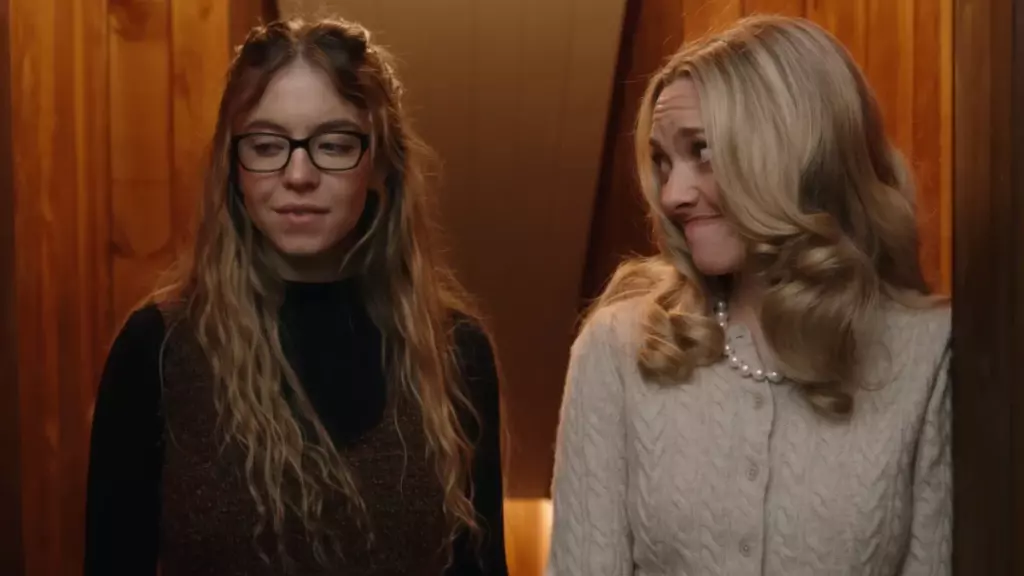
In the plot, Millie Calloway (Sweeney) has just been released from prison and desperately needs a job and housing—such are the conditions of her parole. Fortune smiles on her when she meets Nina Winchester (Seyfried), a millionaire's wife who urgently needs a maid. A luxurious mansion, a decent salary, a room in the attic—it seems like a dream come true. Except the door to that room locks from the outside, and the window is boarded up. Millie doesn't yet know that the Winchester family keeps secrets far darker than her criminal past, and Nina's husband, the charming Andrew (Brandon Sklenar), will begin to take an unhealthy interest in her.
If “The Housemaid” is worth watching, it's for Amanda Seyfried, who plays her unbalanced heroine as if preparing for an Oscar in the category “Best Psychopath in a House with White Walls.” Her Nina is a cocktail of madness, manipulation, and unprovoked rage, seasoned with perfect smiles for the neighbors and hysterics over lost notes for the PTA meeting. Seyfried masterfully switches between “cute” and “scarily cute,” turning every scene she's in into a little theater of the absurd.

Against this backdrop, Sweeney looks... well, let's say, present. The actress seems to sleepwalk through most of the film, waking up only in the finale. This is especially disappointing given that her name is plastered on all the posters as the main draw. Brandon Sklenar as the handsome husband also gets lost in Seyfried's shadow, even though his character is supposed to be the center of a kind of love triangle.
Feig openly flirts with the aesthetic of VHS-era erotic thrillers—the kind where Sharon Stone taught Michael Douglas about life, and “The Hand That Rocks the Cradle” made you distrust nannies. “The Housemaid” diligently reproduces the formula: a wealthy home, beautiful people, dirty secrets, and constant twists meant to make the audience gasp.
The problem is that some of these twists are telegraphed well in advance—the director seems not to trust the audience and plants “Chekhov's guns” with such zeal that you could make a checklist: a tall spiral staircase—check, expensive china—check, a sticking lock—check, hints about the reason for Millie's sentence—check, a mysterious gardener played by Michele Morrone (who, by the way, moved over from the second “A Simple Favor”)—check.
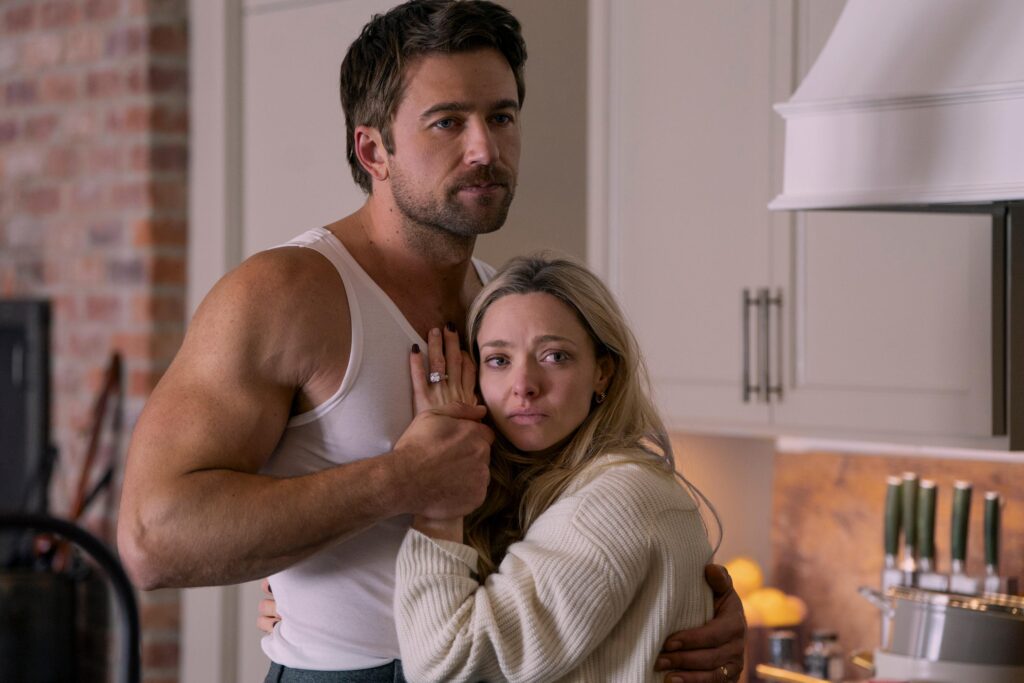
The screenplay by Rebecca Sonnenshine, based on the novel by Freida McFadden, tries to highlight themes of class inequality and play with audience expectations. At first, Millie seems like a classic “dangerous stranger” in the vein of “Obsession.” Then it turns out the psychopath here is not the maid. Then the film cranks up the tension so actively that by the finale, it's unclear who to root for and who is the victim. Some critics compare “The Housemaid” to David Fincher's “Gone Girl”—and yes, the common notes are audible, though this film is a far cry from the masterpiece starring Rosamund Pike.
It's amusing that Feig, for the third time, is filming a story about a poor girl caught in the whirlwind of a wealthy couple's intrigues. In the “A Simple Favor” duology, Anna Kendrick investigated the disappearance of her friend Blake Lively and got entangled in family feuds involving murders and insurance scams. In “The Housemaid,” Sweeney literally lives in her employers' home and becomes a pawn in their sick game. The director clearly enjoys exploring toxic relationships in settings straight out of a luxury furniture catalog. However, while “A Simple Favor” balanced between black comedy and thriller, “The Housemaid” occasionally veers into melodrama or slasher territory. Though there is something to laugh about here.
“The Housemaid” is a film for those who miss the days when thrillers weren't afraid to be a little vulgar, a little absurd, and tried every way to surprise you. Feig has made a glossy trash film that doesn't pretend to have depth but offers two hours of escalating madness with broken china, sexual tension, and Amanda Seyfried in top form. If you go to the film for the spectacle of an ideal life in an ideal house turning into a bloody mess—you'll be one of those raving about it on TikTok. Just don't expect “Gone Girl”—you'll get more like “Basic Instinct” performed by a student drama club, but with a good budget and beautiful people on screen.
Comments
0No comments yet.
Sign in to join the discussion.