
Online you can find “Anemone,” the feature debut of director Ronan Day-Lewis, for which his famous father, Daniel Day-Lewis, returned to cinema. Critics received the film very reservedly. In our review—about why, in matters of independent cinema, onc...
The very first interview with aspiring director Ronan Day-Lewis you find on Google is titled “Ronan Day-Lewis Knows What You’re Thinking.” Well, it’s not hard to guess, and the standard range of opinions in reviews and comments only confirms the obvious: everyone loves Daniel Day-Lewis; nobody likes nepo babies; everyone thinks the father starred in his son’s film purely out of family feeling; and of course, no one cares about alternative opinions.
The involvement of Day-Lewis, a cult actor and arguably the best of his generation, certainly helped the film: without such a star in the lead role, “Anemone” would have remained the preserve of a few fans of slow-paced British dramas. Now, the film is widely discussed and written about. But is this really such a help?
In “Anemone,” there is nothing that suggests a desire to please a broad audience. Not the seemingly caricatured arthouse plot—a retired soldier tries to bring his brother, also a war veteran, back from voluntary exile to help his son. Not the drawn-out narrative, which at some point gives way to nature scenes—storm, rain, forest. Not the fact that silence in the film is not just as important as dialogue, but actually reveals much more significant things about the characters than they are willing to say.
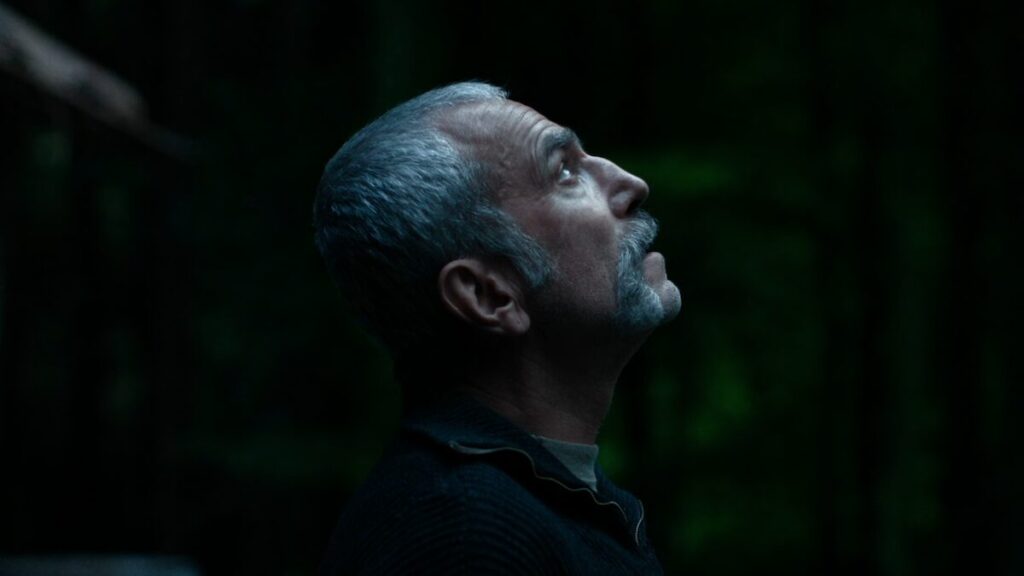
To some extent, working together was a risk for both father and son: for the latter, it meant a serious increase in stakes; for the former, it meant that people would judge not the film but him. And that’s pretty much what happened. However, to the natural question “was it worth it?” one wants to answer in the affirmative. “Anemone” is not the best film of the year and not the best film in Daniel Day-Lewis’s career, but it is a film with a sense of inner dignity—beautiful, intelligent, respectful to the audience and the material.
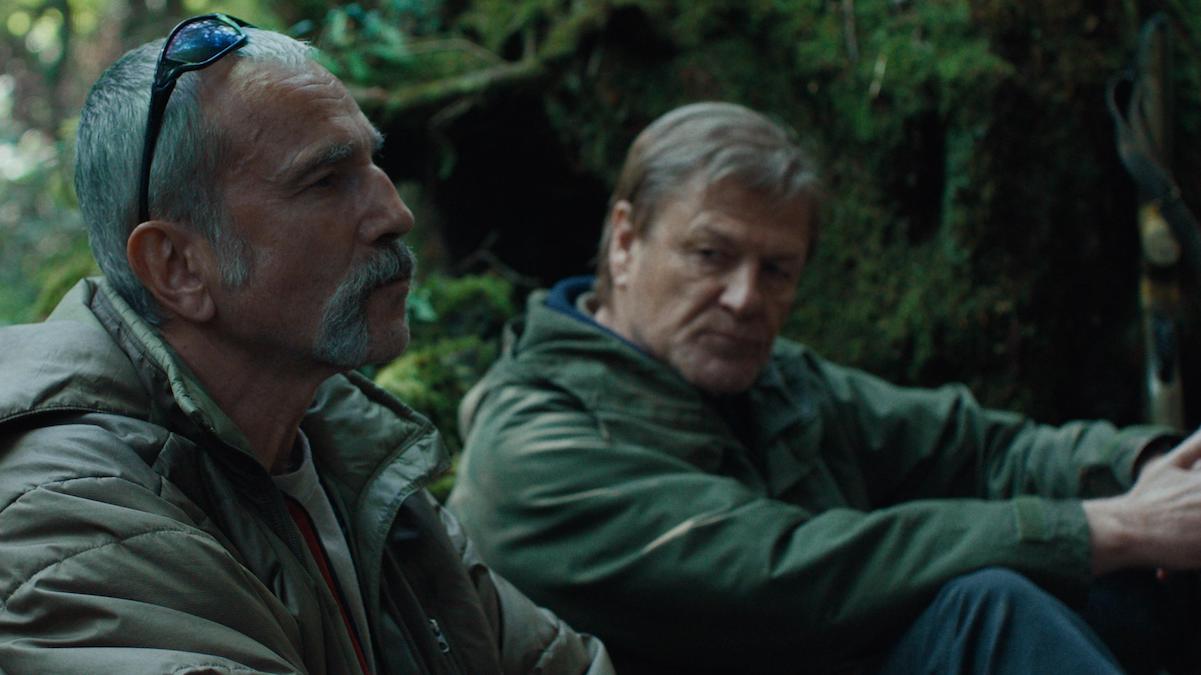
The plot setup, however, is simple. Young soldier Brian Stocker (Samuel Bottomley), who went AWOL after beating up a fellow soldier, is constantly angry at himself, the world, and his father. He has never seen his father. Ray (Daniel Day-Lewis), a veteran, disappeared from his and his mother Nessa’s (Samantha Morton) life before he was born, and the boy was raised by Jem (Sean Bean, outstanding), Ray’s older brother and also a career officer. Rumors about Ray vary widely—mostly that he is a murderer and war criminal who fled justice. For Brian, this is unbearable, and he hates his father, afraid of finding his traits in himself. However, it is for Ray that Jem sets off, hoping to save his adopted son.
Using coordinates left for emergencies, Jem finds his brother in the forests of Northern England, where—in an extremely modest hut with a single-person set of dishes and an impressive library for such a small space—Ray has spent the last twenty years. What made him choose such a life, we don’t learn immediately. Maybe we never learn at all: of course, closer to the finale, Day-Lewis’s character delivers a monologue appropriate to the occasion, but a mystery remains in Ray. What did he see in that forest (you won’t confuse the scene with a creature resembling a Patronus with anything else)? What made him pull the trigger back then? Why for him—a career officer—did the encounter with death push out of life everything that justifies a military career: love, belonging to a community, responsibility, finally?
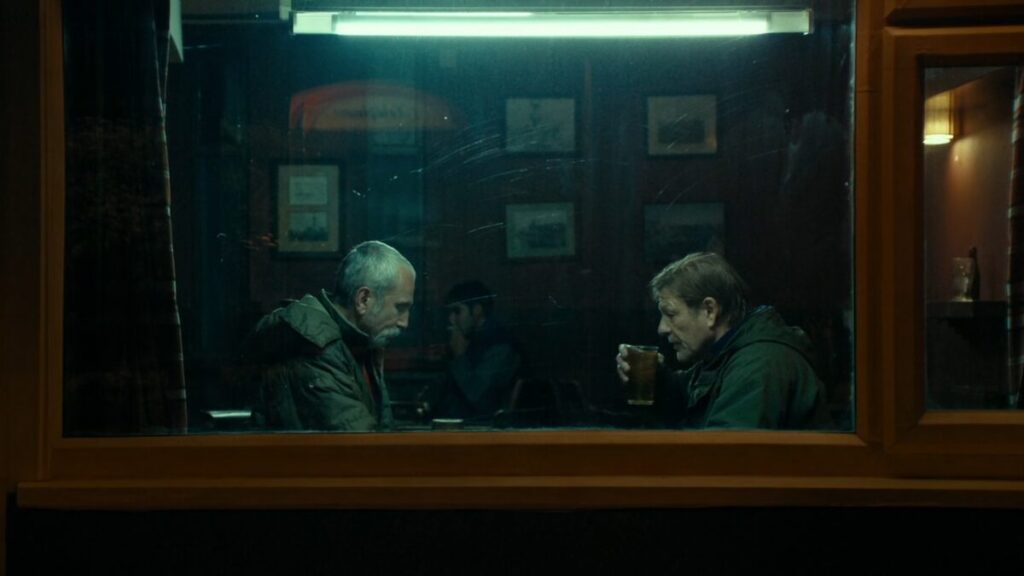
“Anemone” avoids direct answers: we will eventually understand what happened, but not how to feel about it. Jem doesn’t say much in response to his brother’s confession: his judgments are simple, his measured grunts are deeper than words—his words are rather simple. For this refusal of refinement, “Anemone” is periodically criticized. The strength of the script—its refusal to resist the material of life—turns out in critical reviews to be its main weakness, which is, generally speaking, not at all obvious. The soldier brothers cannot talk to each other, Nessa cannot talk to her son, Brian himself cannot talk to anyone.
The film is built on omissions, and in the long pauses between, until a certain point, insignificant dialogues, in the extended landscape shots, one can, of course, see the immaturity of a young director, but also fidelity to the medium. Even if the film did not have two outstanding monologues by Daniel Day-Lewis and one by Samantha Morton, everything would be clear from the very composition of the frames, the chosen locations, the close-ups of faces (Morton and Bean, for example, are amazingly expressive in these close-ups), the brilliant soundtrack leaning towards shoegaze.
At the same time, the main motifs of the film are both interesting and relevant. Of course, it is a story of two brothers who, even after twenty years of separation, have something to talk about and, most importantly, something to be silent about. Jem and Ray are indeed mostly silent, blaming each other for something, asking forgiveness for something. Their few days alone could probably be condensed into a short film—so intuitive is their interaction; abrupt and short, like a gunshot.
Common to Jem and Ray is also the experience of surrogate brotherhood—military service. Both remember not the battles they fought, but those they fought alongside. Both obviously hoped that military brotherhood would be even better than family ties—you are bound not by the past, but by the future; not by reasons, but by goals, even if those goals are for shooting. Of course, it turned out somewhat differently, and the film shows how difficult it is to find social connections beyond the predetermined ones.
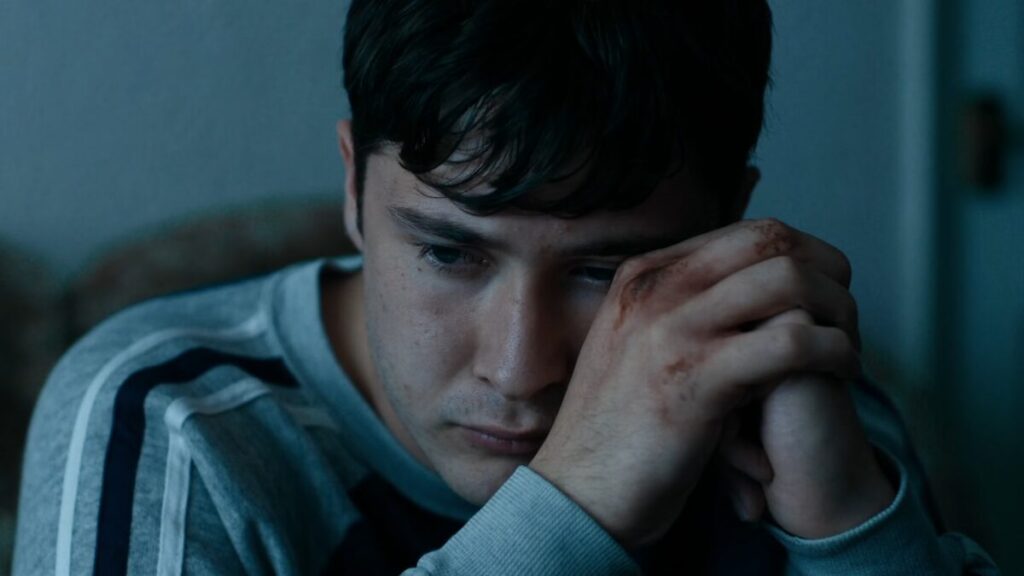
Equally important, however, is the theme of, let’s say, fathers and children. Not the difficulties of interaction between them, but rather the unity of fate. The son despises the father but repeats his path. Both are quite unbearable and stubborn, yet empathetic; everyone is ready to love them, but instead both Brian and Ray choose the path of voluntary exile; both ultimately turn out to be holes in each other’s lives.
But at the center of the film lies Ray’s pain—the inability to forgive himself, the inability to return from war. His story is a kind of modern “Odyssey,” only Odysseus’s ten years between the fall of Troy and his arrival in Ithaca passed tragically but excitingly, while Ray, let’s say, went into the woods. The true return from the front—whether the Trojan War or the Irish Civil War—if it is possible at all, turns out to require distance not so much in space as in time. But even that turns out to be only a trial of grief, and to forgive himself, the hero has to try to live again. That, in fact, is the hardest part.
“Anemone” is a sad but optimistic film. Not all brothers are like Cain and Abel. Not every Odysseus is lost. Sometimes children can still avoid repeating their parents’ fate. Of course, the film occasionally gets lost in the weeds because Ronan Day-Lewis sometimes really wants to show that he can make movies (the influence of Lynch’s techniques on world cinema will soon be comparable in scale of disaster to the influence of Tarkovsky on Russian cinema). But he really can: if today there is cinema in the genre of (magical) kitchen sink realism, then that cinema is “Anemone.”
Comments
0No comments yet.
Sign in to join the discussion.