

How does a bad film become a cult classic, why do Jews and Russians get along poorly in New York, and how to survive comparisons with Guy Ritchie—in our review of the film 'Caught Red-Handed'.
Every film by Darren Aronofsky can be called special. It's not about quality (the director has repeatedly "missed" with the positioning and execution of his projects), but about his approach to the filmmaking process, which explains the heightened interest of viewers in his films even after box office failures, even decades later. Among the buzzing crowd of Aronofsky fans, there will inevitably be a lover of the chaotic "The Fountain" or an adherent of the Hollywood adaptation of the word of God, the film "Noah." Aronofsky is always careful in interpreting his religious dissent and aestheticizing his characters' obsessions.
The hermetic "The Whale," "Mother!," "Requiem for a Dream," or the sprawling and slightly garish "Noah" and "The Fountain" are "saltpeter golems," created to serve the creator and prove his involvement with the world of cinema, the world of art. And until 2025, Aronofsky steadily built a "bell" for his "belfry," taking five-year breaks, until he reached a dead end—the film "Caught Red-Handed."
Many detect something in common between Aronofsky's crime comedy and Guy Ritchie's opuses, which in itself is an alarming warning for the former and a huge advance for the latter (the lover of British philosophy soared higher only during his period of affinity with ). However, such comparisons do not withstand serious criticism and lie strictly in the realm of genre and, perhaps, the expressive-pathological tone of the narratives.

Russian Bulls and Jewish Traditions
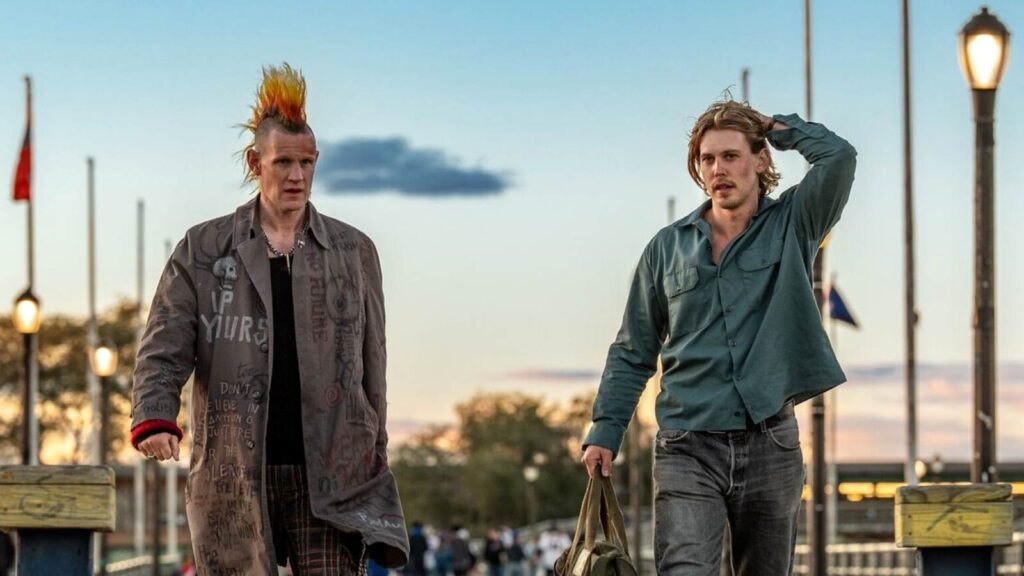
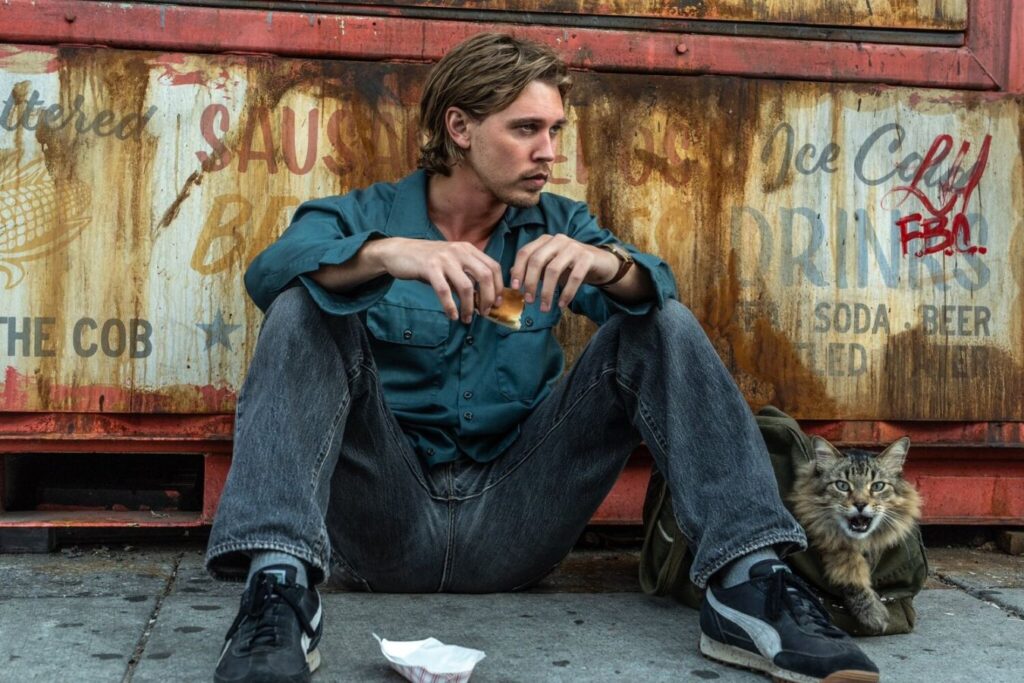
Hank Thompson (Austin Butler), a former young prospect in the national baseball league, got into an accident and suffered an injury incompatible with big sports, now languishing in a bar and breakfasting on beer. His stagnant life is brightened only by calls from his loving mother (wait for a surprise star cameo after the credits) and meeting a girl named Yvonne (Zoë Kravitz) from Chinatown.
One day, his neighbor, London punk Russ (Matt Smith), announces his imminent departure, leaving Hank the keys and a feisty cat named Bud, thereby dragging his friend into the vortex of criminal New York. Just yesterday, the failed athlete and alcoholic was mixing cocktails and dancing on a sturdy bar top, and now he is forced to run without looking back because he is being chased by real thugs—the most charismatic, colorful, and proactive variable in the film "Caught Red-Handed."
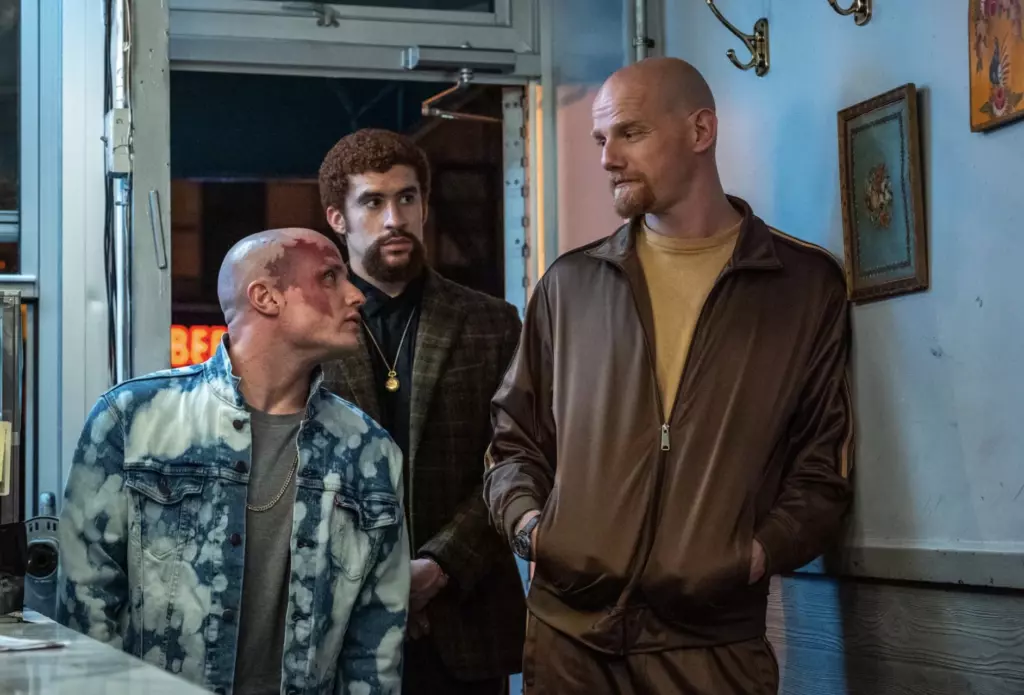
The role of pursuers in a game of survival tag is assigned to paired tandems (as if we are still talking about "Noah") of the polyethnic American metropolis: Hasidic Jews—Shmulli (Vincent D'Onofrio) and Lippa (Liev Schreiber), and Russian thugs—Pavel (Nikita Kukushkin) and Alexei (Yuri Kolokolnikov). Ditties from Pavel and a Shabbat dinner with psychopaths, like a chisel, hack apart New York dinner clubs and cozy gatherings of rednecks—defenders of the Second Amendment with a shotgun at hand.
Contrary to talk of a "rubber" America, Darren Aronofsky makes a film that seems to refute the existence of cozy multinational communities. In "Caught Red-Handed," people do not trust each other, and rightly so, because the main plot twist is betrayal.
Side Effect
Darren Aronofsky is the best actor's director of our time among those who have broken into the mainstream. Even his camera strives to get into the nostrils, ears, and emotion-twisted mouths of the lead performers. Aronofsky's characters are always vividly written or adapted and, more importantly, masterfully played. He is also the best director for reviving a career (proven by Brendan Fraser) and an excellent choice for actors if they decide to attend prestigious award ceremonies.
As a rule, the director works closely with only two to four performers, one of whom is the central axis. This was the case on the sets of "Requiem for a Dream," "Black Swan," "Pi," and all unmentioned works by Aronofsky. In "Caught Red-Handed," his approach changes, and with it, the method changes. Austin Butler, of course, remains under careful and intrusive observation, but it is necessary to control not only him, not only Zoë Kravitz or Matt Smith, but also a dozen other screen destinies. An ensemble cast is a complex instrument, and if Hank Thompson was being chased by criminals, then Darren Aronofsky is being overtaken by time.
The film's plot is based on a 2004 novel by Charlie Huston. We will leave it to the readers and focus on the problems of the "Caught Red-Handed" script, problems that are a consequence of character and plot oversaturation. Explaining to Hank and the viewer the appearance of two-meter Jews and more compact Russians in the story is possible, but only with a five-minute talk—a brief synopsis of events from the characters themselves. What is even more comical: the culprit of the "celebration," the Russian drug lord who sent his "bulls" after Thompson, remains off-screen. In light of these circumstances, the film's happy ending misleads the viewer—the hero is still indebted to an authoritative and rich maniac.
A Shot in the Genre
Every Aronofsky film can be called special, in other words, an event, even if sometimes the significance of this event is determined by film fans much later. "Caught Red-Handed" did not become an event and is unlikely to ever become one. It is very difficult to repeat the fate of "The Fountain" when behind you is a quality but typical genre chewing gum, and your ears are pulled by complimentary comparisons to the "great" Guy Ritchie.
"Caught Red-Handed" is a nice and fun foray into criminal territory, but a weak film from Darren Aronofsky. Hence the comparisons with B-movie directors and the meticulous search for reasons for the "birth" of this film.
Trailer:
Comments
0No comments yet.
Sign in to join the discussion.