
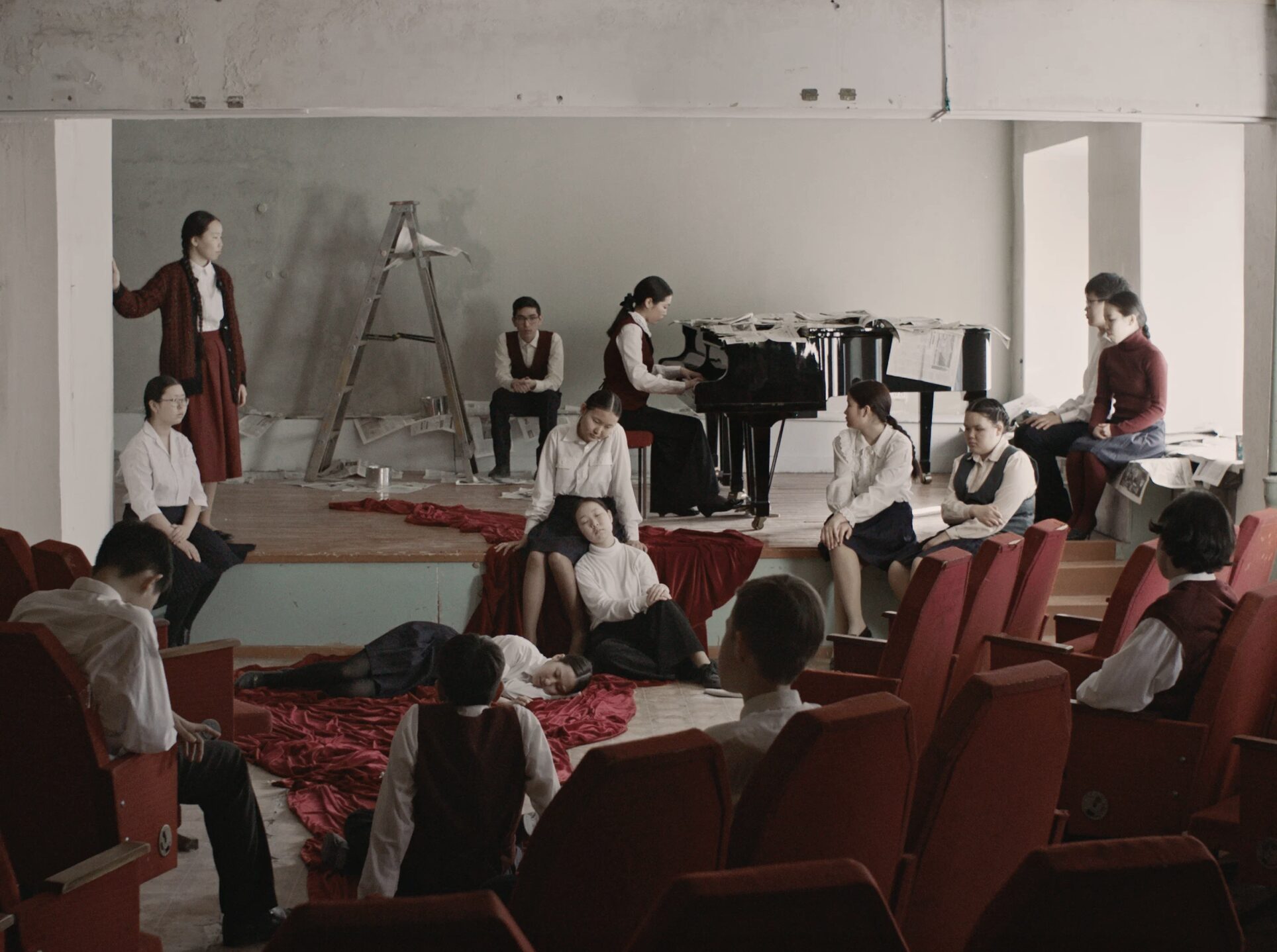
Now in theaters — Inga Shepeleva's "White Steamship," which appeared at several festivals last year. We tell about the mystical Yakut fairy tale based on the eponymous story.
On the threshold of a boarding school for gifted children, perestroika magically appears along with a director (Alexander Koshkidko) sent from Moscow. He intends to eradicate Soviet orders and replace the record with the song "White Steamship," which has been performed here for the last twenty years, with something more relevant. But the choirmaster Marta Grigorievna (Ella Sokolova) is against it. Her choir will perform exactly this song, or she will leave. And she leaves.
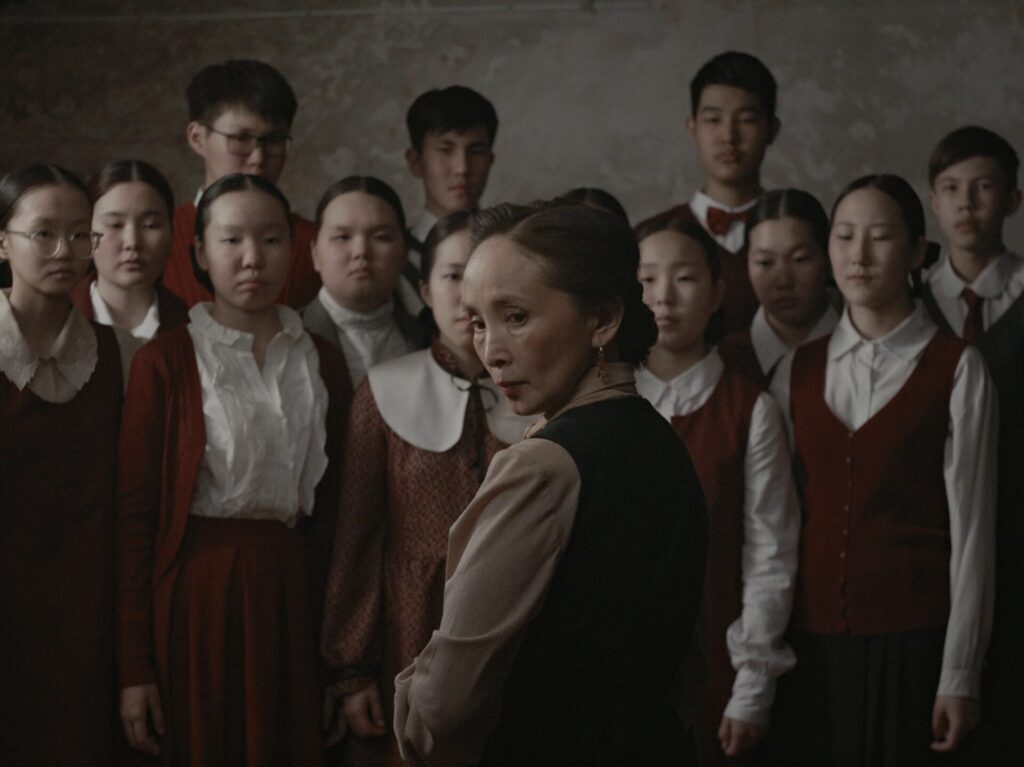
Oleg Evgenievich is left alone with teachers who see him as an outsider, with Yakut winter winds, dusty red curtains and Soviet posters, with the enchanted girls from Marta's choir who simply do not sing what he demands. One wants to write that the director was brought by the perestroika wind of change, that now he will fight, eradicate, act, argue, change. But this does not suit him at all. The silent tall man came only to take his place in the static plot of a fairy tale. And although he is called "the newcomer," he fits perfectly into the world bounded by the walls of the music school. Like a suddenly found, perfectly fitting puzzle piece.
Marta has long taken her place in this fairy tale. In her youth, she fell in love with a Russian captain who left her and never returned. But before leaving, he left a record with his favorite song. And now Marta, as if under hypnosis, repeats this song with each new generation of girls in the choir. This is not a way to summon back her beloved; he is dead. But it is a ritual that has grown so deeply into the foundation of Marta's life, the school, the town, this entire world, that it has become defining. The compulsive mechanical repetition of an action is replaced by a metaphysical way of living and feeling.

The director and the choirmaster find themselves locked in a 4:3 frame, unable to step beyond its walls. A connection arises between them, and history repeats itself again. But in "White Steamship," there is no psychologism with which it would be convenient to dissect these strange love relationships. The characters have no reactions, stimuli, or desires. They act not because they want something. They act because it is necessary. They have psychologemes, motives, and places they occupy. The world of the fairy tale defines them to the same extent that they define the world of the fairy tale.
"White Steamship" does not promise a utopian ending from reworked children's plots of the "and they lived happily ever after" cycle, nor does it operate with grim folkloric cruelty. The film reconstructs a dry equation, perfect and fatally interconnected. All parts are soldered to each other, with no chance of deviating from the axis without damaging the fundamental structure of the myth.
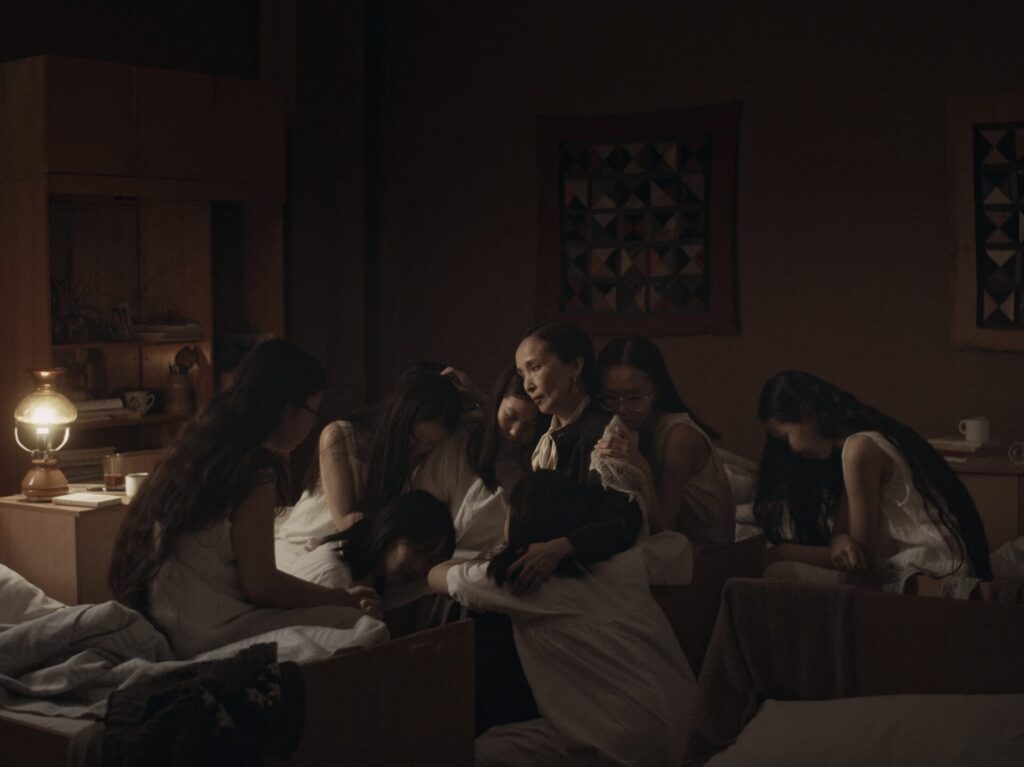
The decorative aesthetic immerses one in a strange state of fatality and infinity of this story. Long static hypnotic shots give way to geometric lacquered-wooden-concrete structures of Soviet interiors and the dense prickly air of frost. The smooth rhythm rhymes music and the dreamlike nature of "White Steamship."
Enclosed in the shell of myth, Oleg Evgenievich falls in love with Marta. But this is not love growing in feelings. It is love-pain. Love-fate. He will stage the song "Stone Queen" with the choir for Marta, but another composition in the repertoire of broken hearts will not tip the formula of the fairy tale toward a happy ending. The heroine will pass her pain on to the visiting director by inheritance. I like to think that upon returning to Moscow, Oleg Evgenievich will perform this song for the next twenty years. Another turn of the spiral. Repetition.

There is no word that can describe the timeless strange connection between the characters of "White Steamship." Perhaps it is love expressed in terms of half-sleep, bordered by pain. The allegorical nature of the film encapsulates the conflict in two figures, but it is not only Marta and Oleg, not only the Republic of Sakha and Moscow, not only retrograde and progressive. Binarity does not destroy this magical world but creates harmony of the parts of the whole.
Comments
0No comments yet.
Sign in to join the discussion.