
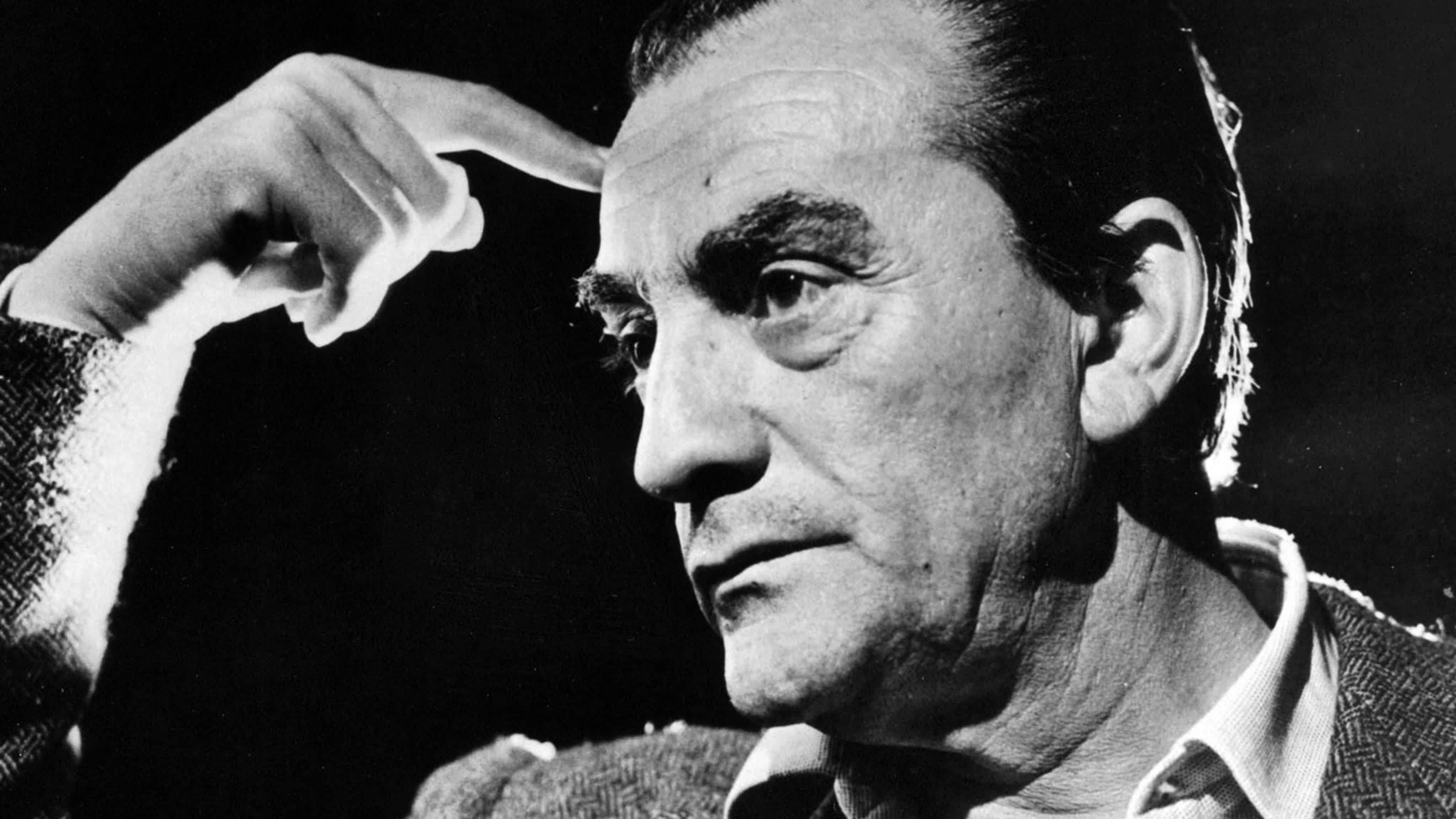
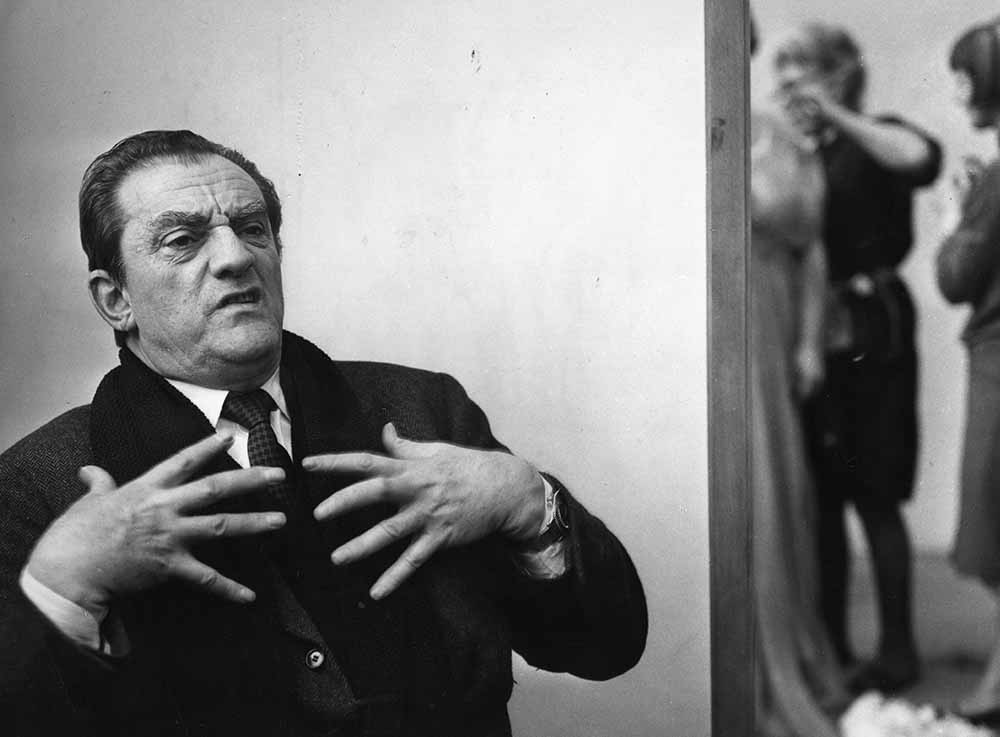
World culture breathes not only through eras, genres, and concepts, but also through authors, their selfhood, and tireless participation in human life. One such author was and remains Luchino Visconti – the most contradictory directorial figure in It...
On the spring evening of March 17, 1976, Luchino Visconti, after a long illness, ceases to belong to himself: dying in Rome, at 101 Via Fleming, Visconti disappears without a trace, for it is still unclear when and where the ashes of the greatest aristocrat in film history were scattered.
The director's final long-standing duel can hardly be called fair – white-haired like Gary Busey, the Tyrolean wind frames the Bavarian episodes of the fateful film Ludwig, then the film crew is thrown into the sweltering sets of Cinecittà; a short break on Ischia, again heat, this time Rome, dinner with producers, a cup darkened by coffee residue, a cigarette habitual for Visconti – he is already ready to move on to champagne. Raising the glass to his lips, he manages to say: "No, it's not chilled enough" and falls, struck by a stroke. His dying phrase is no good, unlike Chekhov's "Ich sterbe." Rather, the words of Vladislav Khodasevich about the heart stopping of an impressionable young Symbolist come to mind: "He died of death." But Visconti did not die, so beautiful gestures had to be left for later.
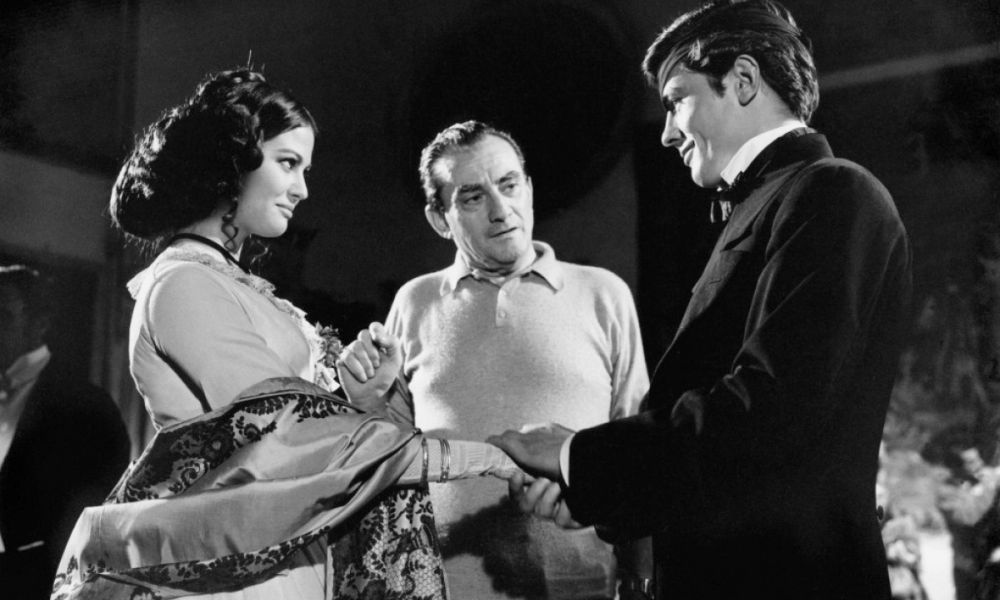
A Milanese bearer of a glorious surname, aristocrat, workaholic, communist, neorealist, theater director, partisan, equerry – one cannot approach him without prior preparation. Visconti knew too much about himself, as evidenced by the scout-like mastery that helped him assemble a creative team of screenwriters, set designers, actors, and costume designers.
The Visconti family lays out the dinnerware, steals the shyness of Claudia Cardinale, leaving behind unquenched sensuality and a husky laugh. They hide in a villa from the fascist government and throw balls, spinning at a devilish pace. A communist family, a theatrical and cinematic one, and at the center of each, like a concentric circle, is placed the authorial body of Luchino Visconti – the Milanese bearer of a glorious surname, aristocrat and workaholic.
Last Among the First
Editor Mario Serandrei "was stunned by the handwriting" and phrasing of Visconti while working on the adaptation of James M. Cain's novel The Postman Always Rings Twice, titled Ossessione. The classic of American literary and film noir in an Italian rendition did not fit into any established tradition and thus gave birth to a new one – neorealism. Shaking coordinates and planes, Serandrei did not even suspect how accurate his striking definition was.
Naturally, the term "neorealism" already existed and was used earlier in relation to English painting and Italian literature of late verismo, but the bourgeois and falsely fascist "cinema of white telephones" of the late 1930s and early 1940s did not let through the scattered ray of light reflected by the mirror of war-bleeding Italy, its Roman outskirts, and southern prose from the plow. Without knowing it, Serandrei made both an ideological and aesthetic discovery: Italian cinema from now on, firstly, takes an equal place among other arts, and secondly, foreshadows the imminent defeat of Mussolini's government and restores the strength of the suppressed voice of the people.
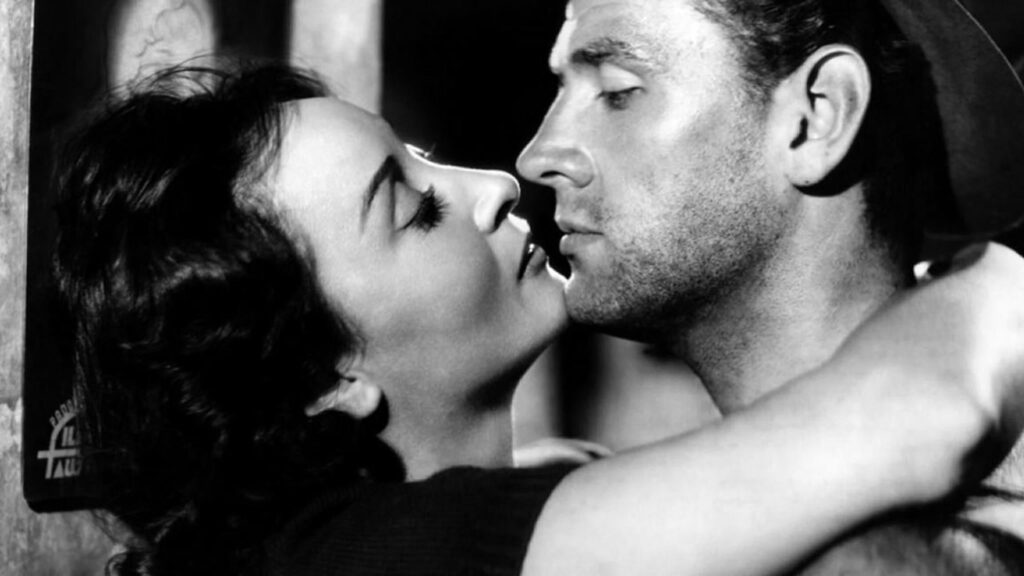
Ossessione is literally everything you need to know about Italy in those years. A young count, after working as an assistant to Jean Renoir and absorbing the spirit of the red spring of the Popular Front, returns to adapt an American novel to the realities of his own gravely ill country. It is the story of Giovanna Bragana (Clara Calamai), wife of a roadside tavern owner (Juan de Landa), who falls in love with a drifter, Gino Costa (Massimo Girotti). Together, the lovers plot to kill the husband and collect insurance money by staging a car accident.
The main task of the film was formulated by a group of intellectuals from the magazine Cinema – to bring villains to the court of public opinion and turn off the glow of the romantic halo. Giovanna and Gino do not love each other, they have nowhere to run, the white telephone has long been silent: someone cut the wires through which the details of another melodrama were transmitted. Ossessione was not produced in a dream factory, but on the next street, where they smoke Umbrian shag and watch the flickering glow of the last unbroken streetlamp.
Ossessione becomes philosophical and revolutionary not only thanks to the central pair of characters. The film owes much to the anti-fascist message embodied in the newly introduced cultural object – the Spaniard (Elio Marcuzzo), who convinces Gino to break off his relationship with a married woman.
Visconti stated that the Spaniard is his authorial character, a moral tuning fork and an exponent of the spirit of free poetry and its contact with an unfree society. The Spaniard, of course, recalls the struggle of the anti-Franco brigades; he is dangerous to the established order because he is ironic and sarcastic, but also cruel and deceitful, he deceives and informs, takes revenge and grimaces. One of the screenwriters, Mario Alicata, attacked Visconti after the premiere, because according to his design, the Spaniard was a proletarian and preached socialist ideas. However, Visconti saw the character more deeply. To make the viewer doubt, you don't need a saint – you need a trickster, a new Quixote, a Luke, a Hermes, who does not state but engages in polemics.
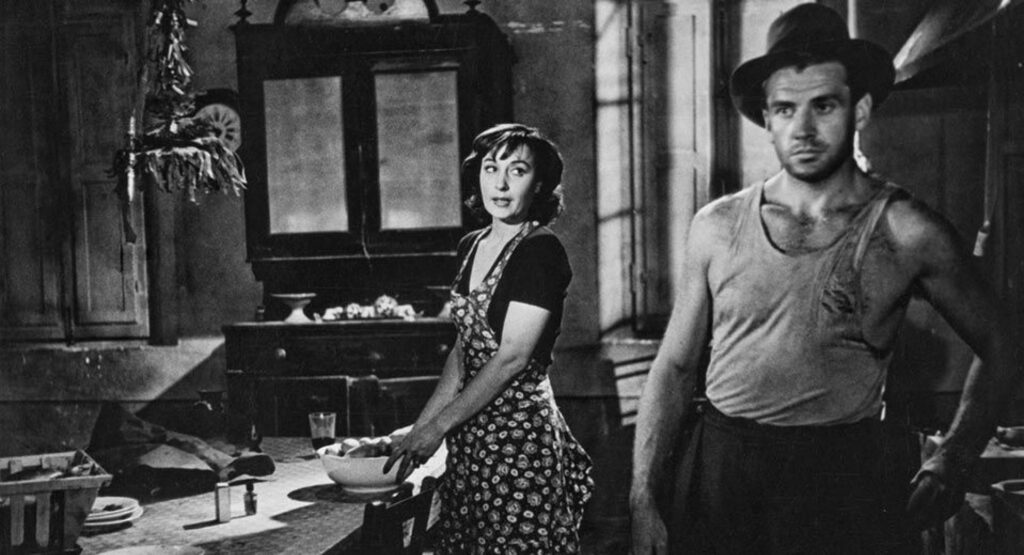
Visconti's neorealist plan is not exhausted by Ossessione, but La Terra Trema and Bellissima are clearly inspired by the manifesto-like and highly influential opus of Roberto Rossellini, Rome, Open City. And yet, even being second, Visconti does not stop composing. Composing a concept of cinema without professional actors, composing a new Anna Magnani, composing an unplanned ending to all of neorealism.
Visconti was among the first participants of the new movement; he preceded Rossellini and De Sica, but he is always remembered third. Extremely unfair – the director not only brought neorealism into the world but also destroyed it.
Radicalizing the spirit of the movement, Visconti fully relied on non-professional actors, and in the film La Terra Trema, the viewer witnessed only a documentary self-presentation, the involvement of artistic language in the world. The script and the materiality of the image are not separated: it is not actors playing fishermen – fishermen catch fish, without destroying everyday reality. "The eye only has to see, the ear only to hear." A fisherman does not become anything beyond what he is. This is his advantage over an actor.
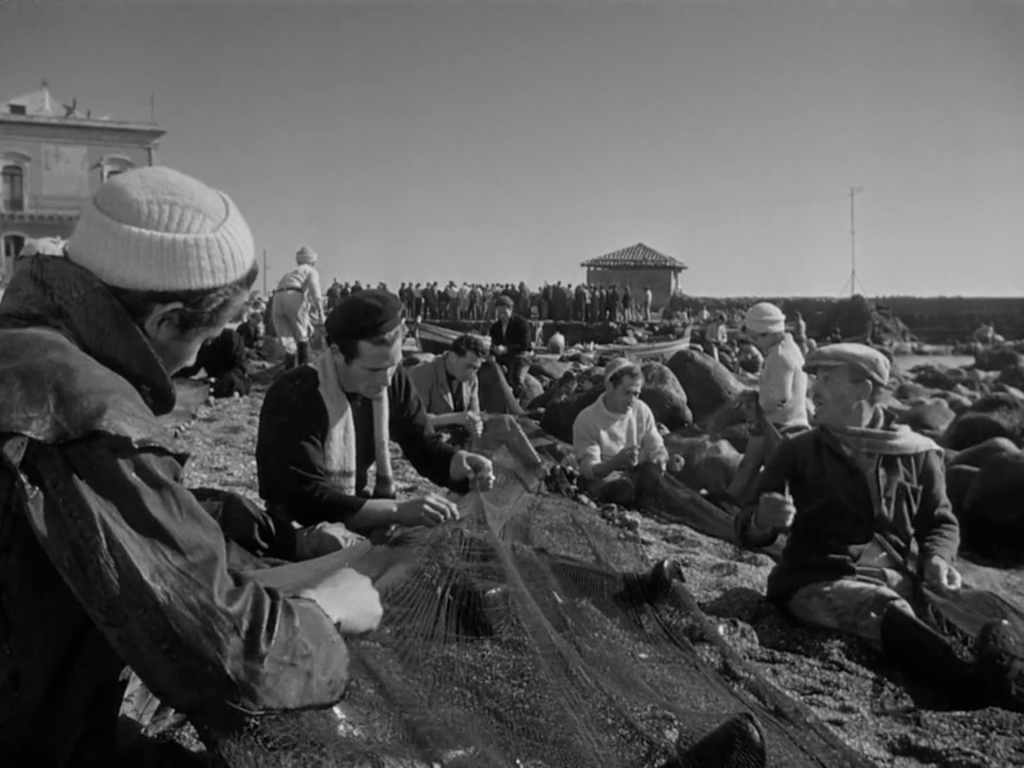
However, already in his next work, Bellissima, Luchino Visconti makes the stars converge in the form of another bizarre constellation: he brings in the main actress of neorealism, Anna Magnani, and the main screenwriter, Cesare Zavattini, and for the first time pays attention to the drama not only of an adult but also of a child. From the moment of pre-production, it becomes obvious that Visconti wants to repeat the success of his colleagues. He wants his own Bicycle Thieves and The Earth Trembles, but he ends up with a completely different film.
Bellissima is a meta-commentary on the relationship between reality and cinema. Neorealism is original precisely because it excludes an a priori view from the observation of reality – this is how André Bazin formulated the formula of Italian cinema of the 1940s, saying that the neorealist phenomenon does not require and even abhors the presence of a knowing and observing subject. Instead, the French theorist proposed a fine calligraphic writing, a "camera-pen" freed from the tyranny of the visual. But what if Bazin was wrong, as were Rossellini, De Sica, Blasetti? What if cinema is an even more inexorable observer, not a servant of the author or movement, but their master?
The young heroines of Bellissima, accompanied by their mothers, rush to screen tests to revive a common dream and enter the world of cinema. Visconti openly polemicizes with his previous film, because the female world of endless waiting for a falling star is similar to the revival of the fishermen who participated in the filming of La Terra Trema.
We choose people from the street, and we are wrong. We sell love potion, but it is not a magic elixir, just simple Bordeaux.
Visconti was one of the first to distinguish between treating the ills of post-war society and the palliative opioid effect of watching movies. Even more – the author accused himself of charlatanism, and consequently undermined the positions of the entire neorealist movement.
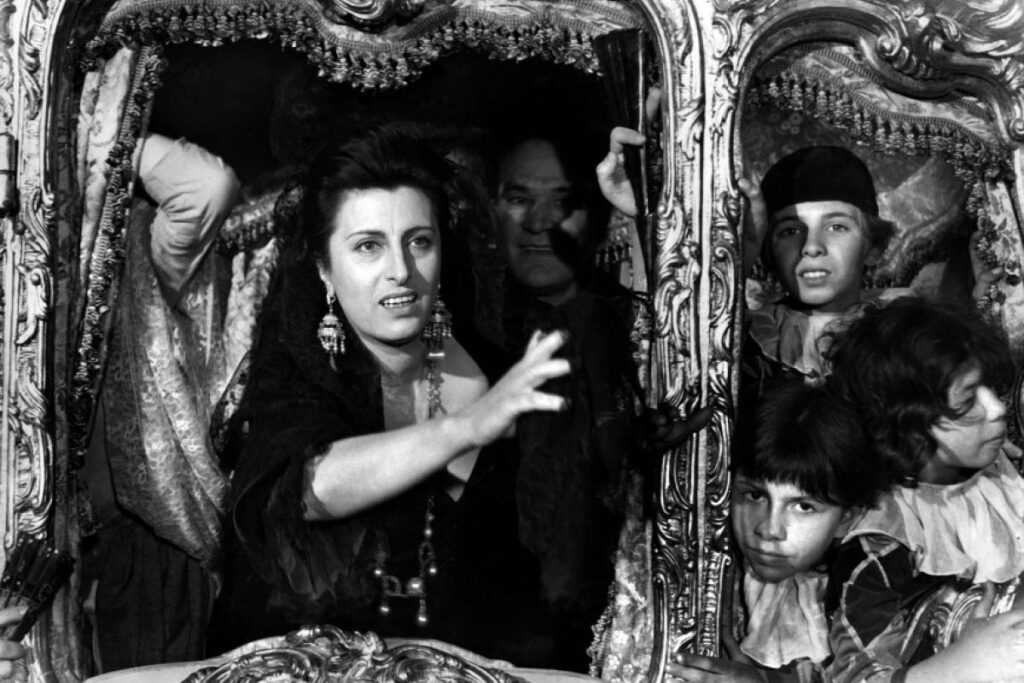
After Bellissima, Visconti participated in the anthology film We Women and returned in 1954 with a new feature film, Senso, in which one can recognize neither the preceding cinematic tradition nor the director's early style. Visconti's aggressive turn remains incomprehensible upon a superficial review of his works, but Bellissima, when properly considered, acquires the status of a logical conclusion to the neorealist chapter and a transitional phase to the large historical costume canvases and colorful adaptations, which will be discussed further.
"Caution: Modernism!"
The 1950s were a time of the rise of the national Italian economy and the "re-enactment" of socio-political life destroyed by Benito Mussolini's regime, which, however, did not prevent the newly formed right-wing sector from gathering strength. Moreover, the state had not fully "recovered" and continued to exercise its powers in an extremely repressive McCarthyist manner.
Neorealism ceased to function normally: having emerged on the wave of a nationwide upsurge, the movement served every viewer, citizen, person. However, in the cultural space of the 1950s, rhetorical constructs appealed not to the community, but increasingly to differentiated manifestations of ideological savagery and even to individuals.
The union of a priest and a prostitute in the pompous passage of Rome, Open City – humanism that turned out to be a rudiment. Both priests and prostitutes and simply people disappeared; only clerics and lumpenproletariat remained.
In response to the political bustle in an atmosphere of suffocating stagnation, as in a greenhouse, auteur cinema began to grow – a new phenomenon for Italian cinema. One can, of course, recall and pay tribute to Alessandro Blasetti, Mario Soldati, and Mario Camerini, but essentially they were just unlucky: they fell into the mouth of the era and, like pilgrims in Gargantua's mouth, balanced between selfhood and fear of the unfriendly seething environment.
In 1954, Luchino Visconti adapted a story by the ideologue and architect Camillo Boito, shocking not only the audience but also his supporters in the Communist Party. The latter painfully experienced excommunication from the church and the fight against neo-fascism. Their anxieties, like those of the "fighters" of the opposite camp, presupposed a rhetorical nature, the momentary alignment of politically charged forces in the space of discourse.
The ethical impasse and death of neorealism forced the major authors to reconsider their views on the relationship between truth and art, art and man. Visconti, defying oblivion, turned to the past, turning nostalgia into a method of understanding reality, because he needed conventional signs as a way to expose the ultimate reality.
At a time when literature was abandoning modernist paradigms, winding down the experiment of the past era, ensuring the "closure" of sign systems, filmmakers came to the conclusion that criticizing modern civilization must be done as Jean-Jacques Rousseau did – by opening horizons of primary being. It is no coincidence that the main director of the era became Jean-Luc Godard, who nurtured "cinema truth," and already in the 1960s, the banner of film avant-garde was raised with Stan Brakhage at the forefront.
And so Visconti joined the essential search, plunging headlong into the neoclassical aesthetics of Boito's work. The plot of Senso revolves around the illicit love of the Venetian countess Livia Serpieri (Alida Valli) for an Austrian army lieutenant, Franz Mahler (Farley Granger). In a fit of passion, the Italian betrays the Garibaldi movement, and Franz abandons his position in the Habsburg Empire's military unit.
Senso is not love against the backdrop of war; it is love drowned out by war, moreover, the destruction of any, even impure, emotional upheaval. "Twilight falls on the history of Italy," therefore the murder in the name of false love in Ossessione is opposed by the defeat of the personal and the crude triumph of history in Senso: "here it is a military defeat, a tragic chorus in the finale of a lost battle seems to drown out the melody of a sadly ended love adventure.
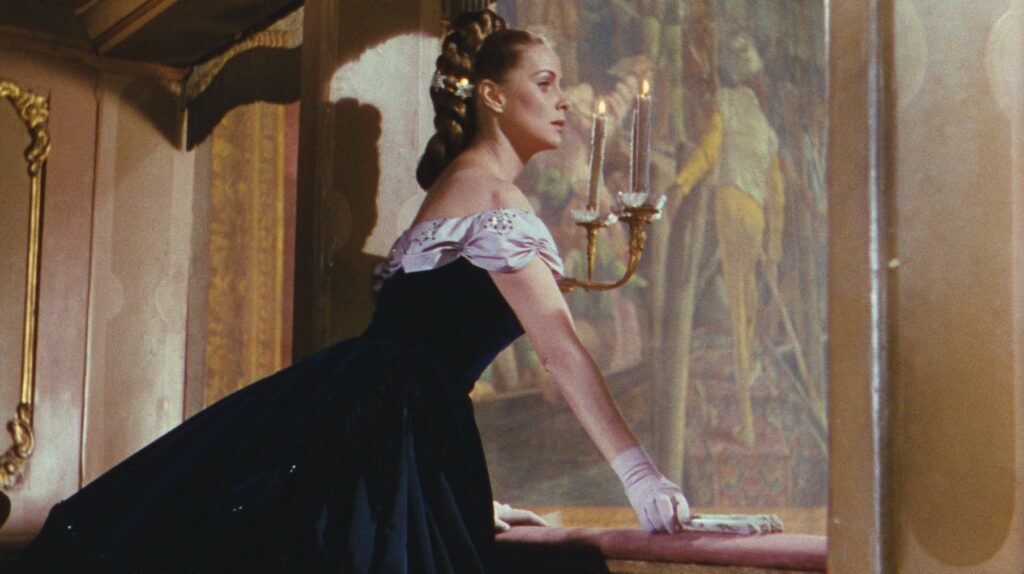
The historical global perspective, the musical canvas, the preceding theatrical production, the literary source, Visconti's and the creative team's behavior on set, and the ostentatious return of the golden child to the bosom of aristocratic order – all this works simultaneously and fragments into singularities that shout over each other.
Senso is structured on the palimpsest principle – before applying a new layer, the old one is scraped off, but it cannot be completely removed, and moreover, the attentive viewer possesses sacred knowledge of the existence of several layers.
The theatrical mask shows through the cinematic one, embodied in melodrama – a condemned genre. However, Visconti places it at the center of a large canvas and presses it down with the weight of sin, depriving the events of lightness, but making an attempt to talk about melodrama as a construct that can produce relevant meanings. Melodrama, on the one hand, loses its genre identity, on the other, raises its status and becomes a subject of discussion. And this is only a superficial analysis of Senso, since absolutely everything here is subordinated to the idea described above.
Earlier we spoke about the modernist nature of Visconti's works, that modernism is always a revolution, as a search for truth, a search for essence, for primordial material. In Visconti's case, the tool of search becomes the palimpsest, as a particular manifestation of nostalgia, because nostalgia is a wistful feeling of loss and simultaneously a voicing of that feeling, a replacement of the signified while preserving the signifier, while the signified is simply erased, giving way to a surrogate – a new layer. The search for layers and their organization in the space of his cinematic language becomes a dogma for Visconti for the rest of his career and life, since the director and the man died at the same time.
"Family Affairs"
Not everyone likes to remember their childhood. The reasons may be war disasters or intra-family crises, a single tragic event, or the lack of interest, the emptiness of early years. And if a lost author does wander into the territory of the past, it is for a serious purpose: confession, a declaration of love, or taking stock at the end of his days. Not everyone is able to settle in their childhood or visit it with enviable regularity.
However, there is a whole cohort of authors for whom childhood does not lose its charm, "no matter how much it may have been crippled by the cares of numerous trainers" – these are hereditary aristocrats, raised in the tenderness of governesses and nannies who rocked them by the window overlooking the family gardens, their emerald, pristine gleam.
Such in the 20th century were Marcel Proust, Vladimir Nabokov, Ivan Bunin, Giuseppe Tomasi di Lampedusa, and many others. Under the covers of Other Shores, The Life of Arseniev, Swann's Way, The Leopard, a bright memory of days gone by or taken away lingered. The 20th century was a time of the decline of the aristocracy, so the voices of its singers sounded especially poignant. This distinguished them from their predecessors, whose writings were aimed at criticizing the lifestyle of high society. This intention gave rise to the so-called "novel of manners" authored by Alain-René Lesage and Claude Crébillon.
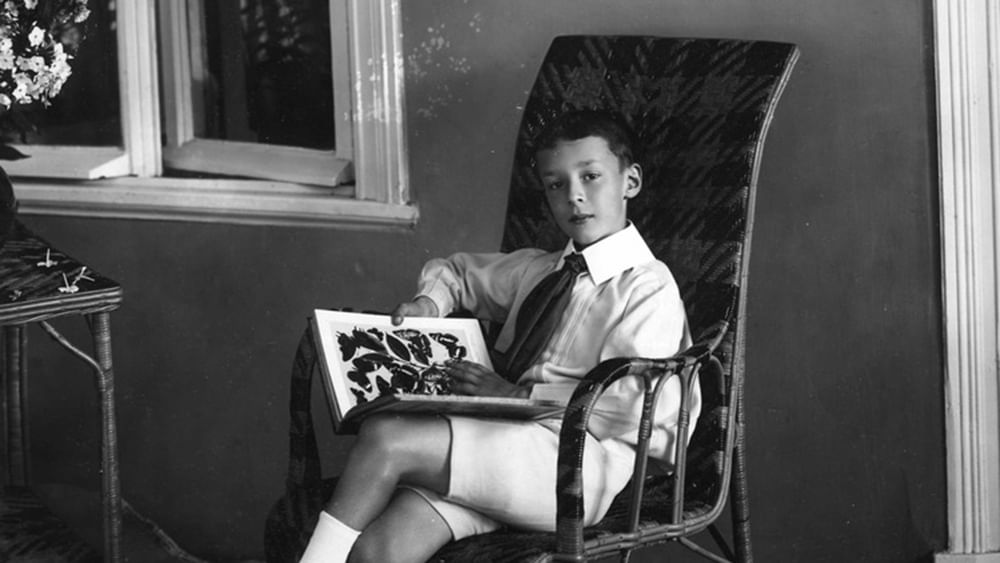
If a full-fledged aristocratic tradition developed in literature, the young art of cinema almost completely bypassed it. The reason lies not only in the historical but also in the socio-political context. The consumers, and often the producers, of films were the lower strata of the population (for example, the main builders of Japanese cinema were students, failed kabuki actors, and the Yakuza).
Moreover, tension between right and left forces was growing. The fascist ideology, which grew out of the bourgeoisie, was opposed by the European communist corps. In France, starting from the 1920s, the PCF (French Communist Party) gained popular support, and since France still held the lead in film production, films were inevitably imbued with anti-bourgeois and, naturally, anti-aristocratic sentiments. The USSR is not even worth mentioning, and in liberal-capitalist America, classical aristocracy did not exist as a phenomenon. It is not hard to imagine how cold and unwelcoming cinema was to a stray aristocrat.
But Luchino Visconti succeeded. The director, firstly, allied himself with the communists (financing and hiding them from Mussolini's "dogs"), and secondly, was not afraid or ashamed of his origins. Starting with Senso, only three times did Visconti forget about his lineage (White Nights, Rocco and His Brothers, and The Stranger), while the rest of his works came straight from the canvas of his life and the lives of those he could consider his equals.
We did not devote a large block to literature in vain, for the main sources of inspiration for Visconti were the same aristocratic writers: Thomas Mann, Lampedusa, and D'Annunzio. If the director wished to bring to the screen, for example, the image of Ludwig II or another detached intellectual, and suitable literature was not at hand, then the faithful Suso Cecchi D'Amico and Enrico Medioli came to the rescue.
Speaking of aristocracy in the material of Visconti's cinema, one must forbid oneself the liberty of using any unambiguous interpretations. Thus, Helmut Berger (the main star of Visconti's films and his lover) played both the role of Konrad – an innocent victim of refined unexpressed human relationships, and Martin von Essenbeck – a repulsive sodomite and product of the pro-fascist industrial elite.
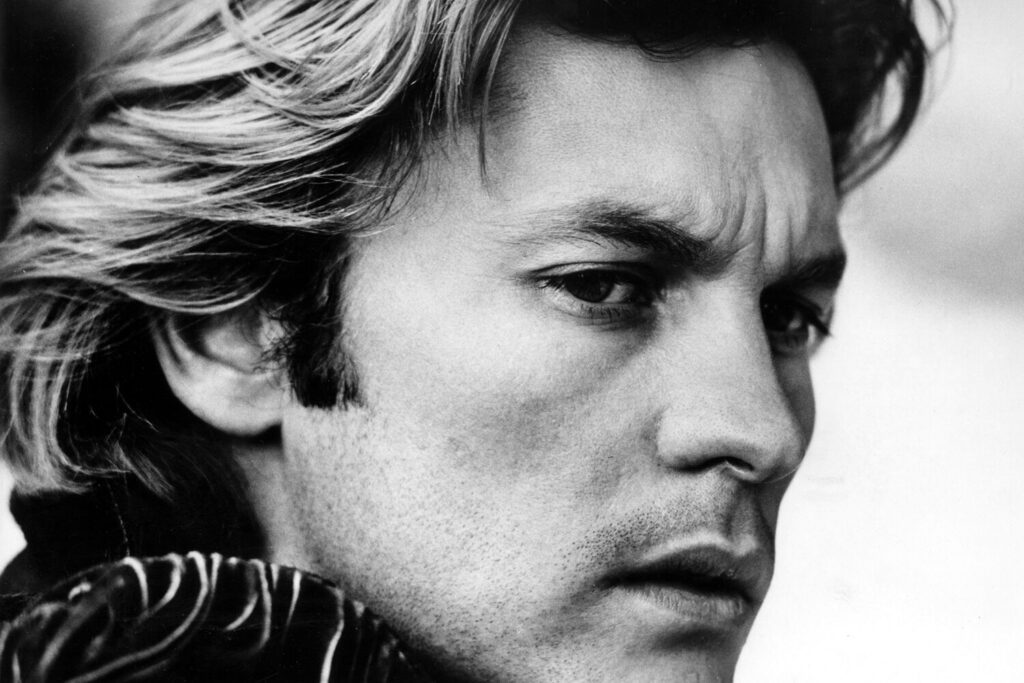
Visconti sometimes scolds the blue-blooded and slender-necked, sometimes illuminates their silhouettes with a sad smile. Of all possible solutions, the director chose the most courageous and honest: he brought the personal as close as possible to the observed, in order to create from biography a perfect material of its kind. In 1968, he undertook an aesthetic "German" trilogy, starting with a study of the role of the Krupp dynasty (in the film, the Essenbecks) in 20th-century German history. The steelmakers from enterprising magnates retooled into arms "barons" of the Third Reich. From under the Krupp machine came such infamous weapons as "Big Bertha," Dora, and Parisgeschütz.
The Damned is a case where the content was "spilled" along with the title, making an important historical discovery. The point is not that Visconti considered the Krupps deities, but in the continuity between Wagnerian paganism and capitalism. And if the former was barely defeated, the latter gradually infected the tissues of the weakened Italian nation.
Helmut Berger's character embodies a new perversely Nietzschean type of man. Martin von Essenbeck grew up in love and abundance, but this did not save him from complicity in the agony of a shameful decade: the young man rapes and kills his mother, violating all human taboos. Yet even he deserves, no, not purification, but a semblance of impartial analysis, so Visconti strives to find a mold for his figure. How else to explain the Freudian visit to Martin's childhood, over which expressionism with a mark of decay gaped its blue eyes, not deeply buried?
However, one must not allow the tragic stasis of the narrative to mislead the viewer. The Damned is only two-thirds Shakespeare; the remaining part belongs to the Visconti family, its mysteries and revelations. Even when adding such minor details as table setting and meals on a strict schedule, the director deliberately checks with his family's habits, and the image of the Essenbeck matriarch – Sophie, played by Ingrid Thulin, is directly inspired by Carla Erba, Luchino's loving mother.
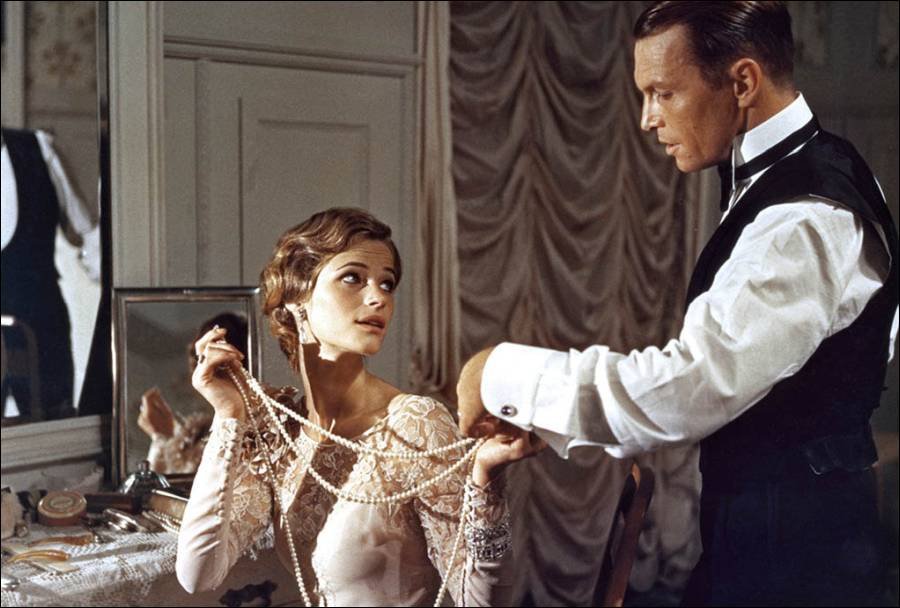
The director's father, Giuseppe Visconti, is also not excluded from the cinema; his essence stenciled onto the hero of the novel The Leopard, Don Fabrizio Salina. "A leopard with a good heart" – that is how his daughter Uberta Visconti called him.
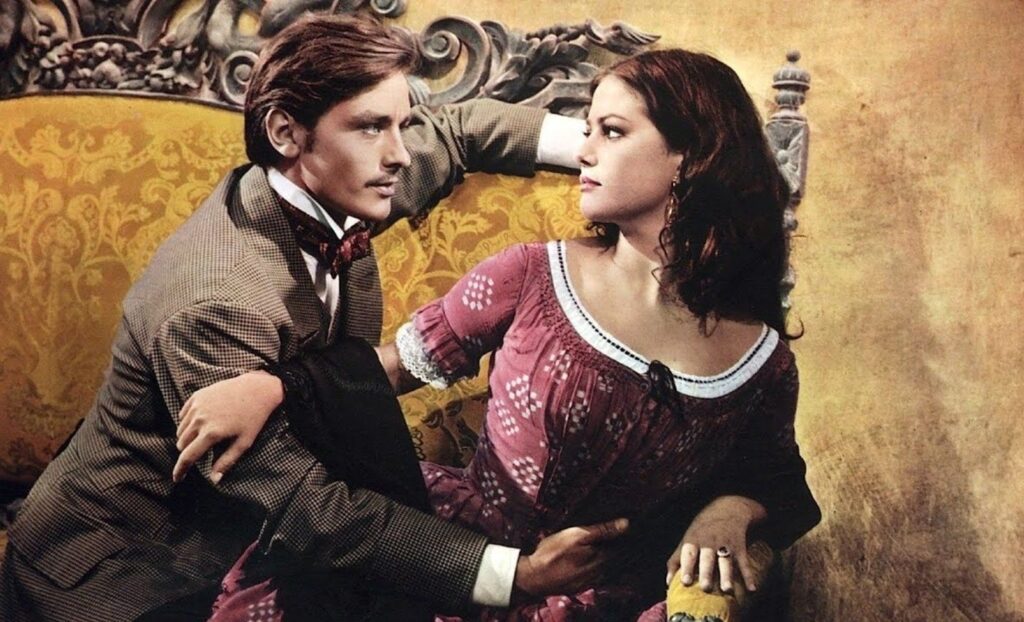
Aristocratism in all its aggregates had never before been subjected to such mature examination. Not a trace of didacticism and lubok eccentricity characteristic of hotheads who criticize, no meekness and defeatist self-love, as in others who incessantly regale the viewer and reader with sentimental details of their biography. The "predator" Fabrizio Salina has already lost, and that is why he has no need to lose dignity. Visconti wisely decided that for this role it was necessary to take a detached person and "delivered" from abroad Burt Lancaster – what is this, if not an attempt to conduct another experiment, to make an actor an instrument for affirming thought through the directly visible?
Salina, like the actor who played him, also remains alone to some extent and is also forced to obey, but not a director-tyrant, but the tyranny of a new time, the Savoy dynasty, which replaced the Bourbons and now establishes the supremacy of bourgeois businessmen. "We were leopards and lions. Those who replace us will be jackals and sheep. And all of us – leopards, lions, jackals – will continue to think ourselves the salt of the earth" – words spoken by Salina, evoking a bitter smile, leave no doubt as to whose side Visconti is on. Both the Essenbecks and the Salinas represent one class, one taxonomic group; the difference is only that the former betrayed themselves, but even so, their story does not turn into a manual and remains a very personal statement.
I Want to Die, Hopefully It Won't Happen Soon
It is still unclear when and where the ashes of the greatest aristocrat in film history were scattered. When you are given a grim diagnosis and strictly allotted a few years of life, it seems fair if in return at least something remains inaccessible and hidden. And this is not only about cremation. Visconti is both a talent of rare beauty, a brave communist, one who influenced generations of directors after him, and the discoverer of neorealism, but all this seems not about him, or rather, not only about him. That is probably why Visconti's biographer, Schifano Laurence, is forced to attack Pasolini, Godard, and others, because they involuntarily steal epithets and characteristics that should belong to another.
And this article is not an attempt to take back the "loot" and return it to the victim. Visconti never needed protection or sympathy from outsiders, but, remaining elusive, he gave up his places, as his family once did, losing the box at La Scala theater. Here, only an attempt is made to outline his looking-glass world, perhaps one of the most elusive in the matrix of cinema, and to elevate the authorial body, but not as Peter Greenaway did with himself, stuffing a thief, but by gently integrating Luchino Visconti into contemporary film discourse.
Glossary:
The Visconti Family (the hands the director used as his own)
Actors:
- Helmut Berger
- Burt Lancaster
- Claudia Cardinale
- Alain Delon
- Marcello Mastroianni
Screenwriters:
- Suso Cecchi D'Amico
- Enrico Medioli
Set Designer:
- Mario Chiari
Cinematographer:
- Aldo Graziati
Costume Designer:
- Piero Tosi
Editor:
- Mario Serandrei
Additional materials for getting to know the personality of Luchino Visconti:
- Schifano Laurence, Visconti: Naked Life
- Konstantin Kozlov, Luchino Visconti and His Cinema
- Andrei Plakhov, Visconti. History and Myth. Beauty and Death
Comments
0No comments yet.
Sign in to join the discussion.