
The red-carpet premiere of the film “Gnome Treasures” took place on April 25. Five days later it was released, and for two weeks now it has been teaching everyone to do good. Our author has been thinking about this film since the premiere. About gnom...
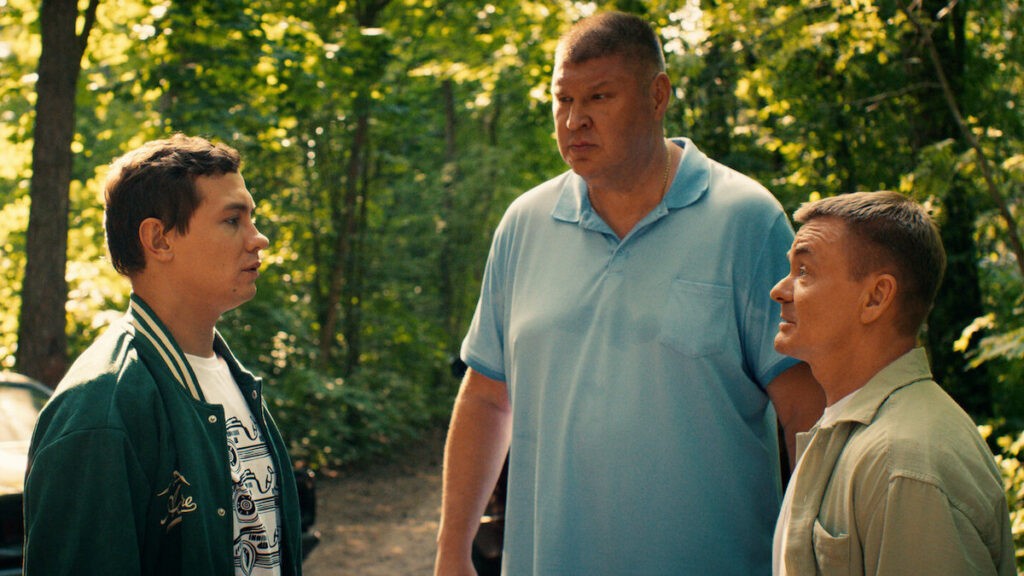
“Gnome Treasures” is a coming-of-age novel in an adventure vein. The point of such stories is that a hero, initially morally flawed, goes through trials and hardships, sees the light, and becomes a good person. In the film, this role goes to Nikita Kologrivy. His character Roma is thirty years old, a small-time swindler who constantly gets into schemes and burns out. Once working at an auto repair shop, Roman is tired of earning honestly, mainly because you can’t earn much that way. His desire for an easy life and easy money, as always in such films, is certainly reprehensible but humanly understandable. Roman lives in a world that, though polished to an unnatural shine, is quite recognizable. The only difference is that in his world, besides people, there are also gnomes.
This difference is small in every sense but decisive. Roman, noticing that his very elderly neighbor in the dacha village has died, sneaks into his house and wants to take something. Luck, he thinks, has finally smiled on him: in the pensioner’s house, he finds an unfinished will. Roman, naturally, inserts his name, becoming the heir of a not-so-poor grandfather. However, besides the house, bank account, and forest land owned by the deceased, he also gets his gnomes and their golden flower.
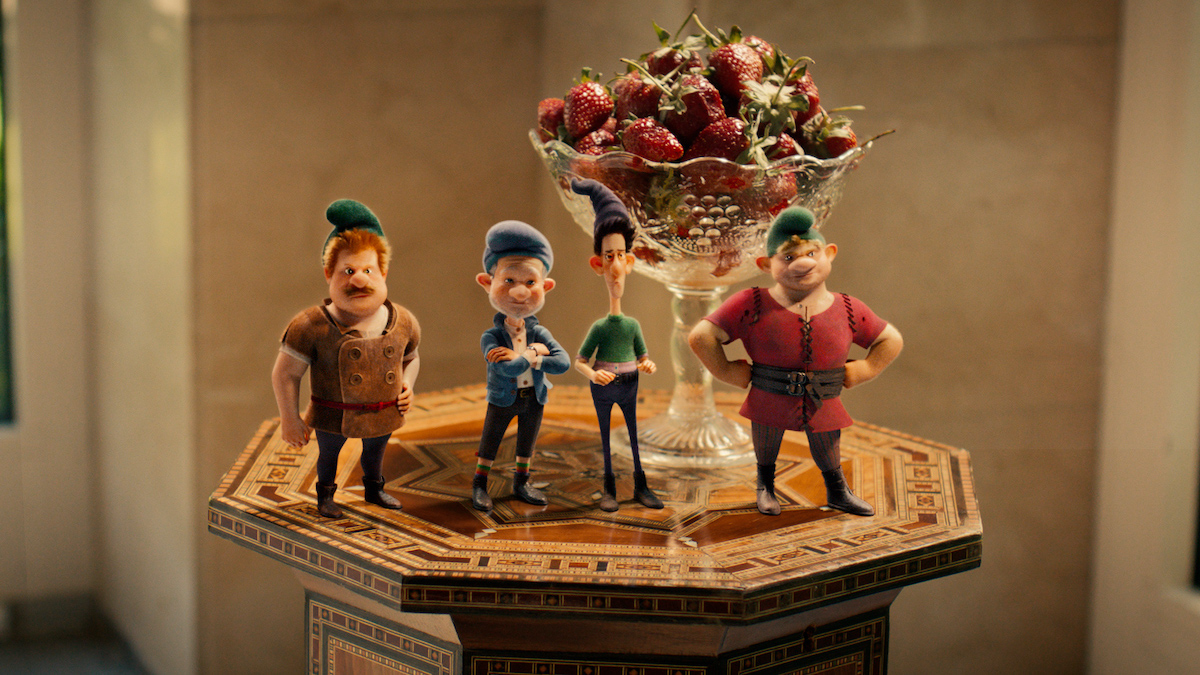
The gnomes in the film are magical creatures resembling Smurfs, whose main task is to seek treasures and do good. They engage in treasure hunting using a flower that can locate any treasure, money, or valuables. This radar, however, runs on a very strange fuel—human kindness. The problem is that Roman is not very kind, and the gnomes are very angry at him for that. Moreover, only the hero can see the gnomes, so one might even think he has gone crazy and this is a strange remake of “Fight Club”—time is shrinking and instead of Brad Pitt, now there are gnomes.
The madness version, though attractive, is quickly disproven: the gnomes are also seen by the main character’s daughter Varya (excellent young actress Alisa Rudenko). She is a kind and responsive girl who seems to understand a lot about her father but still loves him. Gnomes are seen only by their owners—though can one own a gnome?—and they appeared to the girl because she is her father’s heir. Thus we understand that the gnomes are also fine connoisseurs of Russian inheritance law and respect legal succession.

Unlike Roman, Varya immediately takes to the gnomes and learns their names—Smarty, Baker, Strongy, and Gaper. Father and daughter, together with this creatively named quartet, set off in search of money and other material valuables. Needless to say, in the end they will be enriched not only materially but also spiritually?
The search for Napoleon’s treasures—which is exactly what the main character is after—is as absurd as it is amusingly engaging. How many good deeds must one do to get a lot of money? Donate blood? Help an old lady cross the street? Facilitate a father’s return to the family? The hero does all this—and many foolish things along the way—and the viewer (at least the viewer over five) cannot help but wonder: how to separate a good deed from a bad one? Do the gnomes have some kind of list? Do they look at the motivation behind the hero’s actions or only at their consequences? Which side do these little moral champions take in the ethical debate between utilitarians and Kantians, where the former insist that the moral value of actions is determined by their outcome, while the latter propose looking at what guided the person?
The film leaves plenty of time to ponder these questions: what else to do while the characters make obvious stupidities, sing songs in drawn-out musical episodes, or while Kologrivy’s hero once again makes, so to speak, logical errors in moral (and any) argumentation. The action is periodically interrupted by inexplicable things, such as a daytime trip near the forest to the song “Skazochnaya Tayga” by the band “Agata Kristi”.
However, these are all rather superficial complaints. Everyone’s favorite American adventure films also had many stupidities. For example, “Journey to the Center of the Earth” with Brendan Fraser is a wonderful film, but generally not Antonioni. It doesn’t need to be. The main joy that adventure cinema can bring is in its conscious silliness, in the naive belief that behind every turn lies, if not the Holy Grail or the Ark of the Covenant, then certainly some miracle.
However, “Gnome Treasures” probably fails precisely in maintaining this spirit of adventure. The gnomes are, of course, drawn in the style of highly questionable graphics from 2000s films, but making the same bad animation is not enough; that wasn’t the secret of success. The feeling of wonder, of a world of constant discoveries in “Gnome Treasures” is replaced by cheap moralism: do good and you’ll be rich, or do bad and you’ll die (literally).
The magical nature of wealth provided by the gnome flower-radar is analogous to the nature of cursed treasures from myths. Tomb raiders or dragon slayers who seized their gold usually die in classical myths—ancient hoards bring death; you can’t build happiness on someone else’s history. Kologrivy’s hero almost shares the fate of Beowulf and Thorin Oakenshield (and other dragon slayers), but comes to his senses in time and spends the money on a good deed. For this, the gnomes promise him even more money.
The logic of exponential growth of good makes it all a rather boring spectacle. It’s enough to understand that to please the gnomes, you need to be not just a millionaire, but a millionaire philanthropist, and all life’s adversities will resolve themselves. Such a primitive understanding of morality, from which the element of doubt is completely removed—why should Kologrivy doubt how to act if only good is profitable?—makes the film’s message not so much wrong as very dull.
“Gnome Treasures” is a film that is sometimes sincere, made by generally quite talented people, but somewhat absurd, leaving an impression of mild absurdity and, in its moralizing episodes, extremely unnatural. At its best moments, the characters sing “Na Sirenevoy Lune” to the accompaniment of a ukulele (a touching appearance by Mikhail Orlov; the very existence of this scene is both incredible and somehow endearing). At its worst, strange gnomes engage in moralizing. Like any attempt to bring back the past by making an American adventure film from the 2000s in Russia in 2025, “Gnome Treasures” itself seems like a ghost of old times, a randomly found treasure that you don’t know whether to rejoice over or quickly bury back.
Comments
0No comments yet.
Sign in to join the discussion.