
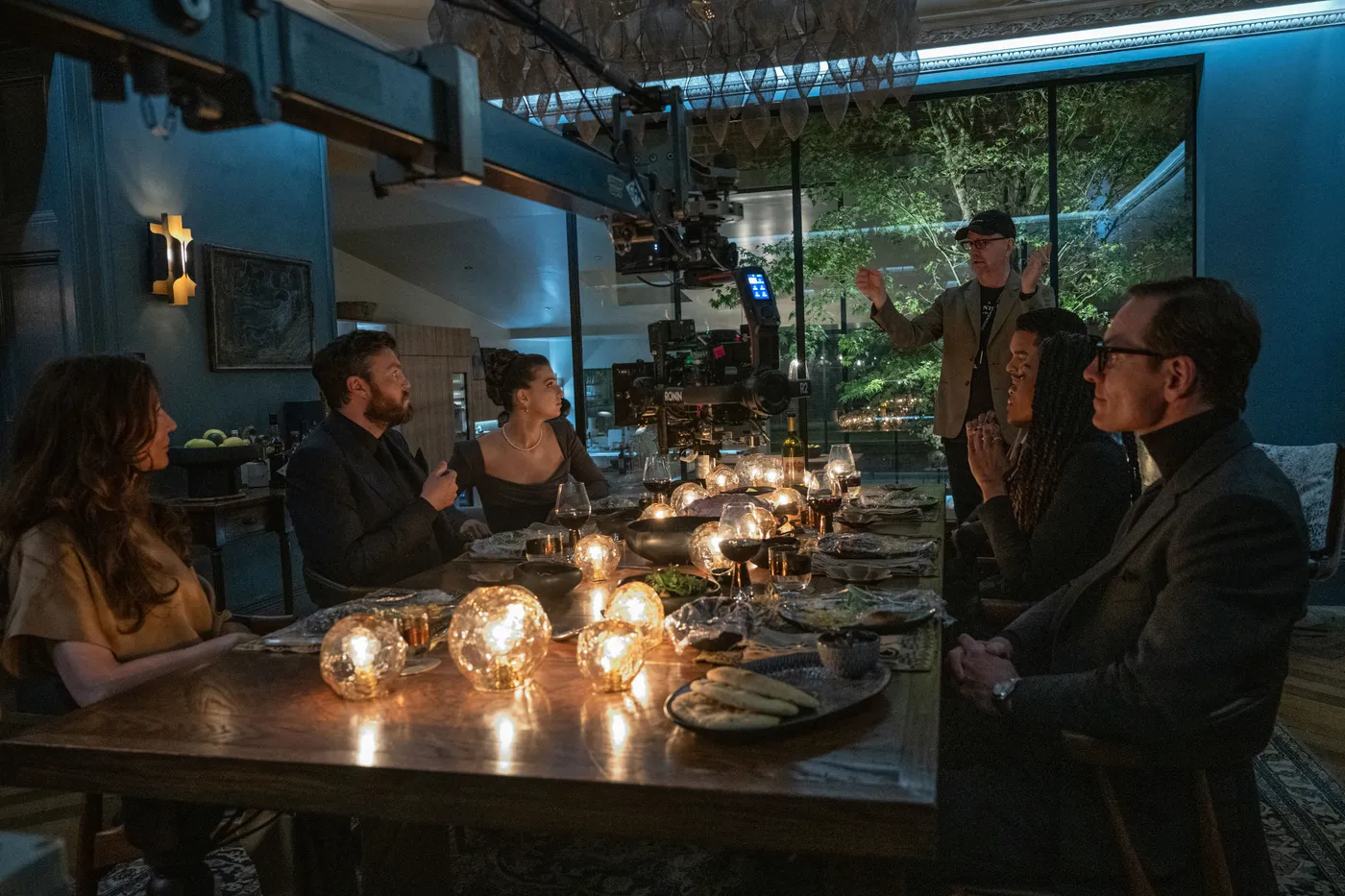
Steven Soderbergh, in a sporty manner, does not slow down and opens his 2025 without long pauses. We talk about his new project “Black Bag” – an energetic but contemplative art thriller
Spy movies are the most occipital subgenre of cinema. The narrative style of secret powerful organizations not only implies but directly states the merging of the observing subject and the observed object, awakening a paranoid itch in the viewer and involving them in a space of ocular violence, violence as a game of implicit gazes, gazes as means of total control.
It is no coincidence that the contextual symbol of the current century has become the hero of the Hitman game series – Agent 47 and the barcode on the back of his head, which is also extremely symbolic. Commodity fetishism has overcome the stage of “direct” desire and derived a new formula, according to which redundancy has hidden from our eyes behind technology, distribution tools, and ways of viewing for the potential buyer.
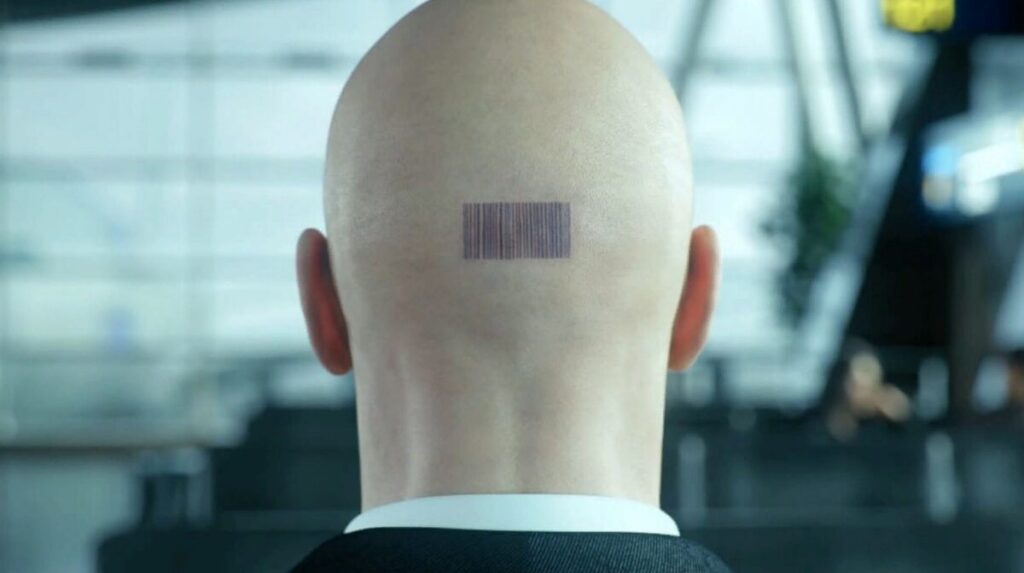
The barcode is the back of the head, a vulnerable area of impact and a blind spot, but also, the barcode is reliable when it comes to visual comprehension of reality: without scanning, it says absolutely nothing about the product, cutting off any attempts to establish communication.
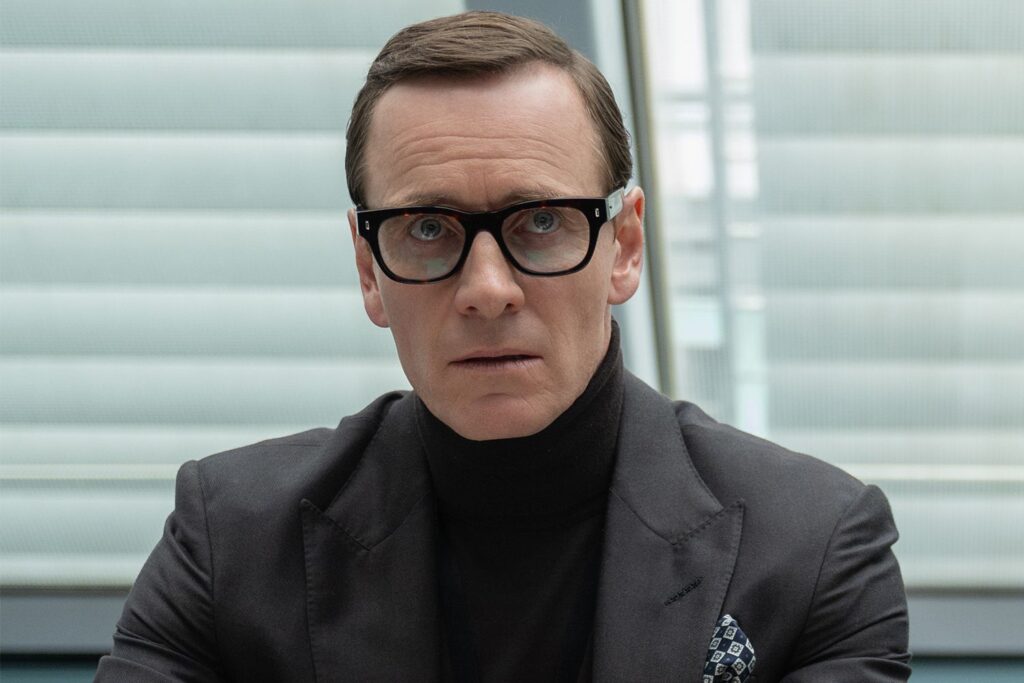
47, 007, Jason Bourne, Lorraine Broughton not only allowed actors to perform but also affirmed the self-worth of the “rear” perspective. This leads to a quite natural question: what is the back of the head of the namesake of British satirist George Woodhouse, played by Michael Fassbender? Neatly trimmed, not protruding, sometimes covered by a headdress – nothing outstanding.
To be honest, the cameraman forgot about Woodhouse’s back of the head, and the cause was hardly professional negligence, but rather the directorial intent of Steven Soderbergh, because his character is an agent secondarily; first and foremost, he is a faithful and loving husband. “Black Bag” is not only the title of the film but also a code phrase that allows secrets to be kept within a large spy family.
An island of trust amid the seething of corporate secrets is the marriage of Woodhouse and Kathryn (Cate Blanchett). They seem to be the only ones who manage to balance work and family life, but one day, data about the secret program Severus disappears from British archives, and Kathryn and four other agents fall under suspicion by the security service. George Woodhouse himself must identify the traitor, and it is with this difficult situation that the viewer is left after the film’s prologue.
What is the director afraid of?
For devoted fans, Soderbergh has long been associated with the anxiety and unease of an ant under the observation of a myrmecologist, with distrust of means of recording and reproducing visual information.
Video and photo inspection with intrusive optics monopolize the meaningfulness of human relationships, expose childhood traumatic secrets, erase the boundaries between feelings and sex, and therefore cannot discern the former in the latter. Surveillance and panic were the focus of Soderbergh’s feature debut “Sex, Lies, and Videotape,” as well as later works (“Kimi,” “Unsane,” “Schizopolis”). The director even took on Kafka, whose characters are unimaginable without the mark of another’s gaze on their back.

“Black Bag” finally breaks with the back of the head. The author no longer feels a nagging subpectoral anxiety, nor does he infect the viewer with it. Not long ago, Fassbender lay as the nameless Killer on a sniper position for Fincher, eye to the scope, and now he is a theatrical agent with a Shakespearean worldview and Byronic romantic wildness.
We see Woodhouse with unbearable clarity: his mouth involuntarily opens from fear, his avatar is always detached from the character and turned frontally to the audience. In a world where trust does not exist, Soderbergh stops greedily framing the image on Eurydice and allows Orpheus to simply believe. George and Kathryn love each other, their love is more important than conspiracy and classified projects; the great feeling remains beyond suspicion.
Old approach, new stage
We must dare to state that Soderbergh regularly “crashes” his cinematic stocks with some thoughtless experiment or Hollywood hackwork, but “Black Bag” is the most coherent and auteur film in the last twenty years of his busy directorial career. One wants to believe in a certain stage-by-stage nature, the root influence of “Black Bag” on Soderbergh.
No, of course, he will not step away from the conveyor-belt type of production, nor will he come to love a meaningful creative pause – he is a creator of a different constitution, but nothing prevents us from taking advantage of the situation and saturating future films not with a diagnosis of the disease, but with a cure for it. The formula was derived in “Black Bag”; all that remains is to distribute the components into flasks and turn on the centrifuge.
Ultimately, “Black Bag” simply succeeded. After filming “Sex, Lies, and Videotape,” Soderbergh stated: “this is the only film I’ve ever made where I felt I had all the money and all the time I needed.” A phrase from 36 years ago has visited our days to land like a butterfly on the tip of its creator’s nose and inspire the already battle-hardened veteran of festival cinema.
All we have left is to count on our fingers. “Black Bag” is, firstly, a cunning and shameless spy feud, secondly, a tender and passionate erotic thriller, thirdly, a visual correspondence of the author’s psyche, and fourthly, an underground fountain of optimism from someone who is not at all disposed to optimism.
Trailer:
Comments
0No comments yet.
Sign in to join the discussion.