

We tell about the craziest film of recent years – the wild auteur experiment of rocker and revolutionary Sogo Ishii 'The Box Man'.
"But everyone wants to look and doesn't want to be looked at" (c) Kobo Abe.
There is an opinion that film theory does not exist because any film theory turns out to be borrowed from another field. Even Sergei Eisenstein's famous dialectical montage is, in fact, an interpretation of Chinese writing.
Perhaps the largest tonnage of references in film theory came from psychoanalysis. But how could it be otherwise, given the deformation of the author's image in the 20th century and the fashion for Freud? And now the author is no longer some writer or musician, but a director—an unstudied, bizarre creature, a subject for scientific speculation. And yet, the creation, in this case, has displaced the creator.
The older cinema grew, the more closely researchers paid attention to its internal structure, so Sigmund Freud receded into the background, and his place was taken by Jacques Lacan and the conduit of his ideas into modernity—Christian Metz. Their views proved more universal and focused directly on cinema, rather than on reverse psychology.
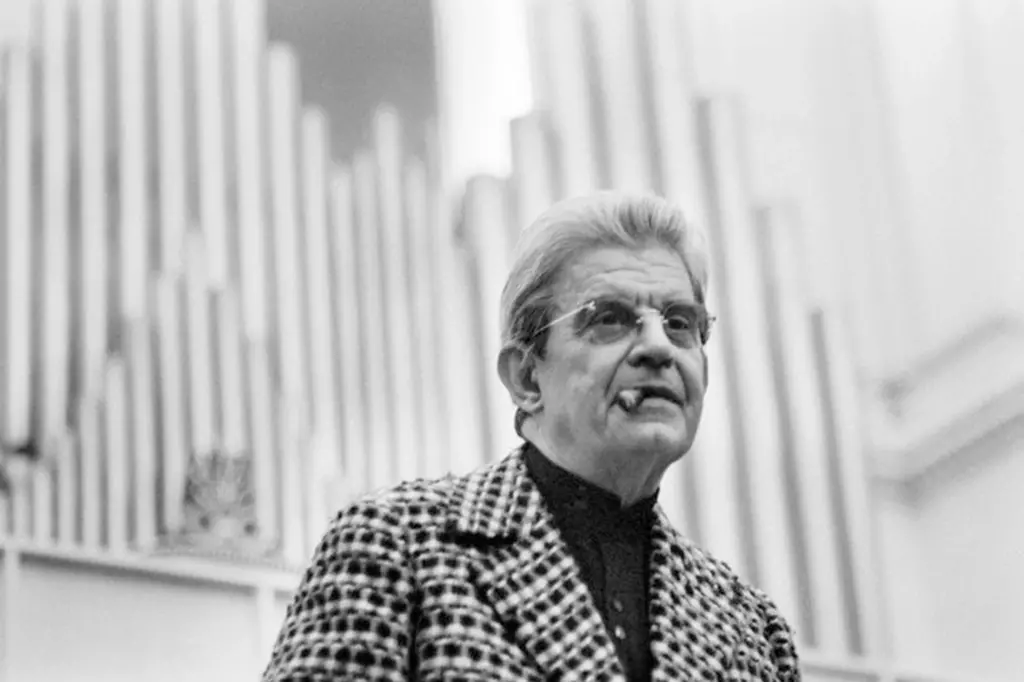
The central concept here is scopophilia, which speaks to the natural desire of an individual to peek and simultaneously be the object of another's gaze. These two factors influence the healthy and harmonious development of the human psyche, and it is precisely their synthesis that the hero of Kobo Abe's novel and Sogo Ishii's film adaptation lacks to maintain his sanity.
Musicians on the Barricades, Mutants on Motorcycles
"The Box Man" or, as it was adapted in Russia, "The Box Guy"—is an immensely irrelevant film because Sogo Ishii never knew how to make commercially or award-winning successful movies.
His professional career started from his university days, and this is a case where the student revolutionaries and their supporters failed to spread their new wave. Sogo Ishii and his comrades were absorbed by subcultural phenomena and did not care about the coherence of thought or the desire to convey it.
One of the director's first projects is Burst City—a futuristic action film about a motorcycle gang of quasi-mutants. The film is billed as a dystopian punk rock musical featuring the cult band THE STALIN (named after the leader), founded by socialist activist Michiro Endo. Even within the framework of a critical article, this combination sounds like a screamer, not so much frightening as incomprehensible and unexpected, though it explains a lot.

Sogo Ishii is a protest musician making low-budget films with like-minded people. He was like that in 1982, and nothing has changed since Burst City. Except that the new films have lost their former pace and ultra-high-speed revolutions, but this is a conscious artistic decision by the aging Ishii:
"When I was young, all I could think about was speed. Then I wanted to start slowing down the pace a bit—now both are important"
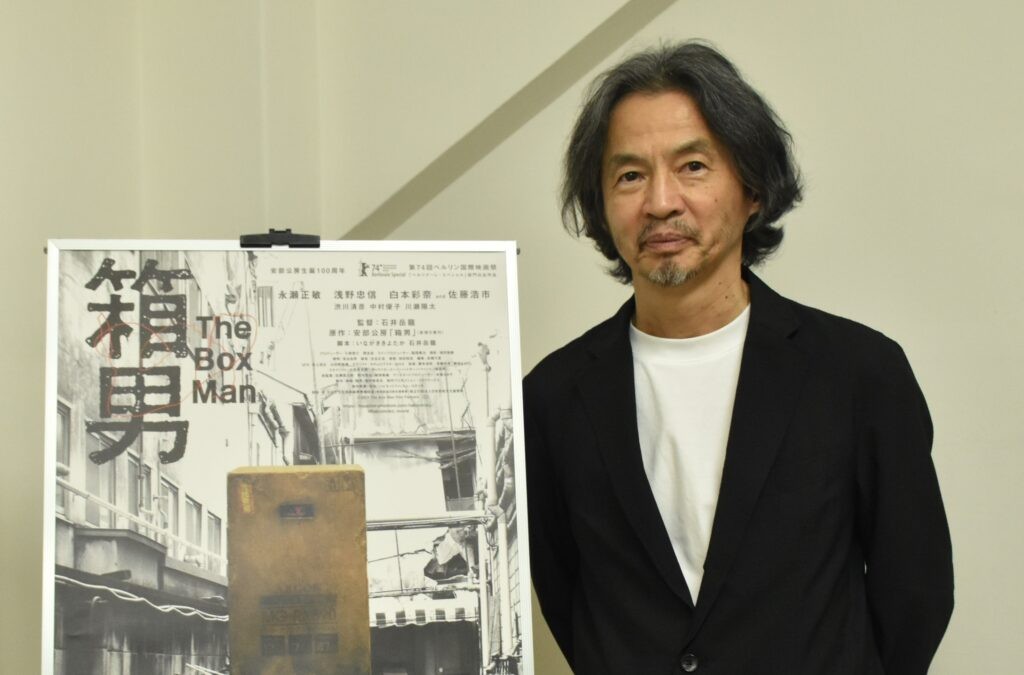
Having bankrupted Suncent Cinema Works, worked as a teacher at a design university (a contradictory choice for a former anarchist student), made a few more films, and twice taken a ten-year break, he returned in 2024 with a film adaptation of Kobo Abe's novel "The Box Man."
The Swan, the Crayfish, and the Pike
During his lifetime, Abe trusted only one filmmaker—Hiroshi Teshigahara. Their joint journey was interrupted by the film "The Ruined Map" in the late sixties, missing the programmatic novel about an inhabitant of a square-shaped cardboard container that turns out to be a labyrinth.
The year 1992 turned out to be "favorable," when anti-novelist Kobo Abe and restless Sogo Ishii met and even settled the rights for the film adaptation, but the project never took off because a year later the great writer died. The rights passed to his daughter, who saw "The Box Man" as a meditative slow-burner, while her father and Ishii had agreed on an entertaining film. However, Sogo Ishii didn't know how to make either, and then due to financial troubles, the film was shelved and gathered dust until 2022.
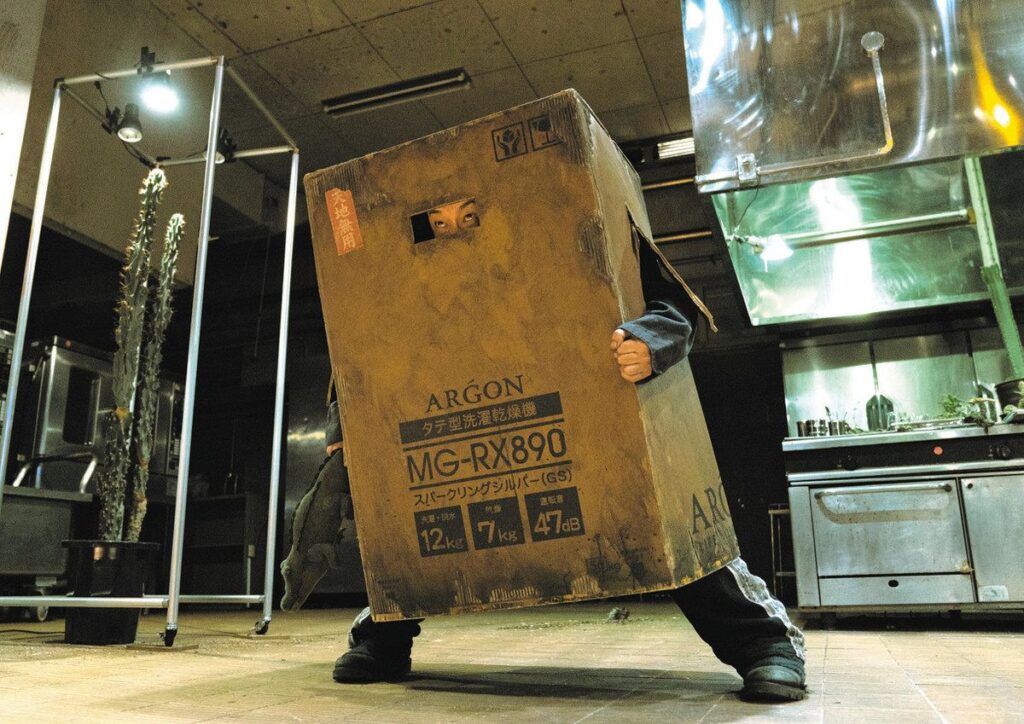
In the cavalcade of narrative plans of a type 3 novel, it is difficult to dig up the central axis and form a synopsis, so we will settle on the following version: a photographer once noticed a weirdo in a refrigerator box and was so amazed by what he saw that he adopted the image of the sudden guest. Now he is a "box man"—no longer an ordinary citizen, but not a beggar either, but someone completely different.
The director faced an extremely difficult task: to clothe a conceptual novel with a stained-glass structure and vague goals in a visual performance that would justify years of expectations. And he did it, but as always, in his own way.

A Diorama of Japanese Culture
Geek and accelerationist, cyberpunk pioneer Ishii carefully treated Kobo Abe's ideas about the sticky nature of the "alien" gaze and self-identification, but transformed the panoptic space into a costumed attraction. Sogo's flirtations with Japanese pop and subculture deserve special mention. The duel of two "box men" is clearly inspired by the internecine battles of kaiju or mecha, and their plasticity and acrobatics adopt the hand-to-hand style from martial arts films.
Incidentally, the bestiary of the "box man's" opponents includes the "spear man," hung with jangling tin badges. Their confrontation in the book is given insufficient attention, and the film, trying to fill the gap, does not skimp on a five-minute chase followed by mutual beating, prioritizing sardonic comedy and action.
This reflects Sogo's approach to adapting Abe. The idea of the book is sacred and immovable, which somewhat poisons the spirit of absolute freedom on which the director grew up, but this does not prevent him from speaking in a made-up language about less significant things not involved in the narrative.
Music grants the director such an opportunity, and he unceremoniously sheds the weight of literary context to plunge into the historical, closer to the end of the 70s, the era of cultural degeneration and the triumphant rise of Japanese sound. The film's sound design is the essence of interaction between what happens on screen and dense musical inserts.
Everything we hear in the film "The Box Man" is no longer even punk, but noise—an explosive chaos of detuned guitar and electronics with a formless combination of absence of melody and harmony and a rhythm that occasionally reminds of itself. The music "shoots" episodically and fragmentarily, and then does it again and again, without need or motivation. It is capricious, meaningless, pre-reflective, and therefore beautiful and never losing relevance, which cannot be said about the film itself.
Already now we can assert that "The Box Man" looks like a failed project in the minds of those who have seen it. A film intended for festivals did not become even a local phenomenon and was ignored by critics, but this is not a problem at all, but a constitutive feature of Sogo Ishii's creation.
There is only a very small probability that someone will stumble upon this film by chance. Getting to see "The Box Man" is like grabbing a ticket to a punk concert from the bandaged hands of a striker (dubious and precious at the same time). But if the viewer manages not to get stuck at the entrance and squeeze through to the stage, then Sogo Ishii's work will remain at least a bright hangover stain, and at most will enter the pantheon of favorite "filmic" memories.
Trailer:
Comments
0No comments yet.
Sign in to join the discussion.