


“Parthenope” masterfully combines mythology, philosophy, and self-discovery in a captivating narrative. We offer an analysis of its key themes and symbolism.
“Parthenope” is a new film by Italian director Paolo Sorrentino, weaving together mythological motifs, atmospheric, almost dreamlike visuals, and a deeply personal story. Since its release, audiences and critics have been actively discussing its all-consuming pursuit of beauty, the mystical presence of Naples (as both a real city and a metaphor), and the elusive journey of the protagonist toward herself.
Below, we break down the most important themes and symbols of the film: from Parthenope as a modern version of the siren to the cyclical nature of her life, where youth and loss seem inevitable.
Warning: Spoilers ahead: the following sections discuss key events of the film.
Plot Overview: The Journey from the Sea to Self
Parthenope (the stunning debutante Celeste Dalla Porta) first appears as a figure “born of the sea,” vividly embodied in the striking scene of her “water birth” in the Gulf of Naples in 1950. Right from the start, there is a reference to the Greek mythical roots of her name. The action then shifts to 1968: Parthenope emerges from the sea—a symbolic “birth” of her consciousness—and begins her journey through the streets of Naples.

The viewer sees the heroine undergo transformations: from carefree youth to a serious interest in anthropology. Along the way—strange romances (with a mafioso and a bishop), a tragic love triangle between her, her brother Raimondo, and longtime friend Sandrino, as well as attempts to become an actress.
Each new step both nourishes and undermines her sense of self, and eventually she returns to science under the guidance of the only person who values her mind almost as much as her appearance. All the while, she realizes that her beauty attracts people and opens doors, but at the same time turns her into a kind of “object” of others’ admiration.
Parthenope as Myth and Metaphor
The name “Parthenope” directly references the Greek siren Parthenope, whose body washed ashore at Naples, establishing a link between the woman and the city. In Sorrentino’s version, Parthenope is a “modern siren,” enchanting everyone who falls into her field of vision but never fully revealing herself. This idea is reinforced by the constant presence of the sea, which serves as both a literal and symbolic “anchor.”
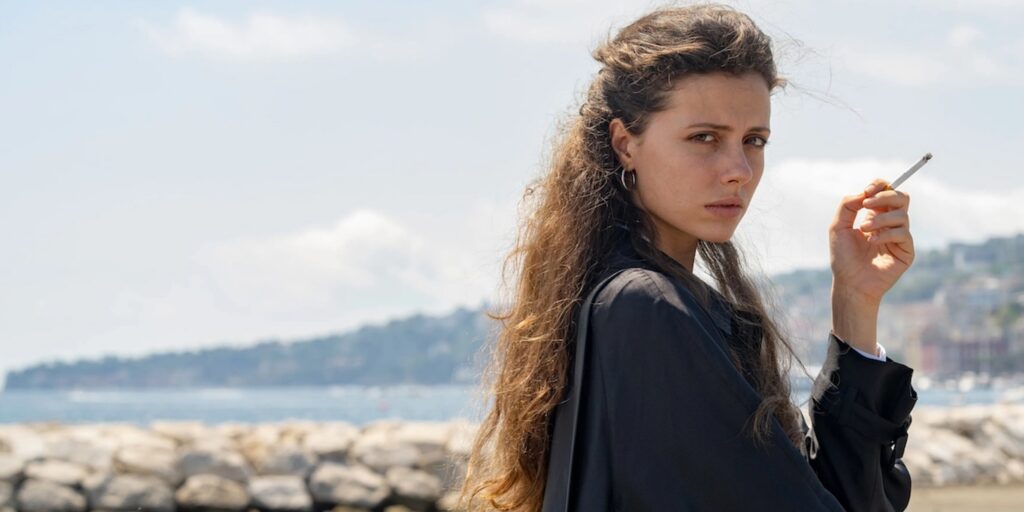
However, Parthenope here is not a supernatural being, but a young woman who realizes how powerful a weapon her combination of beauty and intelligence can be in a male-dominated world. This “double gift” becomes a double-edged sword—much like the mythical sirens who simultaneously mesmerized sailors and lured them to their doom. Parthenope is attractive, yet distant and unfathomable, as if remaining at the center of attention while not being fully seen.
Naples: The Attraction and Trap of Home
Paolo Sorrentino, in keeping with his established tradition, shows Naples not just as a backdrop, but as an independent character, largely reflecting Parthenope’s complexity. The city’s streets are sometimes filled with music and festive cheer, sometimes plunged into the darkness of corruption or falling victim to a cholera outbreak.
In several scenes—for example, when fireworks light up the bay on New Year’s Eve—Naples seems almost like a utopian land of color and life. In others, it evokes claustrophobia, from which Parthenope cannot escape.
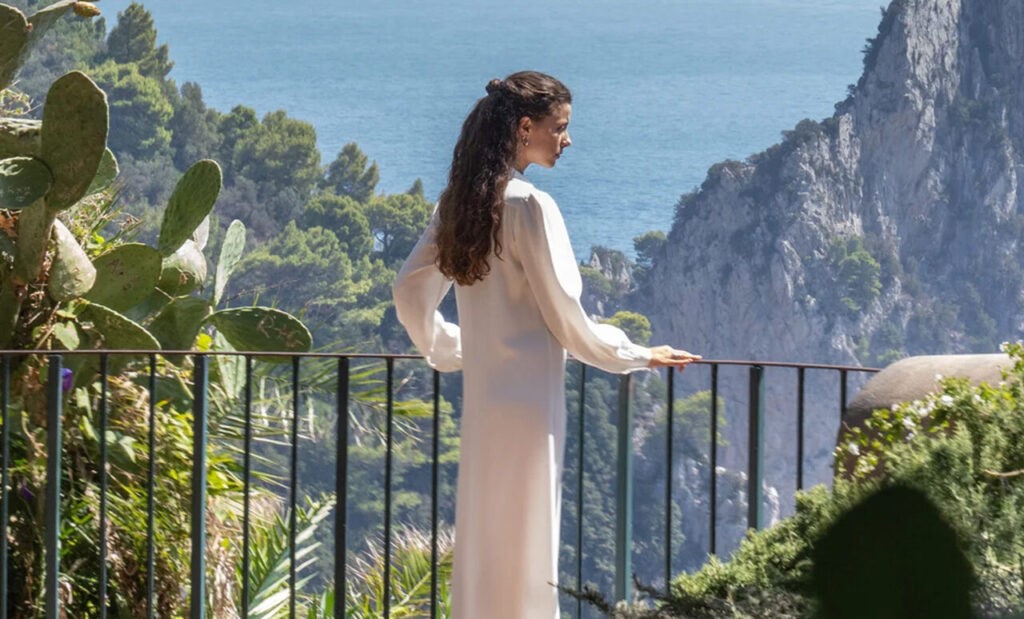
The city acts as a magnetic field, pulling the heroine back, and simultaneously embodies both light and darkness, joy and destruction. This duality underscores one of the film’s central ideas: the environment shapes identity. The beauty of Naples becomes both a blessing and a burden for the heroine—just like her appearance. She can leave, but the city does not let her go, even from a distance.
Youth, Beauty, and the Gaze of Others
The theme of youth and beauty is one of Sorrentino’s long-standing fascinations, and for Parthenope, it is a central internal conflict. From the very first frames, she is perceived as an object of desire, inspiration, and worship. This constant attention influences all her decisions. Even when she tries to hide behind textbooks at the university, her “magnetic aura” seems to block access to her intellect.

In Sorrentino’s refined visual style, Parthenope is always surrounded by soft, enchanting light, further giving her an aura of an unattainable entity. At the same time, the viewer sees that the heroine is not devoid of intelligence and asks quite insightful questions in anthropology lectures. But the people around her often ignore her thoughts, gazing only at her face and figure. This raises the question: is it possible in our world to separate youth and beauty from exploitation, when society is so greedy for external glitter?
Identity, Fate, and the Thirst for Meaning
Parthenope’s desire to understand her own nature is reflected in her choice to study anthropology: by trying to understand people and their motives, she tries to understand herself. But at every step, she is confronted with the fact that others see in her only an “object of desire”—whether it be suitors, her domineering brother, or a disillusioned writer.
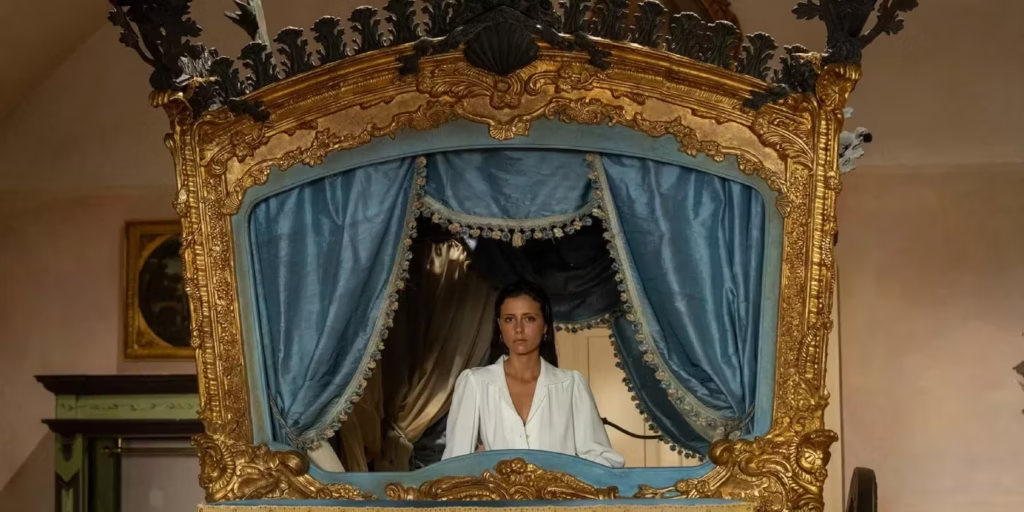
Everything is compounded by a family tragedy—the suicide of her brother Raimondo, who was hopelessly attached to her. This event disrupts the usual course of things and awakens in the girl a sense of guilt that, on one hand, pushes her toward new goals, and on the other, prevents her from living peacefully. She temporarily turns to acting, trying to sever ties with the past and escape Naples. But fate seems tightly intertwined with her story, as if the city itself has inscribed her into its myth. Does Parthenope herself agree that one cannot escape fate, or does she still believe in free will? The film only hints that this burden will follow her wherever she goes.
Symbolism, Surrealism, and Sorrentino’s Authorial Signature
Sorrentino’s signature “dreamlike” episodes permeate the entire film, adding a soft touch of fantasy to reality. Sometimes these scenes are simply spectacular: for example, an extravagant helicopter ride with a wealthy man or an elaborate “reconciliation” ceremony between two mafia clans. At other times, they carry a dark undertone, highlighting the severity of the cholera epidemic or revealing the corrupt side of church officials.
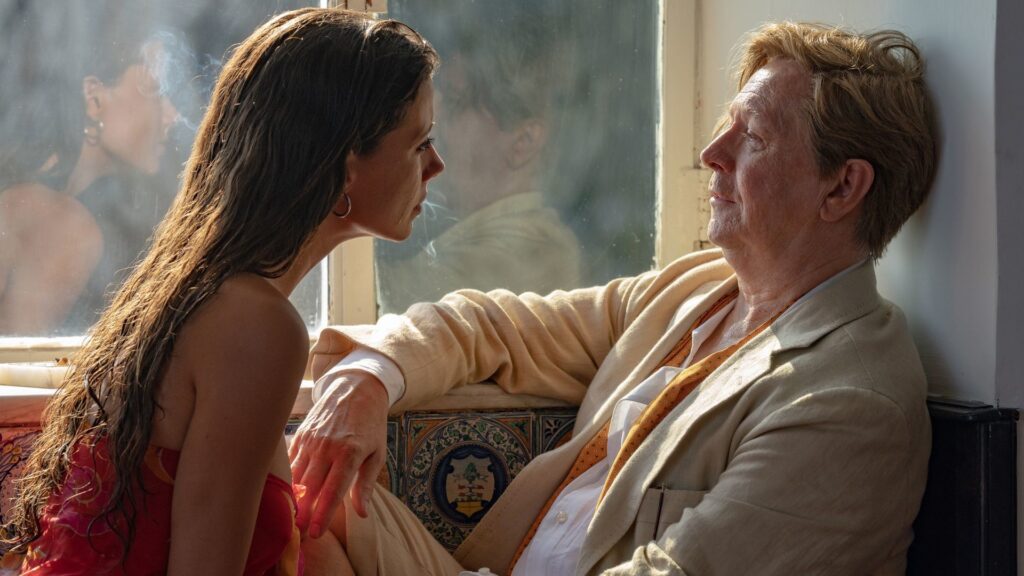
Almost every episode conceals a deeper meaning. When a lavish city festival suddenly intersects with a funeral procession, it literally shows the clash of life energy with the inevitability of death. Parthenope’s encounters with famous people (among them a slightly tipsy John Cheever, played by the ever-brilliant Gary Oldman) illustrate the struggle between creativity and desire, beauty and suffering. Such details may seem independent of the main plot, but together they create a cohesive picture: beauty, tragedy, passion, and the search for self intertwine in this mythical city that seems to hover between reality and dream.
The Ending: Reconciliation with the Inevitable
In the final scenes, we see Parthenope decades later (played by Stefania Sandrelli). She is no longer the carefree young girl, and Naples still seethes with its passions. Having returned, apparently in search of answers—or, like a true siren, simply heeding the call of her native shore—she witnesses jubilant crowds celebrating the victory of their beloved football club. In this fiery fireworks of fan joy, the indomitable spirit of Naples is palpable.
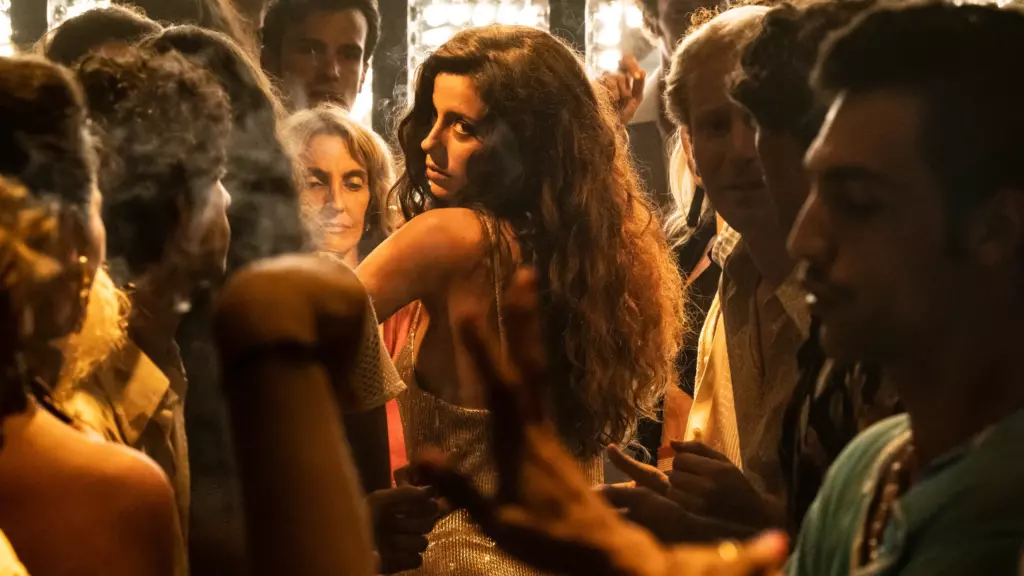
The reaction of the aged Parthenope—a slight, slightly weary sigh—speaks not of defeat, but rather of acceptance. It seems she finally understands that her own story and the city’s story are inseparable. She spent her whole life trying to escape the magnetic field of Naples, but remained tied to it. Like the mythical siren, she will always be part of this place, and the place itself part of her. The legend of Parthenope continues to live in the memory of the townspeople, inextricably linking hope and doom.
“He Is Made of Water and Salt, Like the Sea”: Professor Marotta’s Son
Among the most discussed scenes of Paolo Sorrentino’s latest film is the one featuring Professor Marotta’s son, played by Alessandro Paniccia.
From the beginning, we know that Marotta has a son with special needs, and that he hesitates to introduce him to Parthenope. The reason? More than the professor’s lack of readiness, it is Parthenope’s own lack of maturity needed to meet him.
Toward the end of the film, we see the professor’s son: he suffers from macrocephaly, a disability that makes him appear, even in behavior, like a child in a giant’s body.
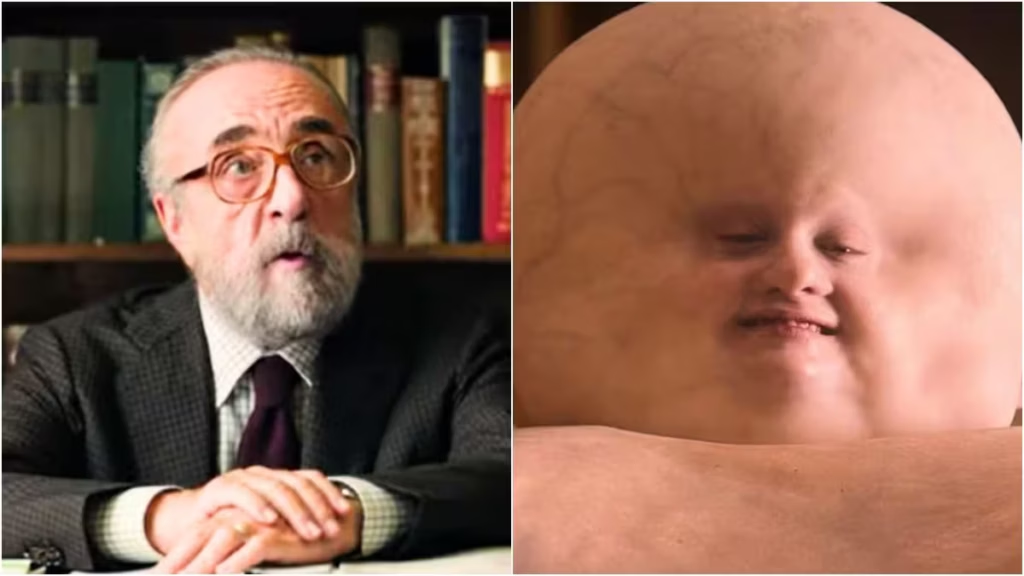
“He is made of water and salt,” Professor Marotta says, while Parthenope replies: “Like the sea.” After observing him, Parthenope comments: “It’s beautiful.” And the professor nods.
The scene has a strong emotional and symbolic impact. However, Paolo Sorrentino does not provide definitive explanations, preferring that the public freely reflect on the topic. In an interview with La Verità, the director noted:
This person seems beautiful and amazing to me, and perhaps evocative for the viewer. The moment I explain it, it loses its meaning.
The professor keeps his child a secret, which likely speaks to children with disabilities who, in past generations, were often silenced or hidden.
Conclusion
“Parthenope” is a lush yet deeply personal story about beauty, self-identity, and fate. The heroine embodies both strength and vulnerability, much like the city that gave her its name and myth. Sorrentino leads the viewer away from a classic linear plot toward incredible visual metaphors and a chain of tragic events, creating a unique atmosphere at the intersection of reality and dream.
Ultimately, the interpretation of Parthenope depends on the viewer’s perception: do you see in her a siren trapped by her own beauty, or a rebel striving to break free from the shackles of fate? The film leaves us with questions that extend beyond the screen: how much does the place where we are born influence us? Can we break this bond? Are we doomed to repeatedly experience the same cycles of fate, or can we rise above it? For Parthenope, the answers remain in the boundless sea—calling each of us to hear our own “siren” within.
Trailer:
Translation and adaptation of materials from What's After the Movie? and Fanpage
Comments
0No comments yet.
Sign in to join the discussion.