
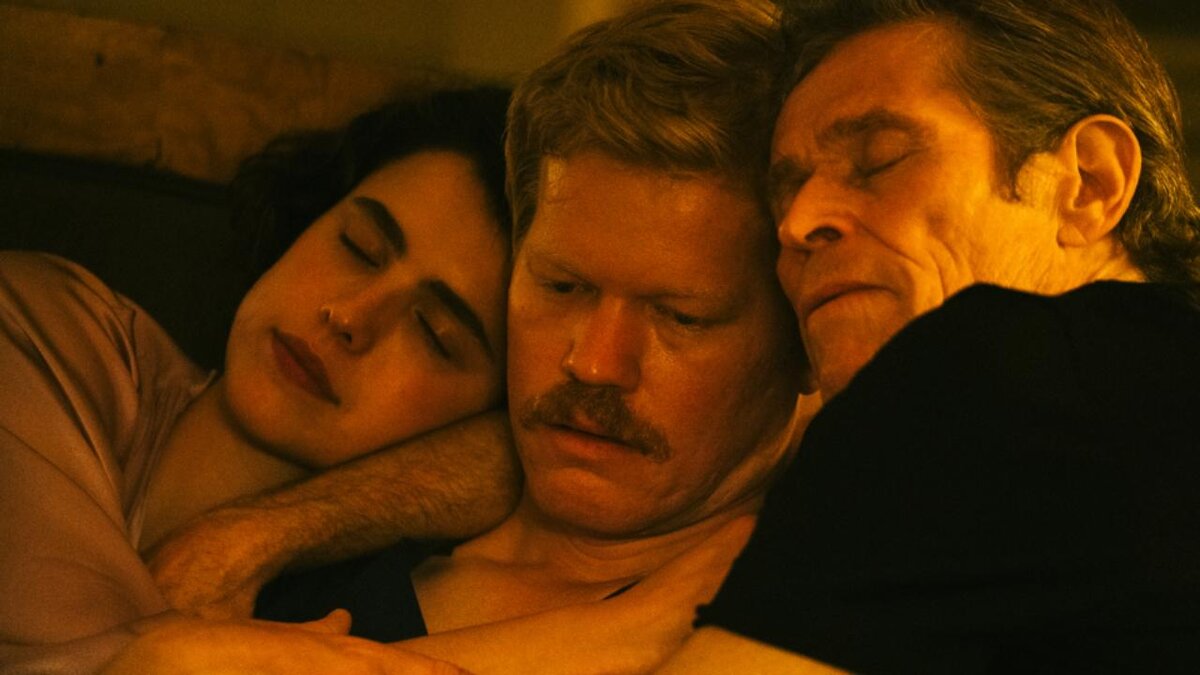
On August 27, the digital premiere of Yorgos Lanthimos' absurdist comedy 'Kinds of Kindness' took place. The anthology film stood out at Cannes and won the Best Actor award, which went to Jesse Plemons. The Greek director's new film, with big-name ac...
Less than a year after the Oscar-winning 'Poor Things', Yorgos Lanthimos has already reunited with screenwriter Efthymis Filippou (they previously worked together on 'The Lobster', 'The Killing of a Sacred Deer', and 'Dogtooth'). The new film also carries over the creative duo from its predecessor — Emma Stone and Willem Dafoe.

'Kinds of Kindness' is three stories connected ideologically and aesthetically. In the first, Willem Dafoe, like a sword of Damocles, looms over office worker Robert, played by Jesse Plemons. The all-powerful boss completely controls his subordinate's life, but when faced with a complex moral question, the hero awakens to the principle of non-violence and rebels. The second story features an unreliable narrator (again Jesse Plemons), who suspects his wife has been replaced. The viewer is never quite sure: is Daniel going mad, or is Emma Stone's character truly an impostor? The third part tells of cult members searching for a girl named Emily, who can raise the dead. The cult itself is characterized by polygamy, water worship, and strange rituals.
Calling 'Kinds of Kindness' a tragicomedy is somewhat inaccurate: it violates the basic rule of tragedy — the protagonist's struggle against circumstances and the loss or death resulting from that struggle. Yorgos Lanthimos' film is more of a mocking comedy, filled with cruelty and violence.

'Kinds of Kindness' is based on two things: Albert Camus' philosophy of the absurd and the ancient Greek concept of fate. In all three stories, the heroes try to rebel, entering into conflict with the world around them, but within the film's conditions, it leads nowhere. Camus wrote about this: 'Strictly speaking, the feeling of absurdity is this discord between man and his life, the actor and the scenery.' However, in the film's canvas, this discord is neither resolved nor eliminated. And here comes the second pillar — the ancient Greek concept of fate.

Yorgos Lanthimos' characters are not in control of their fate — this is one reason they cannot resolve the unfolding conflict. In the first part, Robert resigns himself to circumstances, accepting his fate (this is Camus' 'acceptance of the absurd'). In the second part, Jesse Plemons' character fights, but in a mystical way. He knows exactly what to do to get results. And in the third part, Emily's protest ends very comically.
All characters in 'Kinds of Kindness' have a fate, a certain doom that unfolds methodically and, seemingly, tragically. The same rule applies as in Sophocles' 'Oedipus Rex': all actions of the heroes aimed at changing fate lead to the prophecy being fulfilled. Thus, all actions of Yorgos Lanthimos' characters lead to their protest being groundless.

The concept of fate and the philosophy of the absurd do not live separately on the film's canvas. 'Kinds of Kindness' is their synthesis. 'The elementary and definite nature of what is happening constitutes the content of the absurd feeling. In the dead light of fate, the uselessness of any effort becomes obvious. Before the bloody mathematics that sets the conditions of our existence, no morality, no effort is justified a priori' — this excerpt from Albert Camus' 'The Myth of Sisyphus' literally provides a full explanation of everything that happens on screen for over two hours.
But Yorgos Lanthimos also uses absurdity in its usual sense. He piles mystical details, metaphors, and symbols onto the thesis from 'The Myth of Sisyphus'. They have little impact on understanding the plot but create a special narrative tone. For example, the titles of the parts: 'The Death of R. M. F.', 'R. M. F. Flies', and 'R. M. F. Eats a Sandwich'. The mysterious R. M. F. indeed does all this, but what do his initials mean? Why is he the through-line character whose life gradually unfolds before the viewer? Perhaps it's a profound metaphor, or maybe it's just a mocking symbol.

The absurdity and ridiculousness of situations and characters' decisions intertwine with unpleasant scenes of violence, sex, frustration, and hopelessness. But it is this contrast that creates the basis for comedy in the film. Watching it does not feel heavy or painful. This is largely due to hyperbole, which governs everything: from exaggeratedly strange situations to the eccentric acting.
'Kinds of Kindness' is one of the most mysterious and deliberately incomprehensible films by the Greek director. Perhaps the desire to unravel this tangle of symbols and images, trying to find what it is based on, is already a violation of an unspoken agreement. Sometimes you really just need to relax and immerse yourself in this world, constructed by Yorgos Lanthimos and Efthymis Filippou, existing according to strange laws, because 'to state the absurd is to accept it'.
By the way, subscribe to our Telegram channel 'After the Credits' (here's the link). There we post posters, trailers, and various interesting and fun news from the world of cinema.
Comments
0No comments yet.
Sign in to join the discussion.