

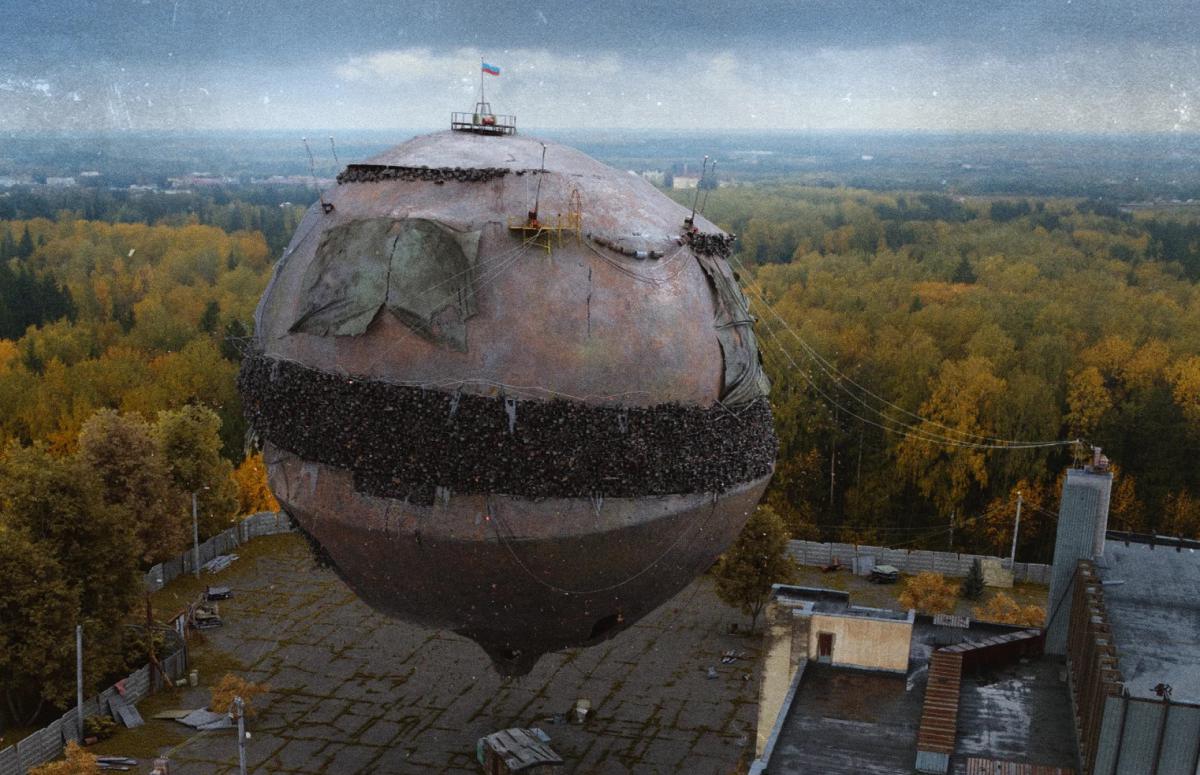
There are many films about aliens landing on Earth and trying to conquer it. But what if the aliens wanted not to conquer, but to assimilate? What would humanity do? In his debut film 'Contacts', Dmitry Moiseev shows one possible scenario using the e...
In the mid-20th century, aliens landed on Earth—biopags, popularly nicknamed Vitaliks. Having settled in, the extraterrestrial guests began actively producing a substance called prak. According to scientists, prak could cure humans of any disease, so this substance was hunted.
The main character Nina works in one of the laboratories studying biopags. But she herself has not had direct contact with them. The girl dreams of escaping her backwater town, curing her sick father, and living in harmony with her boyfriend. But one evening, Nina personally encounters a Vitalik and learns something about the alien creatures that she will never forget.
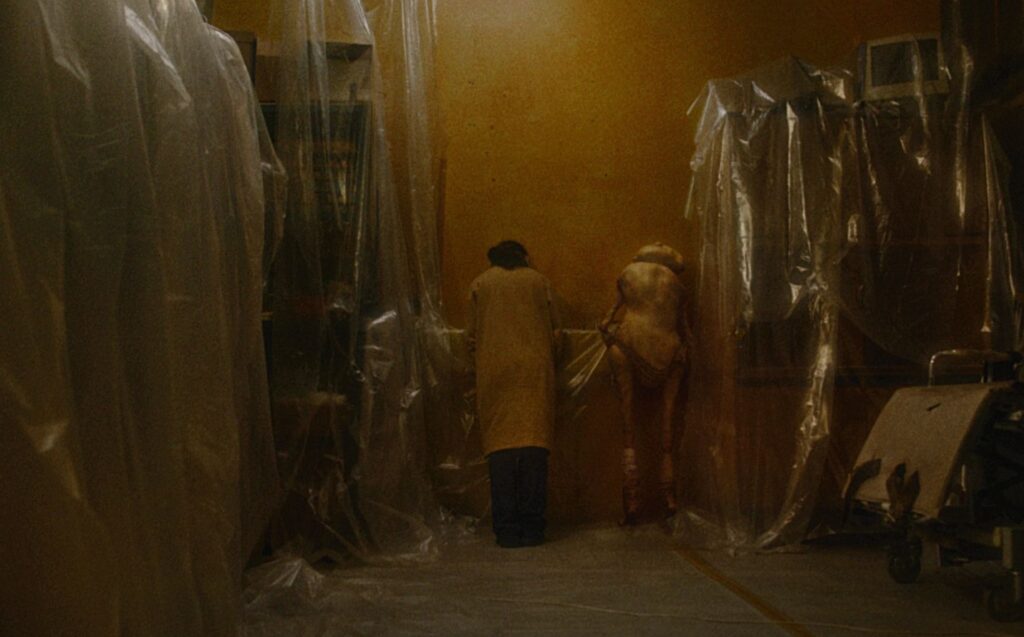
In recent years, science fiction has not been a frequent guest in modern Russian cinema, and when it does appear, it is often an auteur low-budget statement about humanity through the extraterrestrial. And 'Contacts' by director Dmitry Moiseev is another example of domestic indie sci-fi that deserves to be seen by as many viewers as possible.
What impresses in this film? A lot. First, it is striking how detailed the alien world inhabited by the visitors is thought out. We are introduced to new terms and shown how the arrival of extraterrestrial settlers affected Earth's culture and life. Everything is shot in a pseudo-documentary style, creating the feeling that the director knows something about our history that is not taught in official textbooks.
Second, the choice of location. Filming in the Russian hinterland is not new, but sci-fi is usually shot in big cities to show the scale of destruction against a metropolis backdrop. For example, in 'Attraction' by Fyodor Bondarchuk. Or at least they insert news reports talking about the scale of the extraterrestrial event. In 'Contacts', the setting is a godforsaken place on the outskirts of the country, beyond which we never venture. This adds both dreariness and hopelessness to the story, as well as groundedness and intimacy. The fantastic merges with the real, creating a unique tone for the film. As a result, we do not lose touch with our world when we see an alien or spaceships in the style of 'Arrival' by http://Denis Villeneuve. The sci-fi is embedded in reality, rather than carrying us away on waves of fantasy.
Third, minimal use of computer graphics. Despite a small budget, the creators developed a real puppet weighing 50 kg, and then used technology to make Vitalik's movements more natural. The alien's design seems reminiscent of the creature from 'E.T.' by http://Steven Spielberg, but the final appearance is the result of several sketches in which the director and his team tried to create a being that was neither scary nor kind. Thus Vitalik was born.
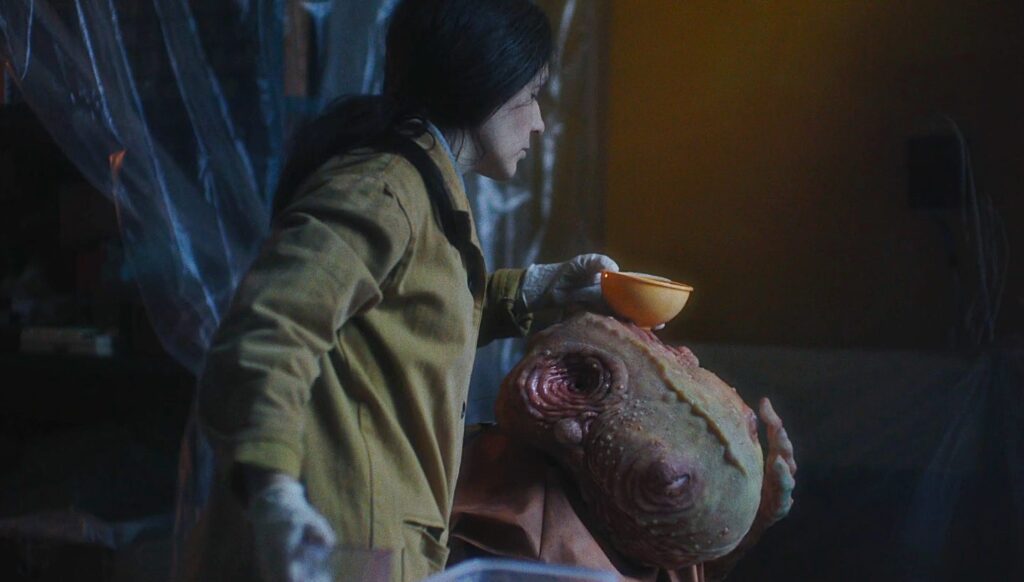
Moreover, there was a lot of fuss with the puppet. According to Dmitry Moiseev, it constantly changed color and had to be regularly touched up, its skull was cracked, and it sometimes fell on the actress. To show the humanoid's 'breathing' in scenes, three people stood behind the puppet and blew air into it through syringes.
Another value of this rather melancholic and even apathetic film is the variety of themes. Here, church representatives argue with scientists, with neither side able to find a worthy answer to the question—why did the aliens come? But around this topic, a powerful fan base of conspiracy theory lovers has formed. Because people love to believe in something. So the aliens are literally milked for a life-giving liquid that supposedly cures everything. And between the lines, one can feel satire on politics and society. We are shown how humanity's encounter with an extraterrestrial race changed the former, exacerbating many vices and superstitions.
Moreover, the aliens in the film are not only objects of study but also subjects influencing humans. TV hosts scare and warn that contact with Vitaliks causes a desire to change life, abandon imposed societal rules, and escape from this chthonic reality. This may contain criticism of any propaganda, for example, of those social norms that do not take into account individual characteristics. This idea, like most others, is often presented in the film through humor, comic images, and situations. But when the laughter ends, tears well up.
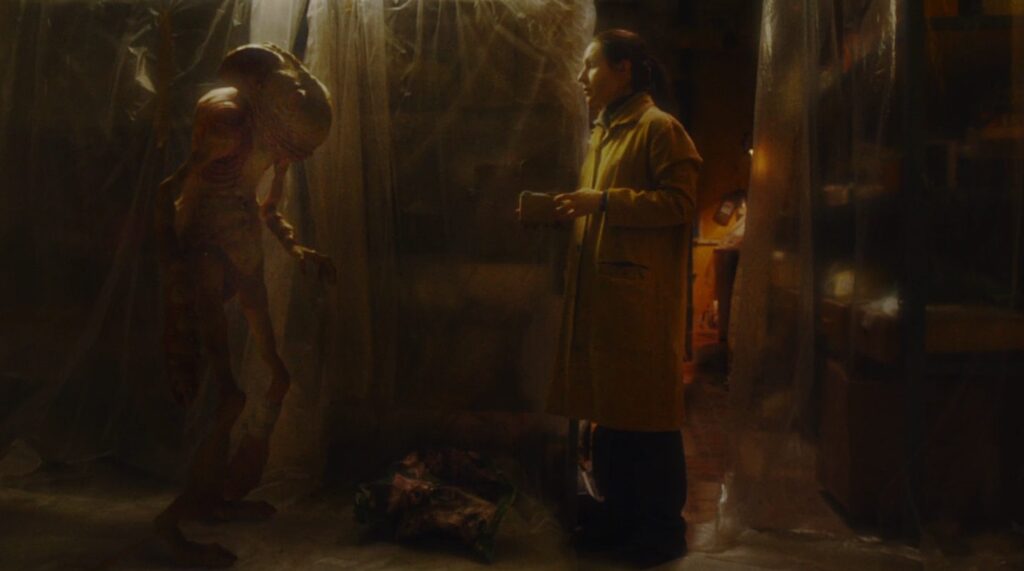
But the main leitmotif that cuts through the entire film like a prominent contour is humanistic. Let us be kinder, cherish and respect each other. This sincere message is read in every action of the main character played by Irina Salikova, in every alien breath of Vitalik, even in the sadness and hopelessness that surrounds all the film's characters. We are reminded once again that movies about aliens are always movies about people. And if humanity has lost contact among itself, then what aliens are we talking about? The depth of the drama in 'Contacts' lies precisely in the absence of deep, close communication. No one truly loves anyone, no one is sincerely attached to anyone, and any contact is rather a deal that holds as long as it is beneficial.
Dmitry Moiseev admitted that the film's concept originated from one idea—a woman caring for a sick alien. And onto this, he built all the relatively brisk action involving bandits and illegal experiments. But conflicts and incidents still remain in the background; they cannot overshadow the sincerity and even naivety of the main authorial statement. After all, selfless philanthropy is a necessary trait of the human personality, on which our moral compass is built, and thanks to which our civilization has a chance to survive for a few more hundred years. And in difficult times, when mercy and compassion go out of fashion, it is important that someone reminds us of what matters.
Comments
0No comments yet.
Sign in to join the discussion.