
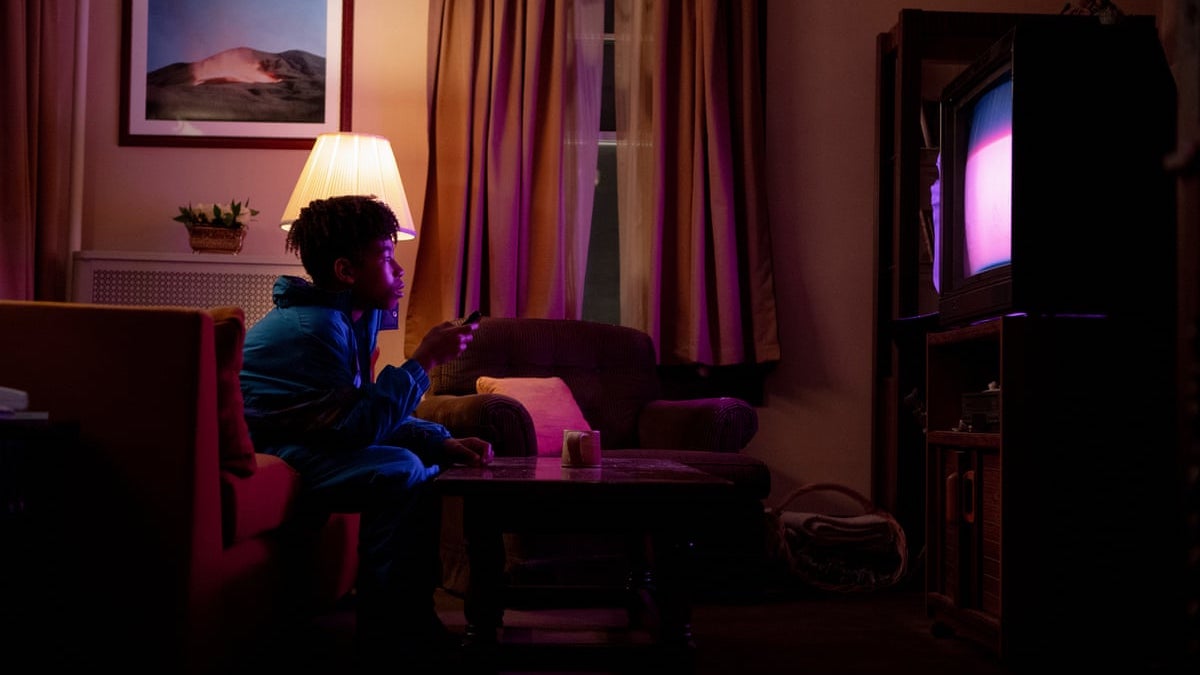
Online, you can find the film 'I Saw the TV Glow,' the second feature film by Jane Schoenbrun. Our author also saw this glow and now cannot forget it. Read about the indie hit of the month in our review.
Middle school student Owen (Ian Foreman, excellent) quite randomly meets high schooler Maddy (Brigette Lundy-Paine). She is reading an episode guide to the series 'The Pink Opaque,' which he has never watched. The show airs on a children's channel, its closest analogue being 'Buffy the Vampire Slayer.' In short, it's a worthy spectacle, but in high school, one could just as easily be a fan of, say, 'Gossip Girl.' Maddy invites Owen to her place and shows him the series, which changes both their lives forever.
They don't interact too actively, but she records new episodes on tapes for him, and for the somewhat gloomy introvert Owen, the world of 'The Pink Opaque'—a creepy, sad, and strikingly real series—becomes almost reality. The same goes for Maddy, who wants to be like Tara, one of the main characters, and inspired by her example, tries to get through high school.
Like any beloved series, 'The Pink Opaque' ends, as does school for Maddy and the familiar life for Owen. The girl disappears, and the boy cannot figure out how to live on. He grows up (and is played by the significantly less successful Justice Smith), keeps returning to the series, thinks about work, wonders why the world around him is real when something much better and more interesting could be real than the murk and boredom of suburban life. And the murk and boredom in general.
For example, 'The Pink Opaque' could be real, where two telepathic girls, having met once at summer camp, communicate from a distance and oppose Mr. Melancholy, a villain on the Moon (an image from Méliès' 'A Trip to the Moon'). And he keeps sending new 'monsters of the week' after the girls, in particular a giant infernal ice cream that fell into depression after a winter without sales.
When Maddy reappears in Owen's life, in a bar straight out of 'Mulholland Drive,' she pushes this very idea on him. The world is a dream, and the series held all the truth, and something must be done about it, naturally. Like the best films of David Lynch, 'I Saw the TV Glow' consists of two parts, two realities, one of which is an illusion and the other the truth. As with Lynch, it's not immediately clear which is which, and in fact, it's never clear at all.
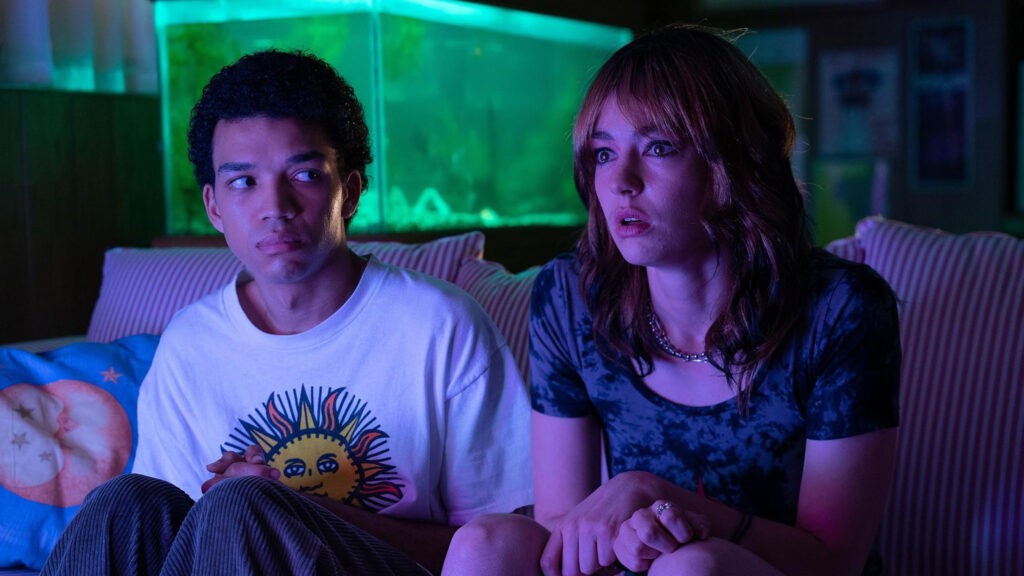
The film, however, has a fairly obvious interpretation related to the issue of gender identity. When the hero is asked who he likes, he gets lost and answers that he likes TV shows. Later, he supposedly enters a relationship, but this is reported by a voiceover; any manifestations of romance or sex remain off-screen, and the hero's main visible passion remains the glow of the TV. And in the context of Jane Schoenbrun's winding journey, tied to certain realizations in the search for self, it's easy to see a metaphor for gender transition in the events of 'I Saw the TV Glow.'
However, in domestic discourse, questions of gender are at best political, and generally speaking, rather philosophical, so the transparency of Schoenbrun's metaphor is shrouded in the darkness of general philosophical problems. Alas, not even pink. The film's characters face two crises at once: they cannot understand themselves and cannot understand the world, and this gap in reality and knowledge cannot be mended. Losing confidence in two constants at once—the world and themselves—the characters essentially solve an equation where all variables are unknowns. The anxiety of the unknowable that overtakes them becomes the center of the film.
At the same time, the most interesting thing about the film is not in the realm of abstractions, but in its sincerity, its hard-won quality, in the fact that the characters' anxiety is psychologically authentic, not just philosophically justified. The author's personal experience allows us to look at the far-from-new plots of Kelly's 'Donnie Darko' and Cronenberg's 'eXistenZ' from an interesting angle. The reality of reality, the doom to sadness, the impossibility of breaking through to some key truth about life—these are indeed more like reflections of old questions, and the TV of every film lover has already glowed on these topics, but Schoenbrun's tone makes us forgive her a lot.
In particular, the fact that, like the characters' beloved series, the film 'I Saw the TV Glow' exists much more organically in memory than directly on screen. This is a film that is hard to accuse of being overly engaging or trying to lure in casual viewers. Rather the opposite—those who gather to watch it should already be 'in the know' in a sense, and the ideal distribution method for the film is exchanging recordings on tapes. As in the best horror films, the tapes, of course, should be a little cursed.
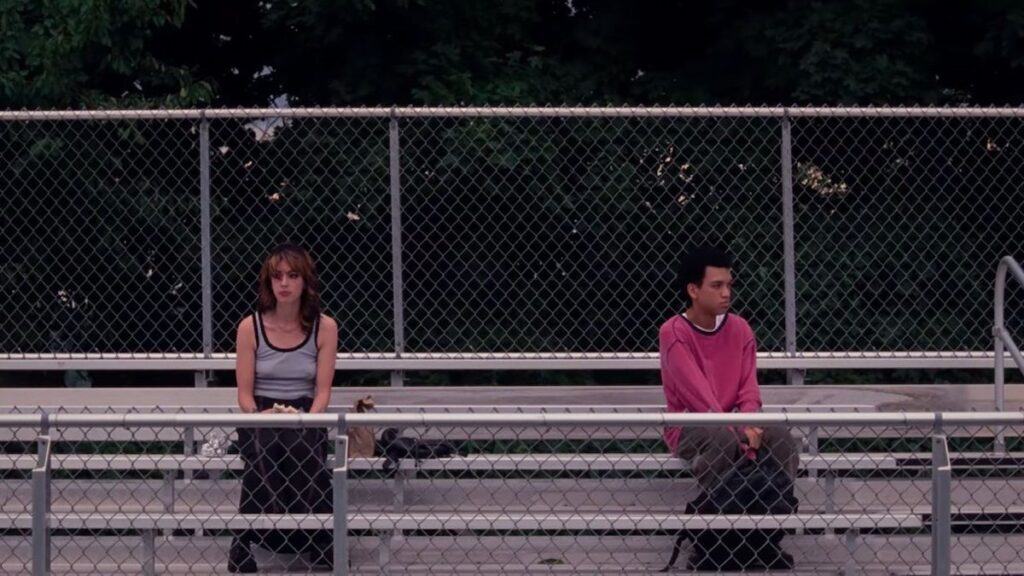
Settling in the mind as a strange, slightly embellished memory, the film truly blossoms, and it's probably not even worth rewatching. Like the series 'The Pink Opaque,' which, if it ceases to be a childhood memory from the nineties, loses not just its charm but itself. The characters also lose themselves, trying to return but not knowing where. The longing for eternal return turns for them into an equally eternal question of identity. Not understanding how to bridge the gap between teenage problems and adult life, between reality and fantasies, between the past and what brightened it, they dream of returning, perhaps to childhood, but can only end up lost. Disappear from the world, see their reflection in the glow of the TV. In the end—to be properly sad.
A fair share of criticism is precisely that Jane Schoenbrun as an author offers neither the viewers nor the characters a way out, only longing. Owen and Maddy are doomed to wonder what their lives could have been; viewers must figure out for themselves what actually happened, and the only obvious things in the film are sadness and a sincere love for nineties television.
However, it's probably strange to ask Richard Kelly to explain what happened in 'Donnie Darko,' and equally strange to criticize Schoenbrun for 'I Saw the TV Glow' being a sad film. This is a movie about people who didn't get a philosophizing rabbit. Who ended up in a movie about the unreality of the world, without having Jude Law's face. About those who got lost between sleep and reality, but not by wandering around glamorous Mulholland Drive, but by falling asleep in front of the TV, whose light ultimately became for them a light at the end of the tunnel.
Comments
0No comments yet.
Sign in to join the discussion.