
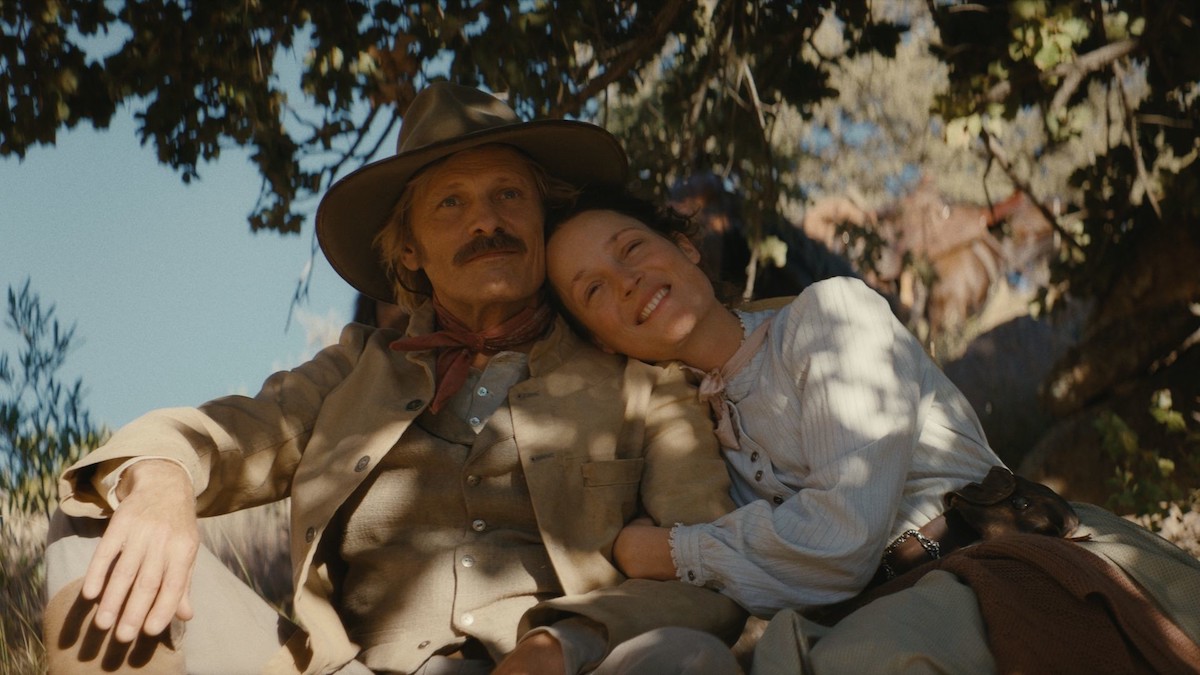
In theaters you can find the melancholic western 'The Dead Don't Hurt' by Viggo Mortensen. We tell you why the actor's second directorial project is a great success in our review.
Vivienne Le Coudy (Vicky Krieps) is about to leave her suitor in San Francisco. He is an unimaginable bore and always terribly pleased with himself. She grew up in France and as a child dreamed of being Joan of Arc. Now she is ready to leave him for nowhere, which is extremely bold given the position of women in American society in the 1860s.
Danish emigrant Holger Olsen (Viggo Mortensen), an outstanding carpenter and veteran of the Danish-German War, is also visiting San Francisco at that time, wanting to see the edge of the world—the Pacific coast (the motif of the ocean as the end of the earth, generally the motif of the limit, is one of the key ones in the film). He meets Vivienne precisely in this strange period of her life. And from then on, they do not part for a while—director Mortensen did not deny himself the pleasure of playing love at first sight with one of the most interesting European actresses of his generation.
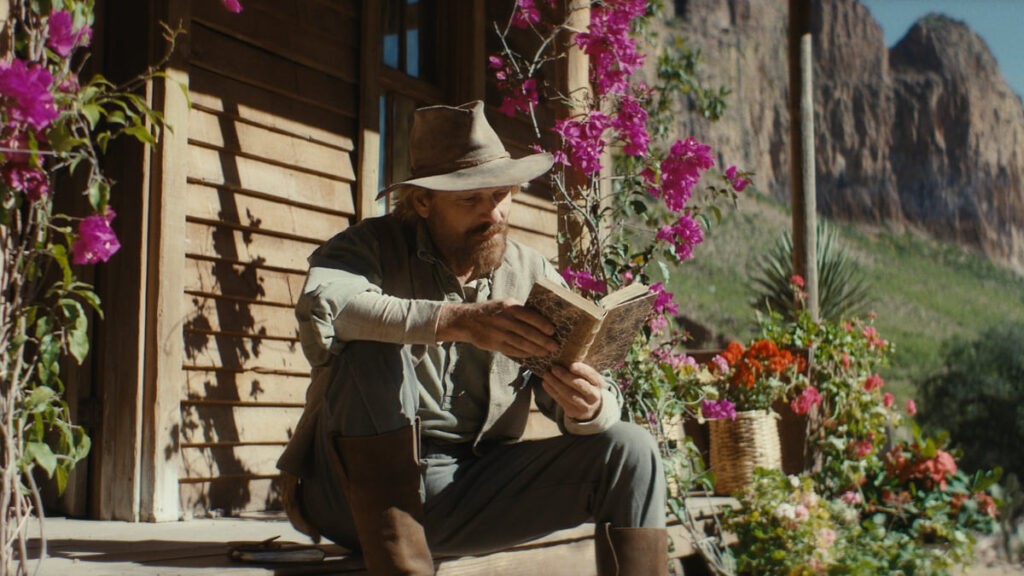
Their love story is hard to call complicated, but it is not simple either. He took Vivienne to the neighboring state of Nevada, where he lived in a neglected house on the outskirts; she took the household into her own hands while Olsen built barns for rich people, never quite getting around to building his own. To avoid depending on her beloved, Vivienne got a job at the local saloon. Their fate was happy, but like any life on the frontier, it was life on the edge. Misfortunes, deaths, peace.
First, peace collapsed, and Olsen went off to the Civil War. He was already a bit old for that and owed nothing to the United States to defend its unity, but he knew war and wanted to help defeat slavery. Vivienne could understand Olsen's noble intentions, but she could not help him, just as he could not help her. Going off to fight for a just cause, he left Vivienne alone in a world of men who do not accept rejection from those they perceive as weak. Naturally, this did not end well.
'The Dead Don't Hurt' is a film with rich cinematic roots. One can recall Zinnemann's 'High Noon' and Eastwood's 'The Outlaw Josey Wales,' but above all, the film is an ideological heir to Robert Altman's 'McCabe & Mrs. Miller' (Mortensen himself admits his love for this remarkable classic). What links Altman's film to 'The Dead' is not only the image of a strong heroine (here Vicky Krieps, there Julie Christie) but also a common, rather unique tonality, and, of course, a certain parallelism in the endings. In the latter, one can see how much hope director Mortensen actually leaves for the audience where he could have completely buried others' dreams.
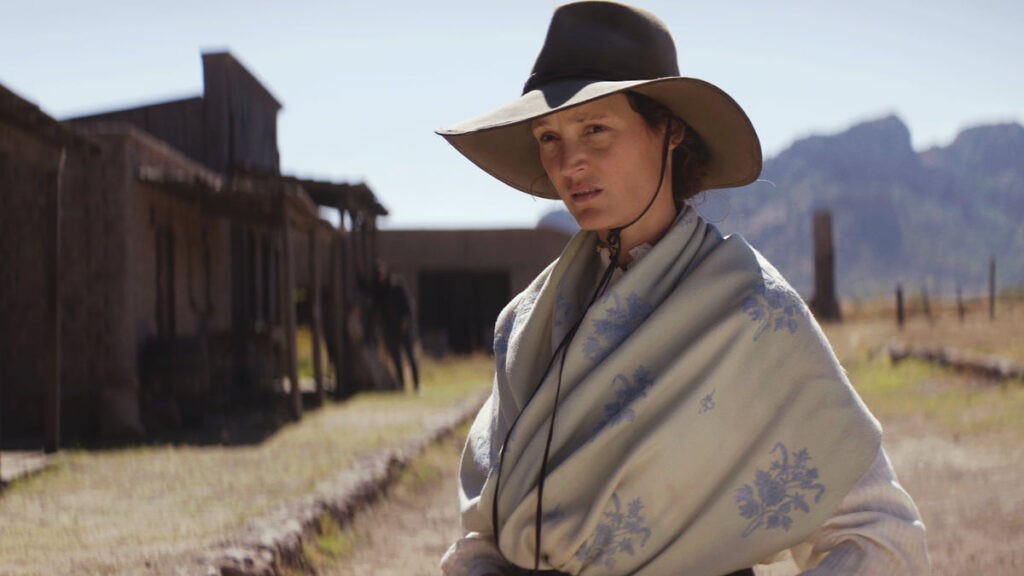
Mortensen's film is one of those movies (there have been fewer of them lately than one would like) that can be retold, but it would be pointless: too much would be lost. It is not about its heavy structure—the lightweight plot is shuffled in a complex combination of flashbacks, flash-forwards, and some very distant memories (even a medieval knight appears!)—but about the amazing tone that the director managed to find. Without it, and without the stunning beauty of the locations, the actors' faces, the scale of the landscapes, the nuances on which everything rests, this film almost completely disappears.
Of course, one can also see in the film a political agitprop for democratic values and against patriarchy. Some do this with pleasure. Indeed, director Mortensen obviously believes that women should have rights and that thieves, so to speak, should sit in prison, but first, there is hope that even among domestic critics he is not alone in this; and second, it seems that he is not limited to this message.
Such a simplified interpretation can easily deprive the film of its charm (and you don't even need to watch it for that), but that is not really a problem of the film itself. 'Killers of the Flower Moon,' for example, is also, in general, about how killing Indians is bad, but how much would a person miss who, after watching, stops at such an elementary truth. Mortensen is not Scorsese, but in his new film he has undoubtedly grown above himself. 'The Dead Don't Hurt' is more confident, deeper, subtler than his debut; it is a rare qualitative leap, albeit a quiet one—like any modest miracle, it is easier to overlook than to enjoy.
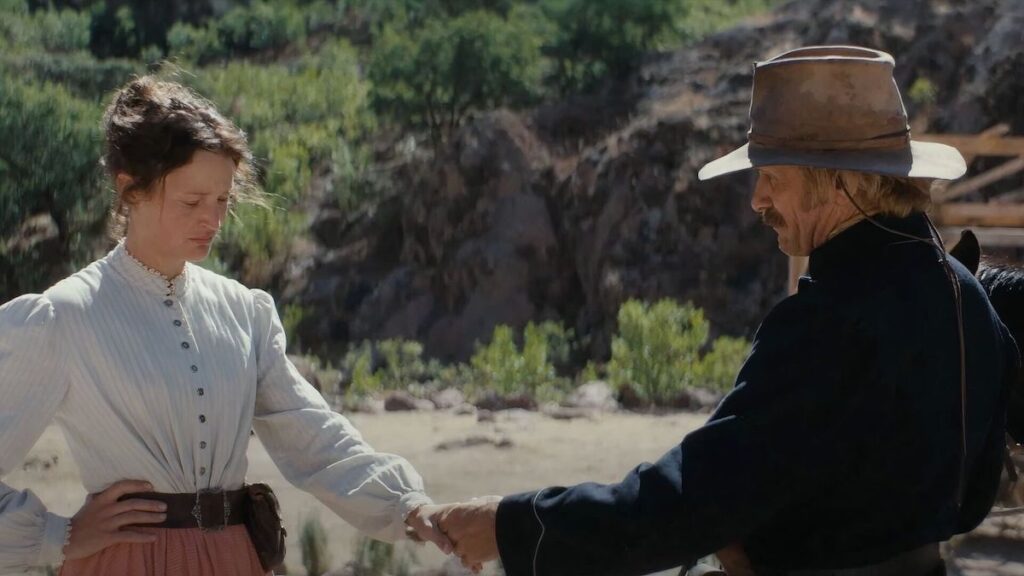
This film is amazing not even for its scenes, but for its moments. Mortensen watches fish trading. Krieps sniffs out dead mice. A veteran prepares for a new war. A pianist plays Northern music in a bar owned by Southern sympathizers. A knight appears from the forest on horseback, an enemy from the desert. Someone leaves, someone returns, and someone never returns. In the quiet sadness of this film, there is surprisingly no vulgarity: it is a sad and tender western that does not allow itself to dissolve into sobs, nor its heroes to drown in self-pity.
On the contrary, as in the best films of the genre, life on the frontier is cruel, but it still goes on. The heroes always see the edge of this life—the end of the earth, the country, freedom—but even when hitting it (as in the wonderful finale), they still keep doing something. The heroes of Krieps and Mortensen are probably hard to call happy, but they live as best they can. And they show, in general, that even on foreign land, in the cruel world of the frontier, one can do this with dignity.
Comments
0No comments yet.
Sign in to join the discussion.