
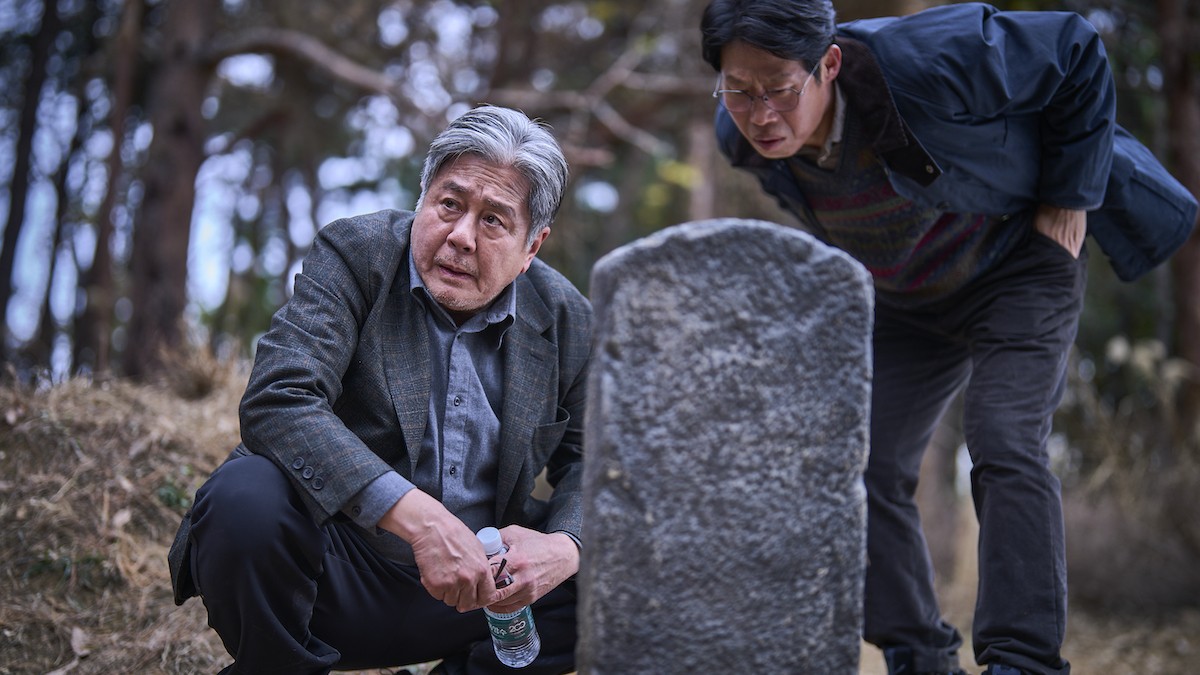
The Korean horror film "Exhuma" is being released—a movie about skeletons in the closet of a family and a country, starring the star of "Oldboy." About what happens when you dig up old graves and why you should see it—in our review.
Wealthy Korean migrants in America turn to a young but experienced shaman from their homeland, Lee Hwa-rim (Kim Go-eun), to exorcise demons from their infant son, who constantly screams. The problem turns out to be not that he is a child, but that the spirit of his great-grandfather gives him no peace. This affliction is called the "call of the grave." To perform the exorcism, the shaman and her handsome colleague Bong-gil (Lee Do-hyun; like Go-eun, an actor from trendy K-dramas) seek help from a duo: an experienced geomancer Kim Sang-deok (Choi Min-sik, star of "Oldboy" and generally a great actor, here especially delightful) and funeral home director Yang-geun (Yoo Hae-jin).
The geomancer, a feng shui specialist who for forty years has been advising where to bury the dead and which direction a hotel facade should face, is not eager to take on the job. The strange grave is surrounded by foxes (which, we are told, do not frequent cemeteries), the soil tastes rotten, and who exactly found (or did not find) peace in such a gloomy place, the hiring family refuses to say. The specialists' doubts are dispelled, firstly, by the child's suffering, which cannot be alleviated otherwise, and secondly, by the client's willingness to pay a very substantial sum.
However, digging up the mysterious grave has far more serious consequences. To avoid spoilers, let's just say that in the first half, the film is a family drama, and in the second, a historical one. The fates of the clients' great-grandfather and their homeland are tied in a knot as horrifying as it is unbreakable, and the heroes, who initially just wanted to make some money, must rise above themselves under the influence of circumstances.
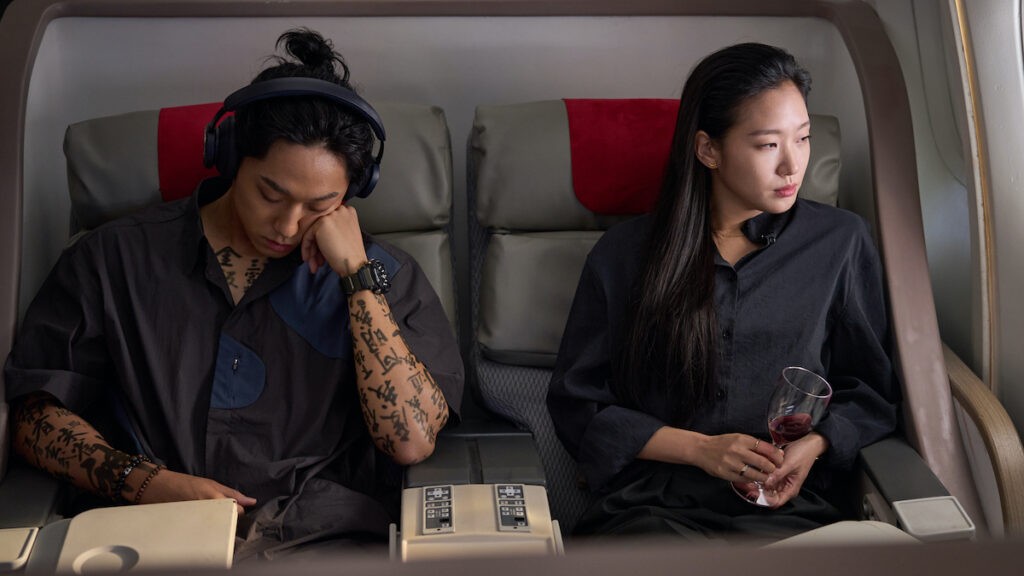
The film skillfully balances between genres: starting out like "Ghostbusters," it boldly ventures into the territory of "The Exorcist" and somewhere toward "The Omen" (the scene with digging up the grave at night is brilliantly executed). This genre flexibility is provided by its detective structure: the psychics have to act as detectives, and to defeat evil, they must first find and identify it, and only then wield the pickaxe.
In the original, the film is even called "Pamyo" (Exhuma), literally meaning digging up. Naturally, the heroes primarily dig in the ground, but also in the past. And in this capacity, "Exhuma" is a smart, scary, but hopeful attempt to make sense of the most traumatic episode in Korean history. The authors also have the tact not to turn the film into either a patriotic propaganda piece or a movie about how modernity corrects the past. The latter can ultimately only be buried and one can try to move on. In a broad sense, the attempt at separation, a new beginning, is the central motif of "Exhuma." Through their rituals, the heroes constantly draw boundaries: between life and death, people and spirits, between countries, but most importantly—between the past and the present.
Many call the film a thematic continuation of "The Wailing," and "Exhuma" indeed works with roughly the same set of hashtags: sin, repentance, family, "all evil from the Japanese." However, it is hardly a second "The Wailing," nor do the authors have such ambition. Although some scenes are copied verbatim, these films differ from each other as "Rosemary's Baby" differs from "The Omen." Polanski's film is a great paranoid statement, while Donner's is a dashing adventure based on it. "Exhuma" has neither the eerie atmosphere of the inevitability of death nor an omnipotent devil; it is a film about how the world, of course, lies in evil, but it can still be saved by professionals if they take the matter seriously. Evil is not eternal but historical, and therefore can be defeated.
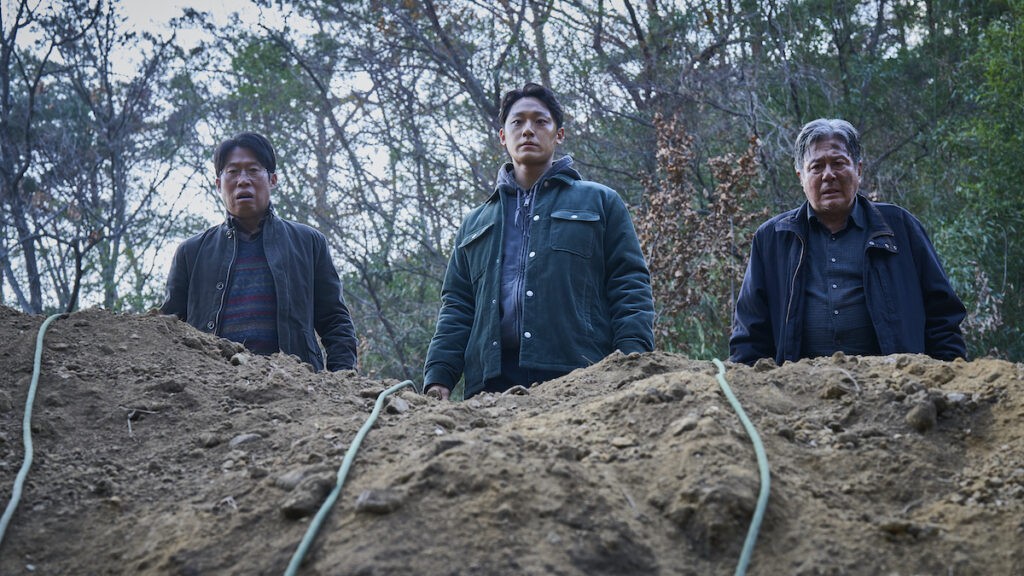
And it is precisely in depicting professionalism that "Exhuma" impresses with its thoroughness. Modern horrors often rely on the viewer knowing the rules of the game: vampires drink blood, werewolves fear the full moon, zombies love brains, and masked maniacs love no one. Here, the authors did not rely on the general erudition of the audience and described in detail what is what. Watching the film as a guide to fighting evil spirits is a special pleasure. How to perform an exorcism? Where is the best place to bury according to feng shui? How do Japanese demons differ from Korean ones? Why will wood defeat iron? Even if these questions never bothered you before, "Exhuma" awakens a serious interest in them.
There is even hope that, just as after each Nolan film new specialists emerge in theoretical physics or time theory, after "Exhuma" experts will appear in truly interesting things. Korean shamanism, feng shui theory, exorcising demons from wealthy businessmen—all these problems still await their researchers. And also, one can probably expect new, so to speak, adventures of the heroes: this is the most interesting team for saving the world, family, and country in recent times, and after such dizzying financial success (the highest-grossing Korean film to date), they rarely stop.
Comments
0No comments yet.
Sign in to join the discussion.