

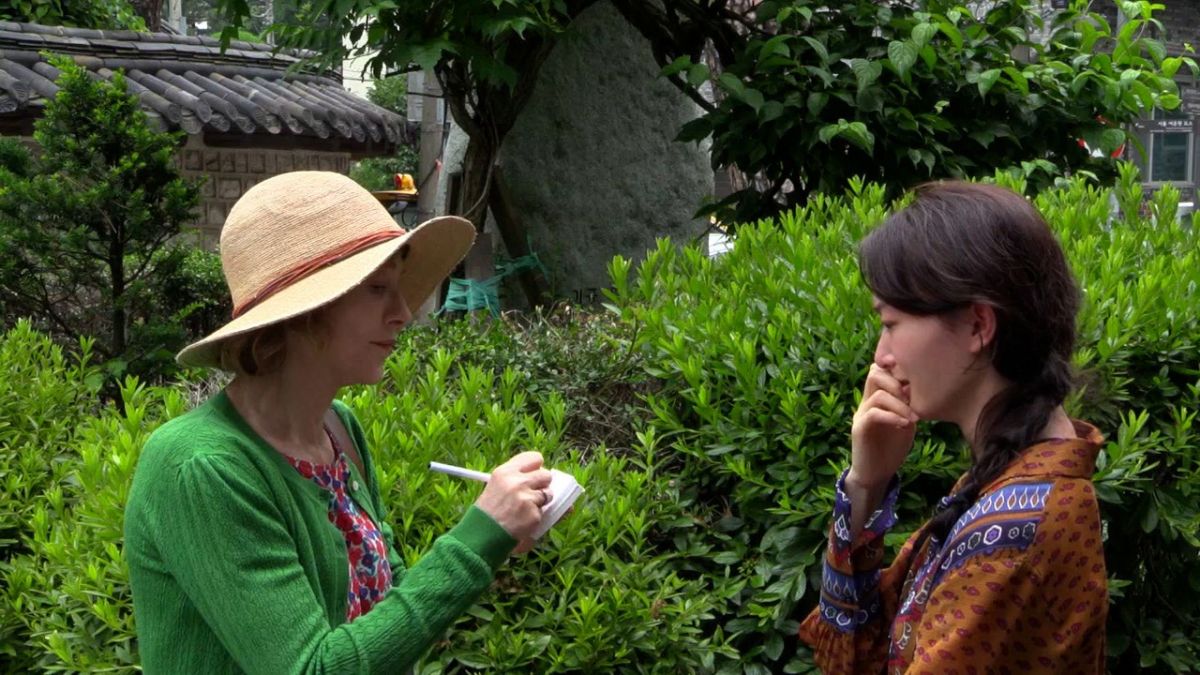
The new film by South Korean director Hong Sang-soo, known for his interesting, largely melancholic view of the world, is being released in Russian theaters. What his film turned out to be and the third collaboration with Isabelle Huppert, read in ou...
Before us is a heroine named Iris (Isabelle Huppert). We know nothing about her past, future plans, career, or hobbies. All we know is that she is a novice tutor, and these are her first French lessons in Seoul. They turn out to be unconventional: students drink makgeolli rice wine, play musical instruments, stroll through the park, and most importantly—no textbooks. Through her teaching of French, we learn not only about the residents of South Korea but also about Iris herself.
When you start watching 'A Traveler's Needs', the first thought is that the director is trying to show the difference between European and Asian mentalities, namely France and South Korea. But later you realize that this layer is just a shell hiding the true essence of Hong Sang-soo's new film, for which he won the Grand Prix of the Jury at the Berlin International Film Festival 2024.
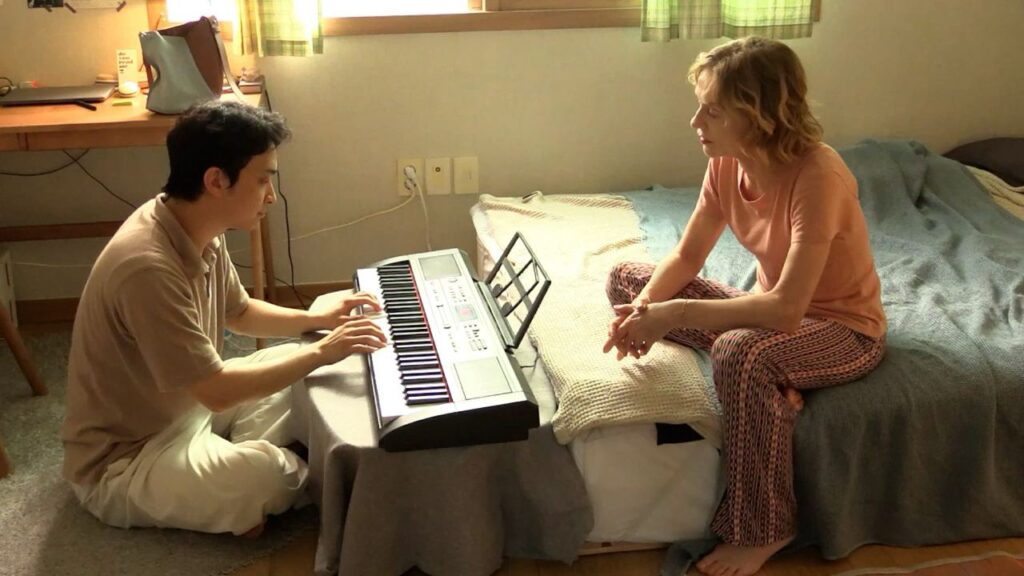
In fact, 'A Traveler's Needs' asks universal questions that are familiar and understandable to everyone regardless of nation, race, mentality, and other differences. They are voiced by Isabelle Huppert's character, who, without experience or special knowledge in pedagogy, suddenly begins teaching French to Koreans. And they agree to the lessons, despite doubts about her competence as a teacher, because they are touched by what she talks to them about.
Her method is quite simple—she asks her students questions about what they feel in different situations. Most often these are moments of conversation over makgeolli rice wine, or when they play musical instruments for her. Huppert's character's questions hit the very heart of her students, and the conversations ultimately turn into talks about unspoken emotions and tangled thoughts.
But in fact, 'A Traveler's Needs' is a sincere conversation of the heroine not with others, but primarily with herself, and in this conversation, comedy coexists with deep drama. We don't know about her past or what she wants in the future. All we have is the present moment, and the film becomes a sketch on the theme of 'a day in the life'. In a way, the film also becomes an illustration of the phrase 'wherever you go, you take yourself with you'. The heroine seems not so much to teach French as to seek answers to her troubling questions. At the same time, she tries to lose herself in everyday things, not to think about the painful. And she constantly runs: from place to place, from person to person, from the room to nature, etc.
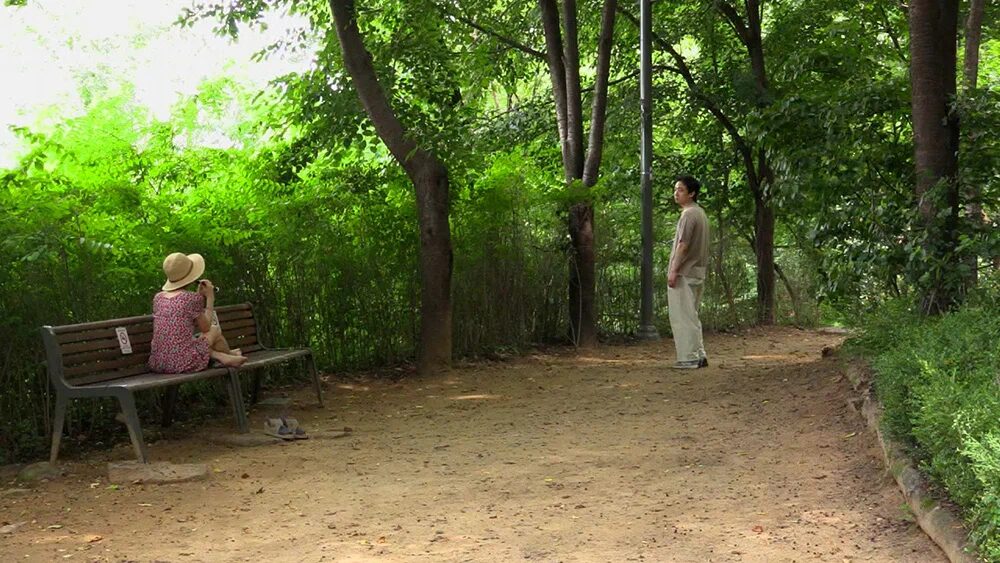
The director himself does not give us, the viewers, any hint of what troubles the heroine, what the cause of her pain is. We can only guess and invent meanings for this film ourselves. But it seems that this is all Hong Sang-soo. During the premiere of 'A Traveler's Needs' at the Berlin Festival in early 2024, he said: 'I made a film, you watched it. And you tell me what the film is about.' In essence, the director thus repeated the ideas of Roland Barthes about art. The French philosopher believed that the author loses control over the work when showing it to people. In that case, the author dies, and control passes into the hands of the viewer/reader.
Each viewer can see something different in 'A Traveler's Needs'. According to the author of this review, it is a film about a person's constant escape from themselves and from other people. Moreover, it is not necessarily that this escape has a specific goal. And its path goes both through laughter and through tears. The escape can be a search for oneself and an attempt to become better. Or the escape can be from something that left a deep and unhealing wound. And then it doesn't matter where we run, with whom, or for how long. The main thing is not to stop.
'A Traveler's Needs' will be released in wide distribution in Russia from May 23 thanks to the film distribution company A-One.
Comments
0No comments yet.
Sign in to join the discussion.