
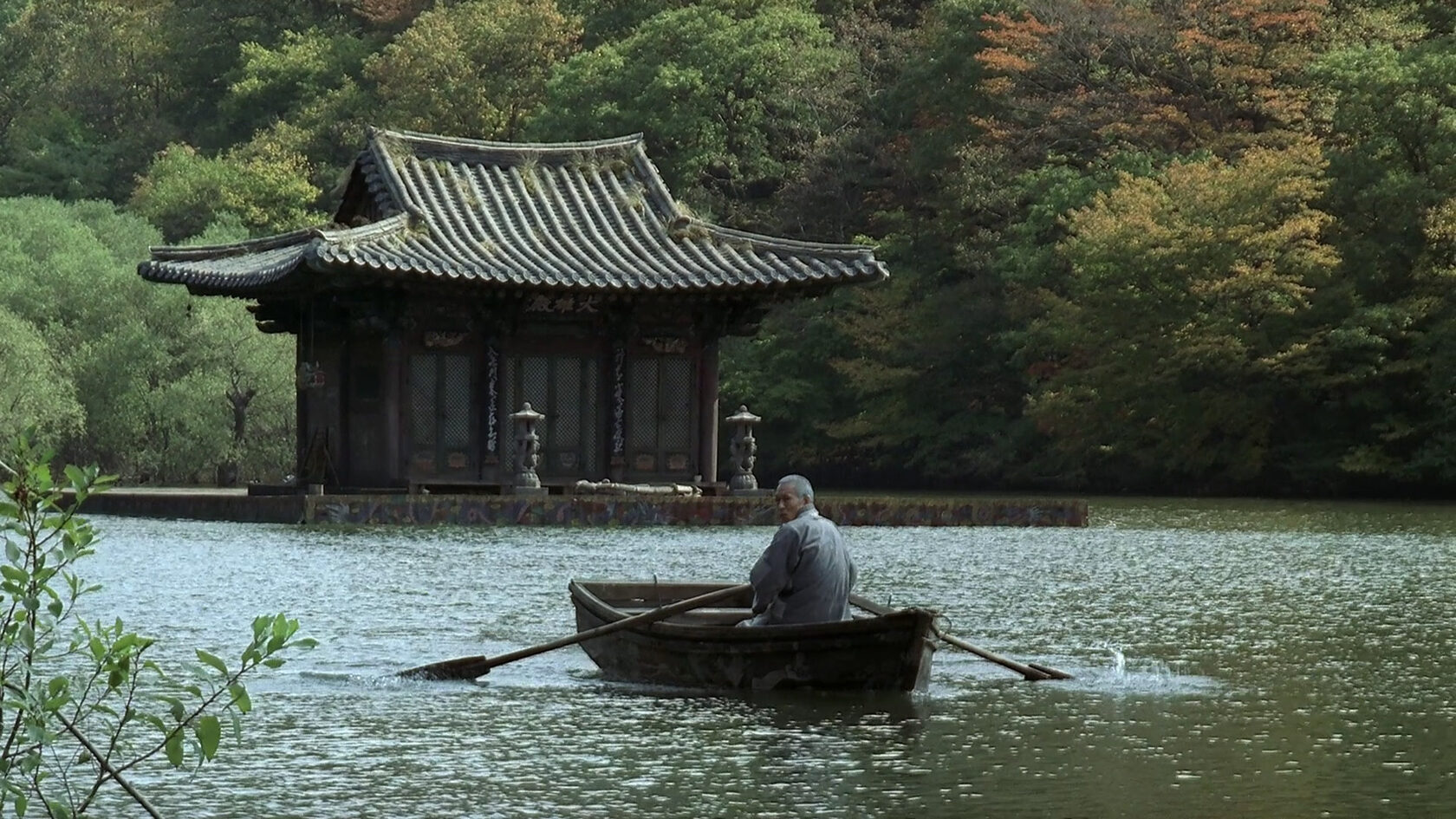
In the April release, one could catch Kim Ki-duk's philosophical drama 'Spring, Summer, Fall, Winter... and Spring'. We talk about why the film, released in 2003, has not lost its relevance, and what ethical principles it formulates.
The setting is the Jusanji Reservoir in the Chuwangsan National Park in South Korea. It is there that a Buddhist temple is located, where a young boy (played by the director himself at one stage of his life) is raised by a monk mentor (Oh Yeong-su). He must go through a difficult path of growing up, experiencing betrayal, love, and the pain of the outside world, only to return and take his teacher's place. A fairly simple plot, lacking complex dramaturgy, with all elements fitting into the circular structure hinted at in the title. No mysteries, no heightened emotions, and no unexpected twists in the narrative. Only a calm, meditative observation of the daily lives of two monks—the mentor and the disciple.
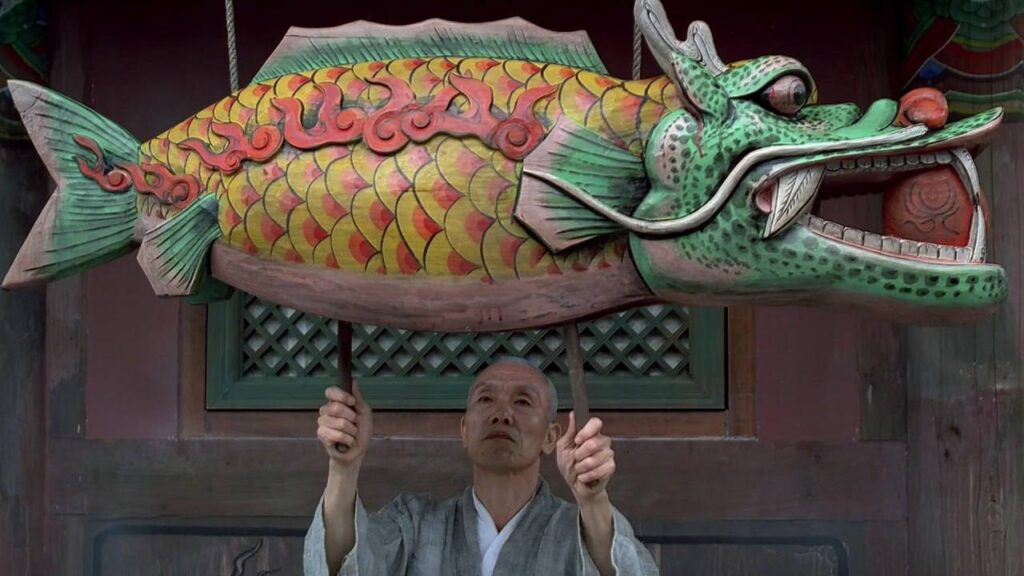
The characters here have no names, but this does not speak to the (my beloved) poetics of mystery. The denial of one's 'self', one's history and individuality (which is exactly what the grown-up disciple will do to become a monk) is one of the main tenets of Buddhist philosophy, 'Anattā'. Adherence to Buddhist canons does not prevent the author from speaking a universal language—the language of images. People here are just people, and even upbringing in a temple does not keep the boy from violence, lust, and murder. But atonement must occur not in the material world, but in the spiritual one; that is why the most severe punishment for killing a snake in childhood becomes the pangs of conscience that weigh heavily on the heart.
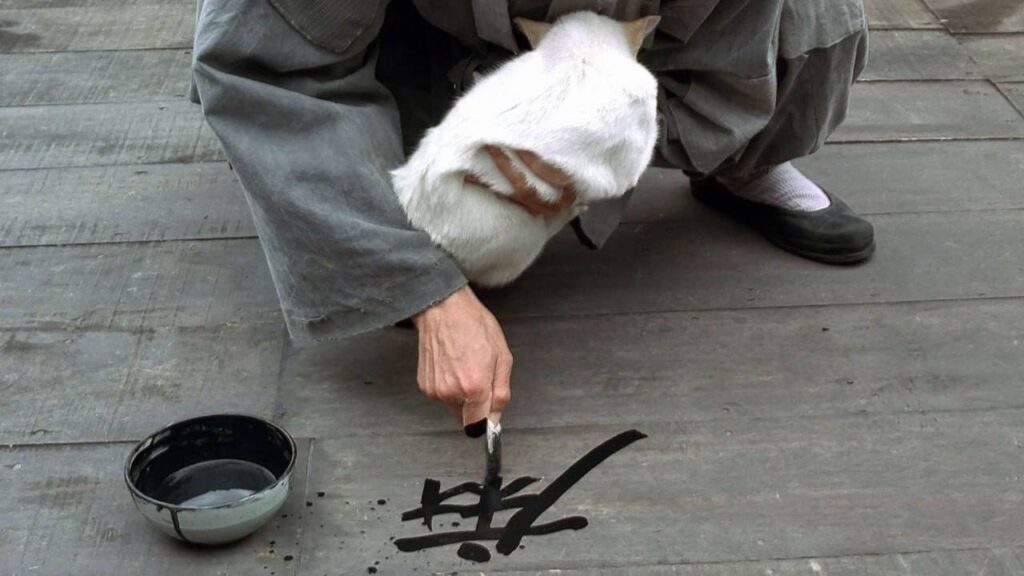
The philosophy of Kim Ki-duk is something polar to the philosophy of existentialists, with their principle of self-subjectivity, 'death of God', and the Übermensch. In 'Spring...', fate is predetermined by nature itself and its cyclicality. Man, as part of nature, is equally subject to this cycle. But dependence on nature does not reject such a phenomenon as 'human nature', which manifests itself primarily in violence (on the semantic canvas of the film), and which man must renounce after atonement. For example, in the finale, the grown-up disciple, now a monk, has his own disciple who performs the same actions as he did in childhood, at the same time of year. Nature here is interpreted as something from which man originated, and it has no power over him. Man depends on nature because he is part of it.
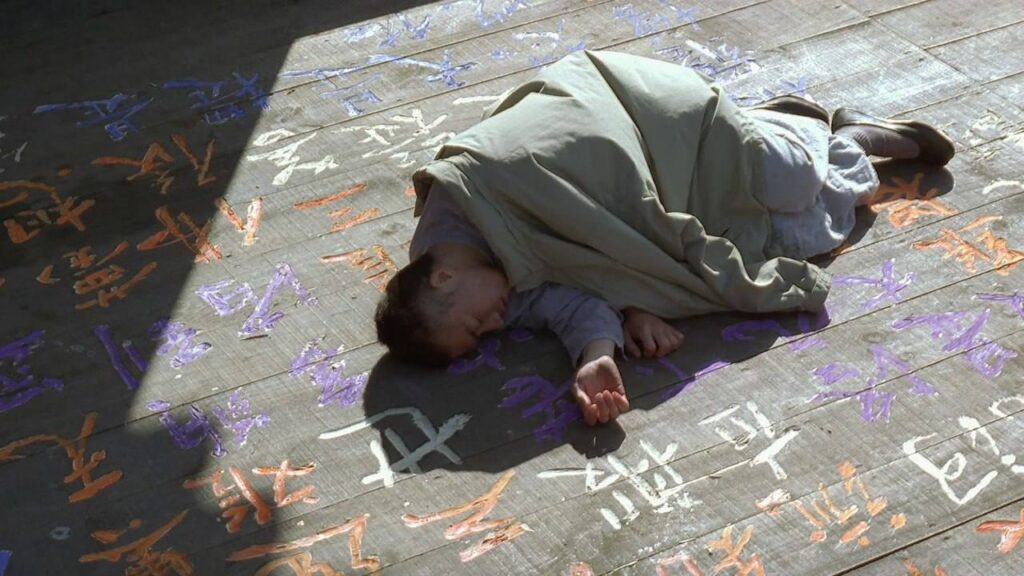
Erich Fromm believed that 'man is the only animal for whom his own existence is a problem which he has to solve and from which he cannot escape. He cannot go back to the prehuman state of harmony with nature; he must continue to develop his reason until he becomes the master of nature and of himself'. It is precisely these 'human' traits and human nature (as a fairly constant but abstract construct, according to Fromm) that distance man from nature itself.
'Spring...' conveys a similar idea: at the stage of the young man's discovery of eros, his mentor says in response to apologies: 'It's not your fault; it's nature'. Lust is something natural and therefore not a crime or vice. But the teacher does not justify murder in this way; accordingly, taking the life of any living being is not a natural process. Violence is something that exists in man, but it is not given by nature, meaning it and its consequences have a negative connotation and require atonement.
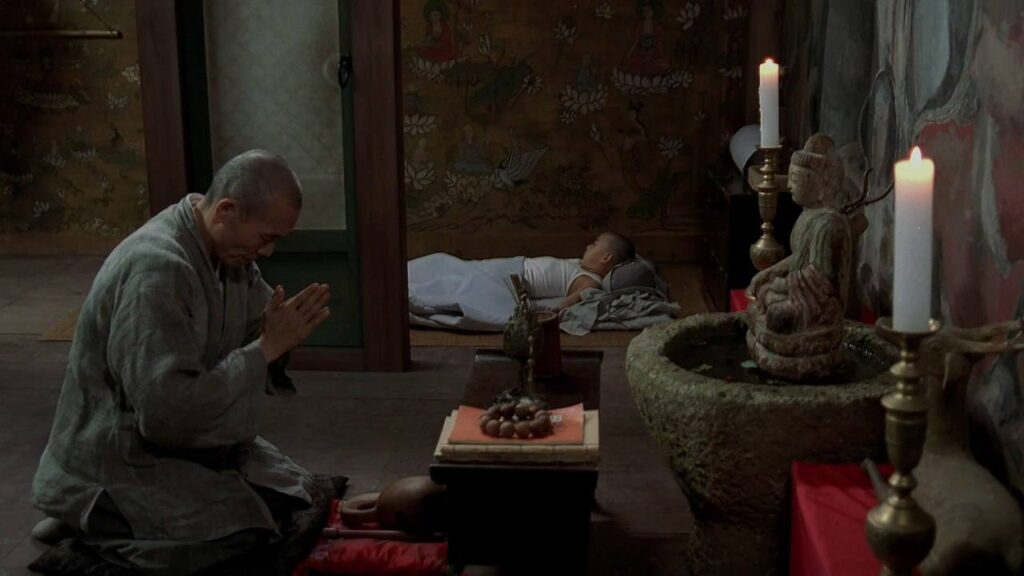
Ernst Cassirer wrote: 'The inevitable moment of human existence is contradiction. Man has no 'nature'—simple or homogeneous being. He is a strange mixture of being and non-being; his place is between these two poles'. And although this viewpoint does not fully align with the philosophical principles of 'Spring...', the hero here also spends most of his time 'between two poles': between his human nature and nature as a whole. It is this opposition that forms the semantic part of the film: the boy goes from the free expression of human nature to its atonement and renunciation. And if the only expression of this construct is violence, then it can be said that 'Spring...' also responds to the ethics of humanism, whose basis is morality and the prohibition of murder.
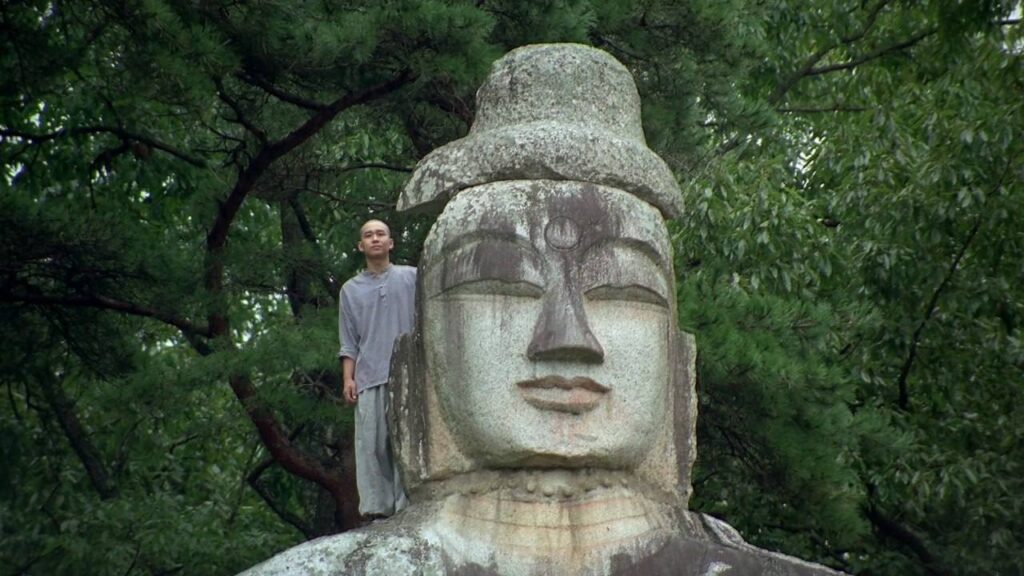
These theses, formed at the intersection of content and form, are understandable to any viewer. Knowledge or ignorance of Buddhist principles has little effect on the perception of the film's philosophical side, because knowledge allows one to delve deeper into the ethical semantic load, while ignorance allows one to view the temple routine through the lens of 'defamiliarization', which enhances the perception of images.
'Spring, Summer, Fall, Winter... and Spring' is not just an hour and a half of meditative contemplation of pristine nature and the ritual actions of monks, in which one can find much that is mesmerizing and enchanting. This film also affirms certain ethical principles, expressing them quite clearly. The basis of the division is the connection of man with external nature and its opposition to human nature. The inevitable cyclicality of life, which underlies all expressive means, makes the ending predictable, but the strength of 'Spring...' lies not in an intriguing plot, but precisely in this slow, almost hypnotic pace and the explanation of simple rules of life through simple examples.
Comments
0No comments yet.
Sign in to join the discussion.