
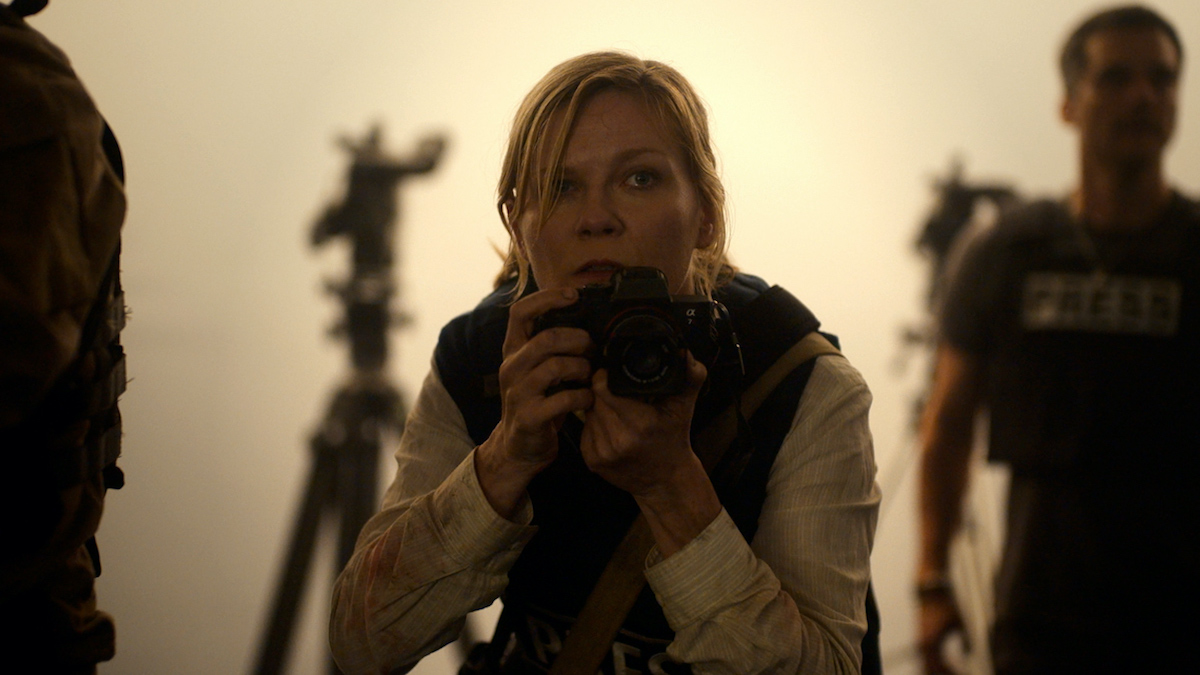
In theaters, you can still see the sunset of Western civilization through the eyes of one of the most fashionable independent directors of our time, Alex Garland. Why "Civil War" is an interesting, though not the most successful, film—in our review.
Photojournalist Lee Smith (Kirsten Dunst) and her friend, reporter Joel (Wagner Moura), are in New York City in the second year of a civil war. There are constant explosions, street fights, and internet outages, but at least there are no active battles and won't be anymore. The fighting will soon end—the president's forces are about to be defeated, and he will be killed. In anticipation of this event, Lee and Joel decide to, as they say, capitalize on the hype and get a last interview with him, accompanied by a final photo.
To give this failed dictator a proper send-off, they are willing to cross a thousand kilometers of the hell that America has become—that is, to drive to Washington. Joining them on this dubious odyssey are an elderly New York Times columnist, Sammy (the outstanding Stephen Henderson), who abhors the idea of a quiet old age, and a young fan of Lee's, aspiring photographer Jessie (Cailee Spaeny).
In this sense, "Civil War" defies expectations. It is neither a philosophical war epic, nor a drama about fratricidal war, nor even a decent action flick. The film unfolds as a slightly melancholic road movie about four journalists—a veteran of the profession, a novice enthusiast, a neurotic pothead, and a tough professional—who go about their business while everyone around is busy with who knows what. This unexpected angle justifies the somewhat obvious choice of subject.
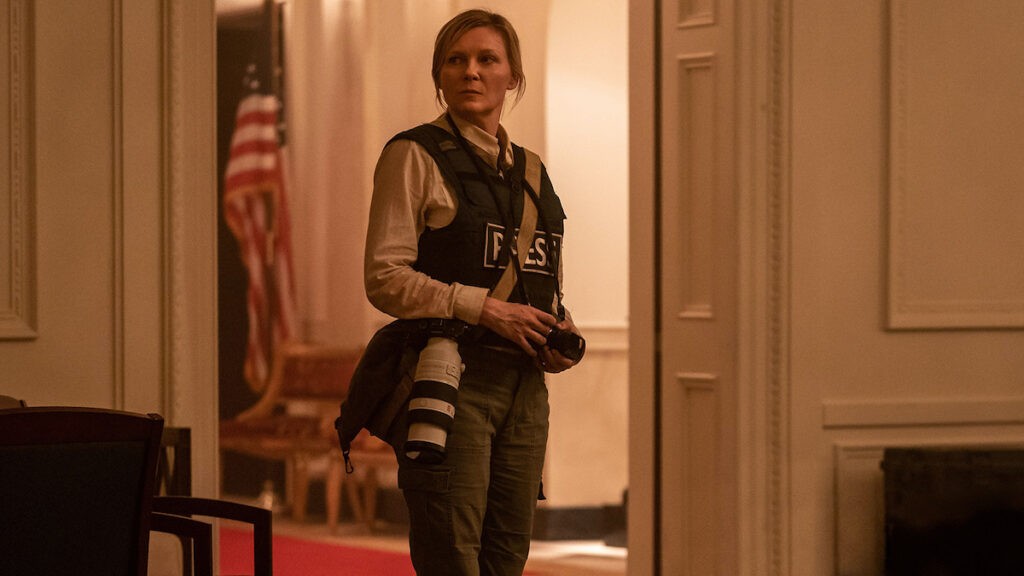
In principle, everyone in Russia understands that America is doomed. TV talks about it so often that watching it in a movie theater is, of course, a pleasure, but seemingly an excessive one. One could reason this way, and it seems that the localization of the original title of Alex Garland's film was conceived with similar thoughts. "Civil War," which obviously refers to the war between the North and South, turned into the ambiguous "Fall of an Empire." It is all the more interesting that ultimately this film is not about war, but about war correspondents. Not so much about the catastrophe as about its viewers.
And precisely as a film about war correspondents, in the spirit of, for example, "The Year of Living Dangerously," "Civil War" is quite remarkable. Kirsten Dunst plays all shades of despair, indifferently watching a gas station owner posing in front of two hanged men, and later trying to come to terms with the sight of herself in a dress. This is an outstanding acting performance and her most interesting role since the second season of "Fargo" (and there should be more such roles, Hollywood, wake up!). Actresses Stone and Dunst this year unexpectedly decided to show that there is no better acting school than being Spider-Man's girlfriend.
Henderson and Moura complement Dunst from opposite poles. The former embodies the old school of journalism—kindness, thoughtfulness, the ability to react to any event with the phrase "I had a column about that." This is a touching and perhaps the most successful character in the film. Moura from "Narcos" has finally gotten a role worthy of his talents. Interestingly, like his colleague from "Narcos" Pedro Pascal, Moura is paving his way to awards season with the role of Joel in a road movie about post-apocalyptic America. A kind neurotic, not broken but damaged by war at some very deep level, his character tries to support the novice colleague Jessie, but realizes that the paths of glory she aspires to are, in essence, a meat grinder.
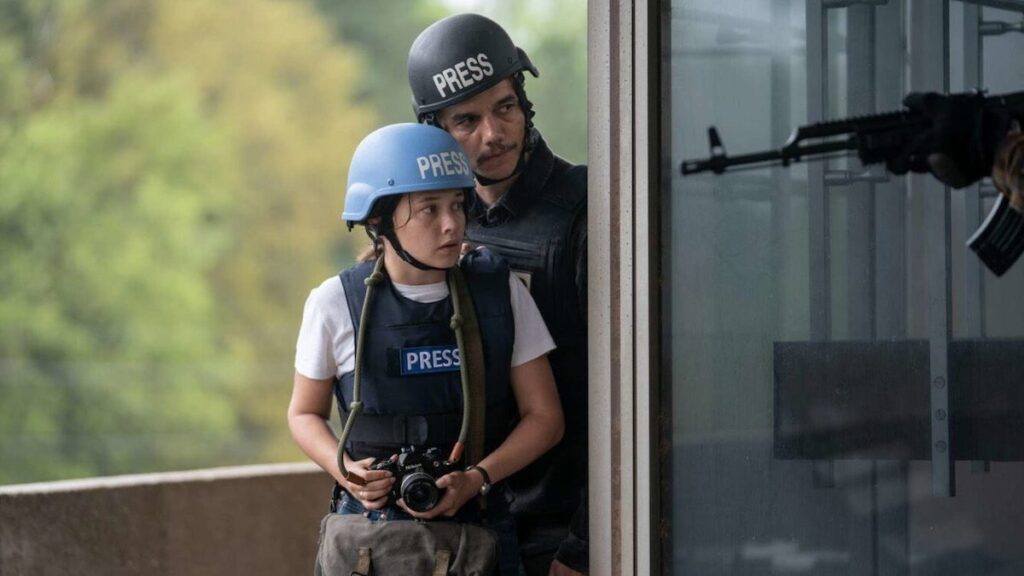
For Sammy, Joel, and Lee, the apocalypse, so to speak, was yesterday, while for Jessie, the apocalypse is still tomorrow, and all three, acting as parental figures towards her, are also a collective Virgil. Jessie is unable to reflect on this, but she is descending into hell, accompanied by sad journalists. Is there a worse fate? Perhaps only the same trip, but with film critics.
They would say (and will say right now) that Garland's war didn't work out. Remaking "Apocalypse Now" and "The Thin Red Line" with the means of a typical action flick in the spirit of "Olympus Has Fallen" is an interesting, innovative move, but the desire to combine moral pathos with stylistic experiments has destroyed directors much more accomplished than Garland.
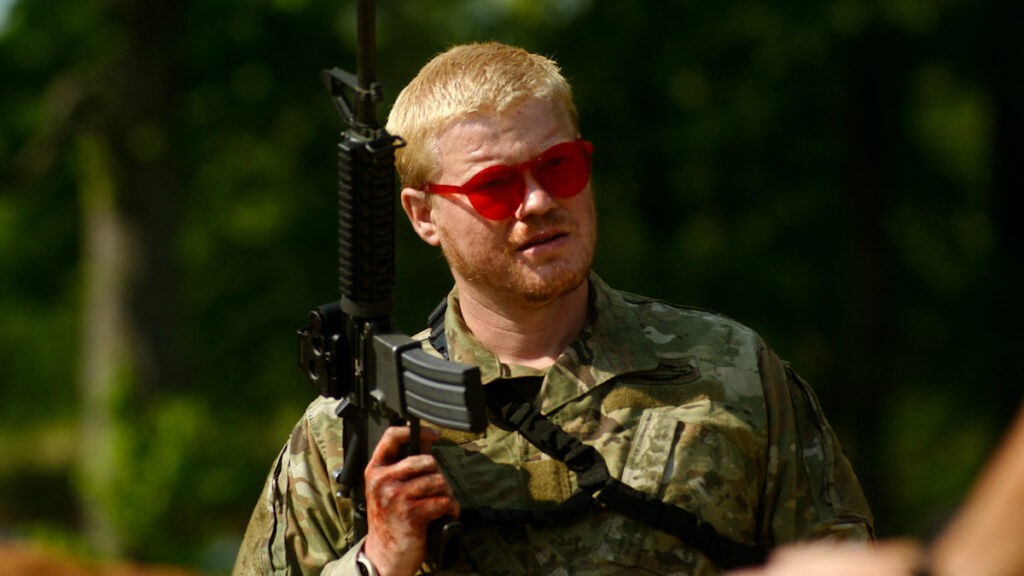
The film has one outstanding technical solution (the sound work with gunshots and explosions) and several brilliant scenes. One that everyone remembers, with Jesse Plemons as a Southerner (after such a role, one desperately wants to see him in something like "The Texas Chain Saw Massacre"). One where Kirsten Dunst tries on a dress (though we can't vouch for objectivity here). There are a few more moments that are not worth spoiling. However, a significant portion of the film is simply not very interesting. It is well-shot, well-written, but ultimately it is a collection of commonplaces: war is absurd; people are cruel; society too easily descends into a war of all against all; there are always people capable of ignoring horrors and atrocities, even if they are looking right at them. If all this surprises you—read the news.
Much of the film is designed for shock effect and looks like a film adaptation of a provocative thread on banned social networks. For example, the alliance of Texas and California as enemies of Washington seems to exist only so that every review can mention how unexpected it is. Indeed unexpected: a strategic alliance of Peter and Chechnya, adjusted for climate. However, Garland's thought goes no further. Each time he stops not even at a fun provocation, but somewhere nearby, as if not reaching not only the essence but even the joke, once again proving that fashionable cinema doesn't have to be very good.
The multiple coy omissions used here to build suspense can be interpreted as a desire to act as an abstract thinker, or as a desire to increase box office revenue by appealing to both Democrats and Republicans. The former enjoy seeing that the pathetic dictator-president resembles Trump; the latter enjoy seeing that not everyone will be taken into the future, especially not frappuccino lovers. For a prophecy, all this is too petty, and for a topical political manifesto, there is too much crying and smoking (literally).
However, maybe this is precisely a prophecy. Maybe all prophecies look like this. Vanga said Kursk would go underwater. Nostradamus said these signs would be lucky next month. Garland said your America is doomed. Perhaps the future is indeed doomed to be just an inaccurate and overwrought retelling of yesterday's news. "Civil War" ends with a not-so-witty cynical joke that is also predictable from about the fifteenth minute. And such a denouement seems to be the most accurate of Garland's prophecies.
Comments
0No comments yet.
Sign in to join the discussion.