


In his directorial debut 'Monkey Man,' star of 'The Green Knight' Dev Patel delivers mind-blowing action and introduces viewers to Indian culture. What came of it — in our review.
A young Indian named Kid (Dev Patel) from the fictional city of Yatana (a twin brother of Mumbai) suffers one defeat after another on an underground boxing ring run by a slick man nicknamed Tiger (Sharlto Copley). Kid is beaten in the ring not for nothing: he loses for money, which he needs to get a job elsewhere, a posh hotel called "Kings." It gathers all the rich people of the city, including the local police chief Rana (Sikandar Kher). Once he burned Kid's village to the ground, killing his mother, and now the young fighter uses every opportunity to get closer to the police officer and avenge his mother's death.

Dev Patel, who made his big-screen directorial debut with 'Monkey Man,' took a long and thorny path to bring his film to wide screens. Patel and his team fully experienced all the delights of what is commonly called production hell. From the start of filming, the group was tested by the coronavirus epidemic, and later by a limited budget, lack of people and equipment. Patel had to perform tricks during production, shoot on the fly, and conjure up what was needed literally out of thin air.
Initially, Neill Blomkamp was supposed to sit in the director's chair, but then everything was reworked. From the director of 'District 9,' only his loyal friend and colleague Sharlto Copley remained, appearing in a couple of scenes to colorfully announce the next opponent of Monkey Man. The film was supposed to be picked up by Netflix, but then Jordan Peele unexpectedly appeared on the horizon, seeing potential in Patel. He insisted on releasing the film on the big screen. In one interview, Patel admitted that in the absence of extras on set, they had to put absolutely everyone in the frame: from makeup artists to workers. Perhaps that's why the film turned out so chaotic, somewhat fragmented, but in a good way desperate and gritty. All the hardships during filming gave the film the necessary nerve.
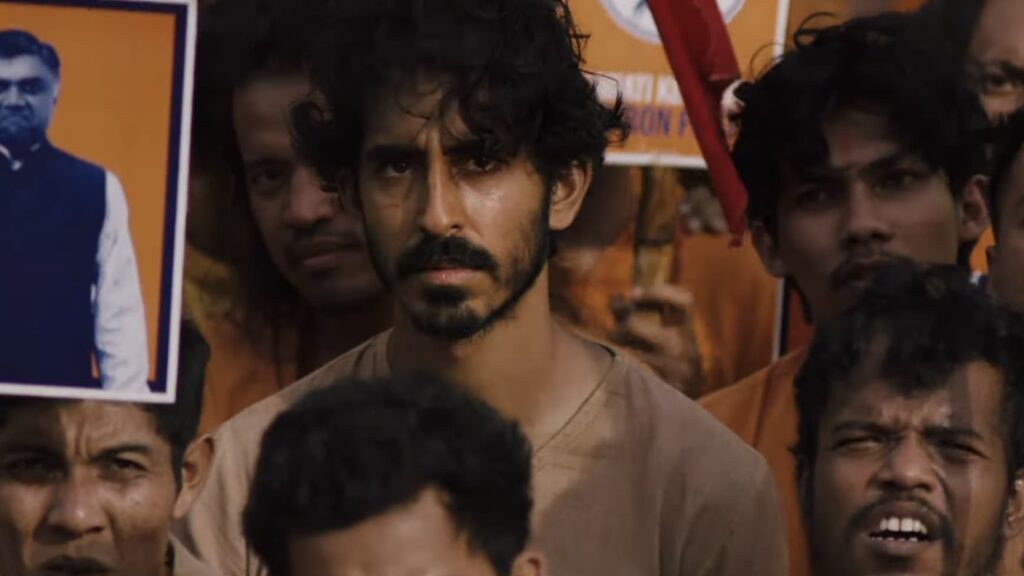
Patel the director was not shy about taking the best from established masters. Eclectic shots with Indian flavor, rushing past the viewer at locomotive speed, elegantly hint at 'Slumdog Millionaire' by Danny Boyle, the film in which young Patel began his career. The fierce and brutal fights came from Chad Stahelski, although at the beginning of the film there is a little joke about guns from 'John Wick,' but it's more meta-irony within the plot, because later Patel did not think of disowning the rich legacy of the seasoned stuntman and director, but rather used it to the fullest (including even red-blue neon and a little dog).
However, it's not enough to just take from the best; you need to add your own. Patel chose the path of hurricane editing and action, stomping the pedal of ultra-violence to the floor until the film's engine simply runs out of resources. It's clear that many scenes simply lacked funds, and technically this had to be solved by enlarging shots and increasing the speed of actors' movements in editing, but 'Monkey Man' does not focus on this; it carefully doses both the brutality and the easily readable message about the monstrous social stratification of a particular city in India. And to prevent it from serving as a faceless location, Patel does not forget about the rich culture of this country, periodically detailing (as much as possible given such a dense rhythm) Hindu mythology, with which the film is literally saturated.
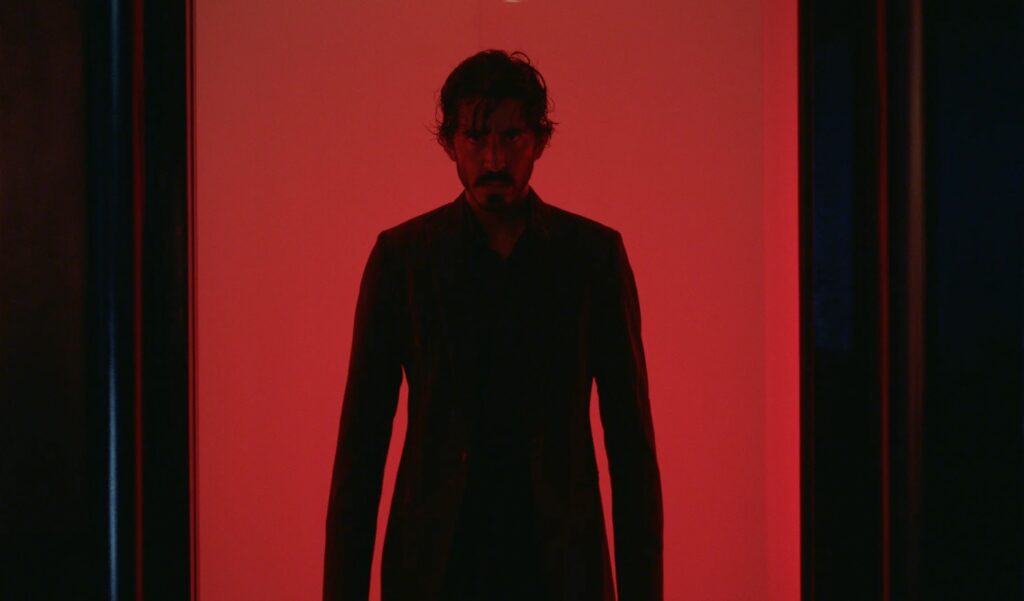
In rare moments, Patel tries to focus on the inner world of his hero, in one scene doing it literally when Kid, in a sleepy delirium, tears open his chest like the ancient Greek Orpheus. In some moments, this greatly slows down the film's pace, but more than the masterful predecessors, it endows Patel the actor with human qualities. He is furious, angry, and confused; he worries and sweats profusely; he doesn't always know how to act correctly; his palms are burned, and in one scene, when he tries to kill the antagonist for the first time, the gun treacherously slips from his hands and he barely escapes the chase, barely surviving.
All these disparate details sometimes do not come together as a puzzle, giving away the novice director. Patel wanted his film to stand out among other genre representatives, so he tried to cram absolutely everything that was born on paper into the two-hour runtime, including even margin notes (he wisely refused Bollywood-style dances). This attempt largely succeeded, given both ratings on the 'tomatoes,' but at some moments, such a kaleidoscope of rapidly changing registers causes elementary fatigue, which Patel, in a noble effort to make a quality product, simply did not account for.
Nevertheless, for all its roughness and minor flaws, 'Monkey Man' does not lose its authorial identity and can well be at the forefront of B-movies. Its main quality, perhaps, is that Patel did not think about what would happen next to his hero. Kid found peace from the accomplished revenge; he is completely satisfied and nothing more needs to be known about him. Sometimes, a single hearing of a tale about a noble knight is quite enough.
Comments
0No comments yet.
Sign in to join the discussion.