
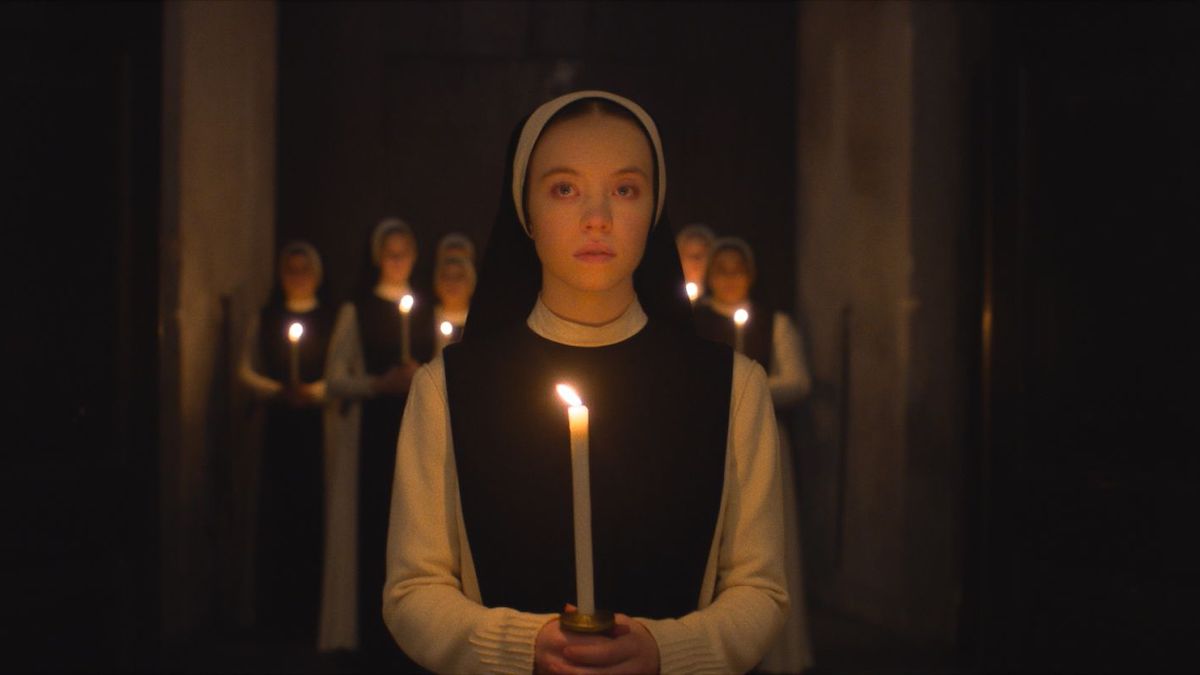
You can still catch the Christian horror film 'Immaculate' in theaters, in which 'Euphoria' star Sydney Sweeney tests the limits of God's mercy with a fake belly at the ready. Our author partook in the mysteries of late-night screenings and regrets n...
Young novice Cecilia (excellent Sydney Sweeney, in whom a seventies horror star suddenly shines through) flies to Rome to become a nun in a monastery hospice for elderly servants of the faith. They have a meeting with God only in the near future, but Cecilia has already seen him. Or rather, he saw her. She was very young when she fell through the ice on a lake near her home in the American heartland and survived despite clinical death. It is clear that the Lord saved her for a reason. But why he did it is also unclear. Apparently, so that there would be someone to elevate genre cinema.
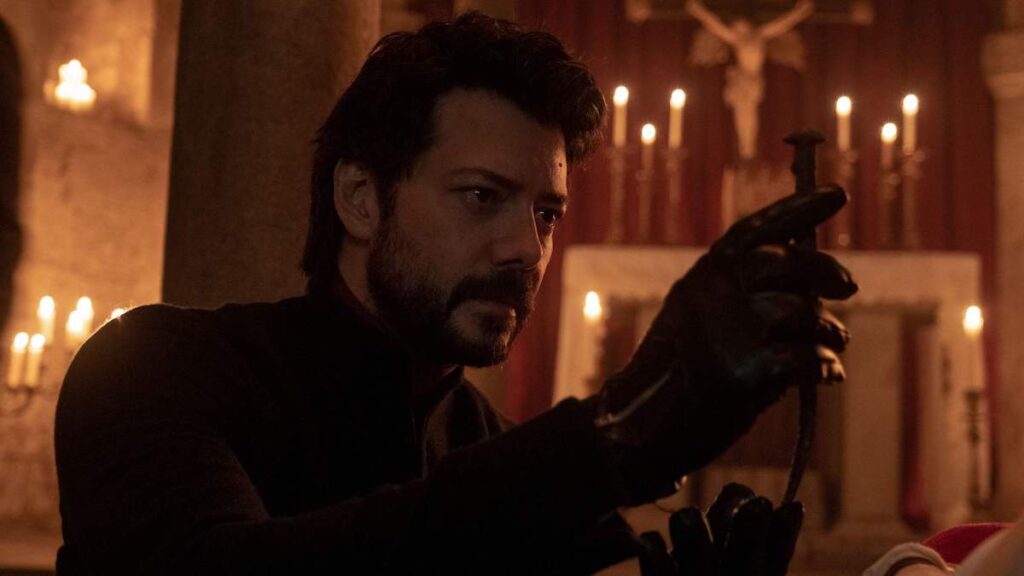
In search of the meaning of life, Cecilia came to Italy, not knowing Italian. She is an outsider here, although everyone tries to convince her that she is one of them. The sisters look askance; the mother superior decides to show the nail with which Jesus was nailed to the cross on the very first evening; the cardinal ominously extends his ring for a kiss. The existential burdens of the American woman do not particularly bother anyone except the handsome priest (Álvaro Morte), who was once a biologist and found God in some unusual way.
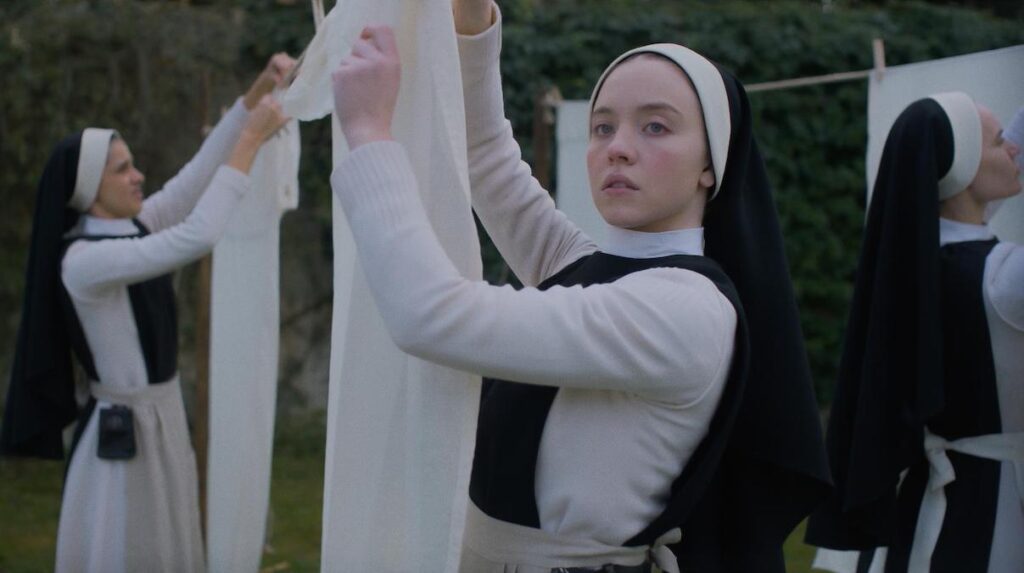
Cecilia's best (and only) friend becomes another novice nun, Gwen (Benedetta Porcaroli, whom we will now follow), and the best moments of the film are associated with her. A kaleidoscope of the friends' first weeks in the monastery, set to unexpectedly cheerful music, already justifies the money spent on the ticket. Here the sisters laugh at something with an elderly nun. Here the monumental interiors of the Catholic monastery shrink to claustrophobic corridors (excellent work with space). Here Sydney Sweeney demonstrates a plane at dinner, here she winces at the sight of a chicken being killed, and here she herself needs to kill that chicken. In general, the fate of the monastery chickens and the chest of actress Sweeney (to the delight, for example, of the author's neighbors in the row) sometimes occupy director Michael Mohan even a little more than religious issues.
Everything in the friends' lives falls apart when it turns out that Cecilia is pregnant. Moreover, she did not break her vow of chastity — it just, so to speak, grace descended upon the star of "Euphoria". Then everything inevitably slides into the mysterious intrigue indicated in the title (yes, this is another horror film about immaculate conception), Sweeney begins to portray predominantly one emotion, as do all the others. In B-grade Euro-horrors, the scariest thing is when the plot starts to develop for some reason. Until that moment, as a rule, they can still be watched. After that, it's not worth it.
In this case, the plot is built on mixing and shaking several great films. The American woman's entry into a hostile closed female collective is borrowed from Dario Argento's "Suspiria". The idea of ominous people in red masks was given by Mario Bava (the great "Six Women for the Murderer"). The theme of pregnancy — unwanted, imposed, ominous — first received serious treatment, it seems, in Roman Polanski's "Rosemary's Baby", which the authors have certainly watched more than once. There was also room in this cocktail for the classic "The Omen", and "The Reaping" from 2007, and many other things. And strangely enough, the forgotten conspiracy thriller "Coma", also about mysterious experiments around and about pregnancy. For some, it's classics, for others, a treasure trove of plots.
In fact, there is nothing wrong with stealing from Bava and Argento. Better directors than these two in the seventies and now are hard to find, and besides, they are stealing for a good cause. And making a Catholic horror film with Sydney Sweeney as a nun is undoubtedly a godly deed. For an hour and a half, the clichés of such films come to life on the screen, as if we haven't watched completely identical films for so many years about how scary it is to be the Mother of God. "Immaculate" is not the most original, but a very authentic movie. It resembles antiquities and is dedicated to antiquities, but everything is done with such visible pleasure that it is easy to forget about the plot inconsistencies.
Although one can't even talk about inconsistencies. For them to exist in the plot, the plot itself must exist. Here, a story of kindergarten simplicity is retold with such attention to each scene and at the same time a complete unwillingness to think about the plot as a whole, that at some point you forget what it was all about.
The fact that the film is built on omissions — what it all was, who was born, how it was conceived, who the people in red masks are, where Gwen went — has, however, a certain charm and some honesty. It is clear that when something is not explained in a film with the localization "Immaculate", it means only one thing: they simply didn't come up with a coherent explanation. In this sense, it is pleasant that the audience was not deceived by trying to prove the opposite.
True, regarding the main mystery — how Cecilia actually got pregnant — the creators couldn't resist and decided to explain everything. Unfortunately, it still didn't become clearer. The priest explains that Cecilia is a victim of his experiments (obviously approved by the Catholic Church), and meaningfully nods towards the nail (the very one from the cross), saying that the answer lies in it. Sydney Sweeney nods understandingly. Did she get pregnant from the nail? How many hours does one need to stare at it or pray to think, "If only we could make children out of these nails"? There are no answers, as usual.
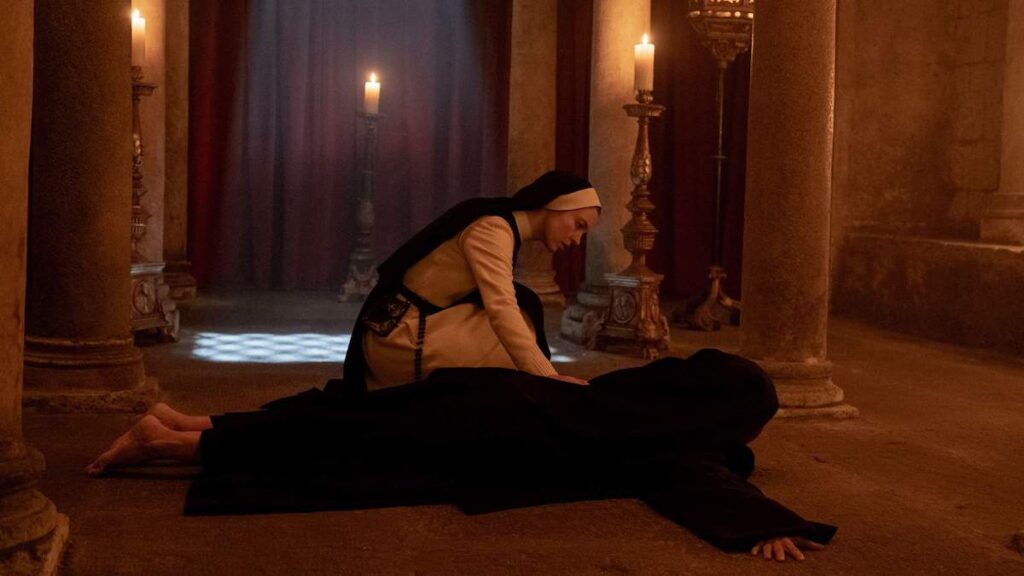
Moreover, the moral, or one might say political, content of the film is, on the contrary, quite obvious. It is not an anti-religious pamphlet, as one might think, but rather an invitation to a conversation about abortion and women's emancipation. In our latitudes, these are relevant topics, and it is a pity that only at late-night screenings of B-movies can one hope for their coherent discussion.
The tragedy at the center of the film is that when Sweeney is recognized as the new Mother of God, she loses all subjectivity, becomes not a person but a religious artifact. In status, she is somewhere on the level of that same nail, only alive for some reason. Her task is to give life, not to live her own, and the only way not just to find herself but to remain herself in a world where she as a person is not really needed by anyone is to fight. Everyone around, on the contrary, persistently teaches Cecilia that the meek and obedient will be rewarded.
It is also clear that Christ's feat was, among other things, that he could have saved himself from unjust execution but did not. However, this lofty example, no matter how much Cecilia wants to follow it, can hardly help her. Her drama is that she would like to show Christian virtues in a world where they are corrupted. Where showing meekness means becoming another faceless victim of oppression. This is a tragic situation, and Sweeney shows the heroine's torments with unexpected sensuality.
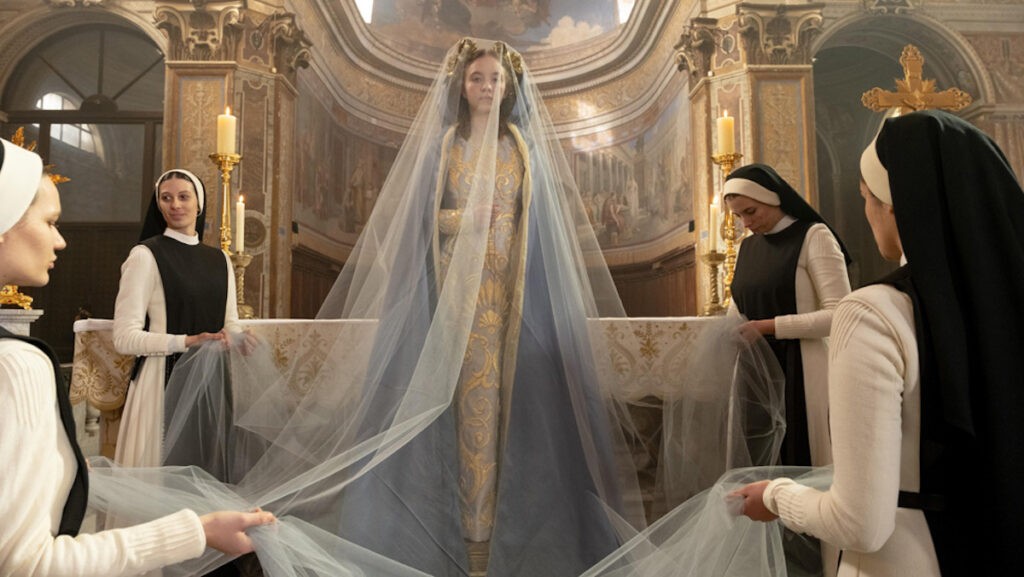
Several subplots — conspiracy theory as a way of explaining reality, the phenomenon of being chosen, the problem of the possibility of bringing about the Second Coming — are also quite interesting, but due to lack of time, everything too often boils down to cheerful nonsense. In the muddled finale, for example, the pregnant Sweeney turns out to be quite a fighting unit (if she had met Bruce Lee himself in the monastery catacombs, he would have been better off afraid) and escapes from captivity through a hole in the ground. It is clear that the hole symbolizes the womb, and Sweeney, climbing out, is reborn, but the rest is still unclear: so what does the nail have to do with it after all? And yet, "Immaculate" is the first Christian horror in several years that leaves questions. And captivating ones at that. Isn't that a reason for euphoria?
Comments
0No comments yet.
Sign in to join the discussion.