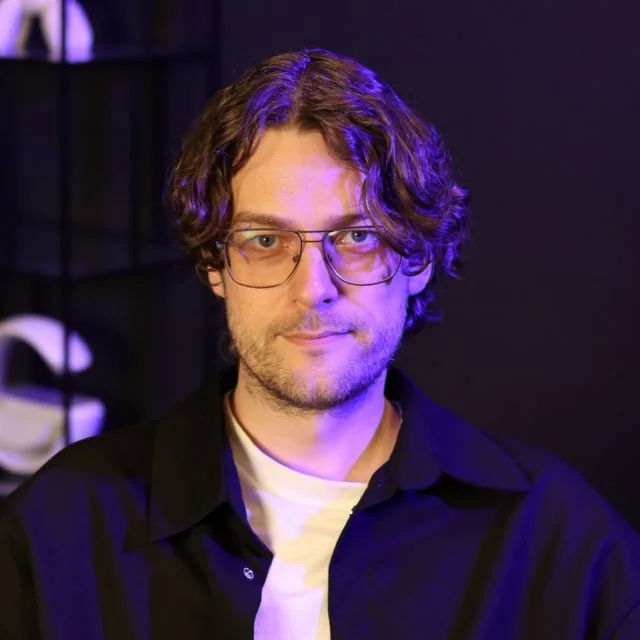

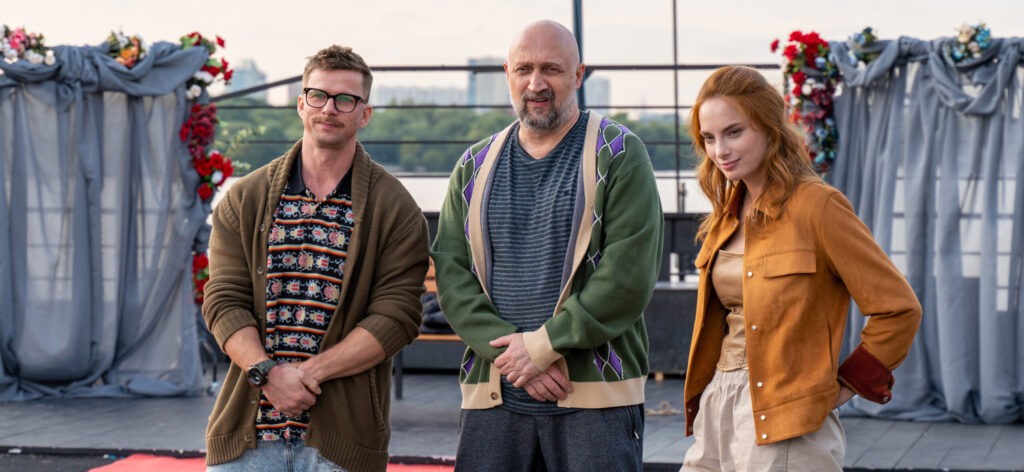
The debut season of the series 'Red 5', in which a former special agent hunts down criminals with superpowers, has concluded on the online cinema Premier. The main antagonist of the project is Lilac, played by Maria Lisovaya. We spoke with Maria about what inspired her for the role, how she manages to create on-screen chemistry with her partners, and the most important qualities for an artist.
– Let's start, of course, with your latest project. Tell us, which character did you look to when creating Lilac from 'Red 5', or what inspired you?
In one of the early versions of the script, the villain was a man. But then the creative team decided that an antagonist in a female image would look more interesting.
We thought about how to make the character deeper, adding nuances. So, from a simple antagonist with nothing in common with the main characters, she turned into a strong, cruel, and interesting girl who has a direct connection to the central characters – Bekishev and Anatolich. And in this tangle of relationships, including professional ones, lay the cool arc of my heroine, which allowed me to reveal myself as an actress over time.
The main inspiration for Lilac is Villanelle from the series 'Killing Eve'. She is a girl with a childlike face, a person who perceives the world like a child. But at the same time, she is a ruthless killer, ready to tear people's heads off. We wanted to embody something similar in Lilac. Of course, we have a comedy, a completely different story, but we wanted to try to transfer some essence to our heroine.
– Did you enjoy playing a villainess? Or is it not in your character at all?
In my filmography, there are many ambiguous characters with complex personalities who don't always wish well for this world. I was interested in working with the image of Lilac. She is a very mischievous, energetic, absolutely crazy girl. I could let loose as an actress.
– So, there was a lot of improvisation?
Yes, we suggested some ideas and additions to the existing scenes to Zhenya Shelyakin (editor's note – director of the series 'Red 5'). At one of the first script readings, we met with the entire cast and discussed the nuances and what we would like to include for a long time. Zhenya heard us and got excited about many ideas.
When we started filming, new solutions appeared on set: we removed some things, added others. In general, the process was very lively and creative. There were cases when improvisation went somewhere wrong, so some things made it into the final version, some didn't, some turned out unimportant, some caused a wow effect.
– Like the fencing episode?
Initially, this scene was planned as a fencing one. At least, it was in the script. But then over time, the idea was dropped. I asked Zhenya: 'When will we set up the fencing?' He said it wasn't needed, we'd remove the scene and do it differently. But I couldn't come to terms with the thought that this small but pleasant detail for me was removed (editor's note – Maria is skilled in fencing).
I insisted on my own, convinced the director that without it the scene would be boring, and this way we'd get a cool episode. I invited my fencing teacher to the set. It seemed to me that this was a big challenge for my partner, who, moreover, was in heels. And in general, it was quite difficult to quickly come up with and execute a sequence. But we handled this small, but, as it seems to me, very sexy detail like female fencing very well.
– I agree, it turned out spectacular, especially in the context of the episode's narrative. Continuing the topic: do you generally like it when your own character traits, hobbies, and so on are reflected in your heroines? Or is it more interesting for you to embody images of people completely unlike you?
Rather the second. I, so to speak, 'flew out of the nest' where it was forbidden to start from oneself, where you always focus on the character. I studied at the Shchukin Institute, where the approach to the role, to the image, to its creation, 'catching' it from life is important. You spy somewhere, try to bring it to life through yourself, then imagine further.
Anyone can do it from themselves, but here it's completely different. So I try to do this, to the best of my talent, of course. It's always interesting when you can be someone else, not yourself, when your traits don't follow you, but you are in search.
– You have experience filming both historical projects and blockbusters, and now a parody spy series. Which format do you find more interesting to work in?
Probably, in comedy I get the most pleasure. In all other genres, I have to search for myself, and that's always difficult. I generally try not to get involved in melodramas. I think I'm allergic to them.
– Why?
– This genre is hard for me; it often presses on the viewer's tears, tenderness, or sweet love stories. I don't watch melodramas as a viewer, and as an artist I feel inorganic in them.
– In one interview, you said that to immerse yourself in the context of a story, you read additional literature, search for information on the internet, and even listen to music from that era. Is this a universal approach or does it depend on the project? Perhaps for a comedy like 'Red 5', you had a different way of immersing yourself. Tell us how it generally happens.
It varies. For historical projects, additional information is needed to rely on. Especially if real events are the basis. This cannot be ignored. When you participate in such films, you try to soak up historical documents, films, music, letters.
In the case of 'Red 5', I had references. For example, I recalled the series 'Killing Eve', observing how the characters develop there. Additionally, I tried to feel the rhythm – quite fast – through similar projects. Those where jokes are born quickly, easily, and sparklingly. Among these, I can highlight 'The Inbetweeners', a very funny series in my opinion.
To some extent, I feel overlaps with 'The Favourite' by Lanthimos. There is such amazing and elusive humor there, even more than just humor.
– That's unexpected.
Yes! The actors exist in the frame so well there. If we have joke-beats, then there the humor is at the level of relationships, and it's easily readable. I laugh when I watch it. It inspires me.
– What do you enjoy most about working on set?
I enjoy coming to makeup and seeing the transformation process. With each visit to a new department – makeup, costumes, props – you transform more and more. And it's a great process, actually.
On one hand, cinema is sometimes a very difficult thing for all team members. I think the director, cinematographer, producer, lighting designer get more tired in this sense than the actors, because their process is continuous and they have very little time to breathe. But if you get into it, you can't stop loving it. It's a different reality that you manage to immerse yourself in. You get a kick out of living new lives each time.
I generally get a lot of pleasure from the process, especially when there is an opportunity to improvise, when I trust the team, and all partners are on the same wavelength.
– Let's talk about chemistry. How do you create chemistry with other actors? Are there any exercises or approaches that help establish an emotional connection with your co-stars?
I'll say this: I'm a closed person, but when I come into a new space, start collaborating, and engage in the process of co-creation, I become open to partners, they become friends to me.
Of course, we are all people, each with their own character, temperament, and situations vary: someone is dissatisfied, another didn't get enough sleep, etc. I treat everyone cautiously, but if I feel that the person is mine, I immediately open up, and we can engage in creativity wonderfully.
And vice versa – if I feel sharp edges, I treat the person very respectfully and just do my job. Although sometimes I'm afraid of someone. You know, it's like entering a cage with a tiger – it's scary, but you overcome those fears, try to survive.
– Interesting comparison. What were the filming of the series 'Red 5' like? It feels like you had a fun atmosphere and everyone enjoyed it.
Yes, I can say that from the first meeting, the first reading, we immediately understood that we were on the same team, could relax, and not worry.
Although at first, it seems to me, I had some nuances with Roma Kurtsyn, which we overcame (laughs). I don't know, maybe I imagined it, but it seemed to me that we existed on completely different wavelengths, joked very differently, and didn't understand each other at all.
I thought then: 'God, will nothing work out for us? Will we part as enemies?' But a little later I realized that it's just a different humor, it works differently.
– Did you discuss it with him later?
Let's say, I told him a couple of times: 'I thought you were crazy, but you're actually a normal guy.' Not that we discussed it directly. I don't even think Roma noticed that anything was wrong. Perhaps it was only my impression that we couldn't understand each other or keep a conversation going.
Now we communicate perfectly, send each other very strange jokes on Instagram*, reply to stories, and so on. That is, with completely open souls towards each other.
– Let's take a break from cinema for a bit. You recently starred in a music video for the legendary band 'Moral Code'. What music do you listen to yourself?
Various. I can't say I'm a fan of any particular genre or style. I definitely like what polnalyubvi does; she mesmerizes me. I listened to one of her tracks for days on end. Her style and manner touch me.
I also love techno. I often go to events related to techno music. I used to love Eminem, 50 Cent, adored cool guys, rap, how they could spit everything out quickly. I even tried to beat their speed records for a while (laughs).
I listen to classical and folk music. I really love folk music, I even sing it myself.
– You have repeatedly mentioned that you are interested in ecology, promote Zero Waste, etc. What projects are you currently developing in this direction?
There are no global projects now. There was one that was supposed to happen last year. It was related to content where I was to participate as a heroine or co-host, but it didn't happen.
There are no film projects, festivals, or eco-center openings. For now, I'm focused on cinema and maintain a lifestyle that doesn't contradict my views. I bring my own dishes to shoots. I suggest to producers to replace plastic tableware with reusable ones from my kitchen. Often companies meet me halfway. In this way, I feel my contribution.
– Are such suggestions not met with hostility?
It happens. Once, it seemed to me, they twirled a finger at their temple when I suggested something like that. One of the executive producers said 'yes, yes, yes' when I approached him with this issue. Then at some point, I just saw in his eyes that nothing would happen. Well, okay, it's my job to suggest, theirs to react. Most often, people react well to this, sometimes they even become more ardent eco-activists than me.
– If you were offered to star in a film or series that promotes a positive attitude towards ecology, something in the spirit of 'Extrapolations', how would you react?
A difficult question. I think I would agree, but on the condition that the project is well-made and not only promotes eco-friendliness but also carries artistic value. For me, cinema is not propaganda, but a conversation with the viewer about something important and necessary.
– Excellent answer. Everyone should remember that. And what do you think, should a young actress in Russia be somewhat of a blogger to become a big star?
Unfortunately, yes. I always thought it wasn't so, that these are different things. I believed that the greatest value is the fact that you live your life absolutely quietly and modestly, no one recognizes you, but knows your roles. But over time, I realized that it won't work that way. Although I don't even know when it could have been otherwise. In the last century, actors were somehow on a pedestal. Of course, they weren't bloggers, but they could always say something important, influence the masses, change people's consciousness.
Today, to be remembered by anyone at all, you often have to resort to blogging. I'm against it. Honestly, I'm not even good at it. I really envy those actresses who can combine blogging and acting, because a lot of time goes into the craft, including free time. If you don't have shoots or performances, you're still preparing for new roles. I don't find the time or enthusiasm to create a content plan. I'm more interested in doing what I do professionally.
Someone once told me that Instagram* is very necessary because that's how people find you. And I got my profile about 5 years ago, much later than it launched in Russia. When everyone was on social networks, I didn't even know what Instagram* or Telegram was.
– Do you plan to develop in this direction somehow? Maybe through 'I don't want to'.
I made attempts through 'I don't want to'. I talked to content managers who help build a plan, refine the profile, etc. I lasted for about three meetings. And then...
Of course, I do some things. Sometimes I tell myself: 'Masha, you must post 3 photos, 3 stories, and something else next week.' I start doing it, but at the moment when I need to publish the photo, I look and think: 'Why? Who needs this?' Some existential arguments with myself begin. I try to understand what artistic value there is in it. Usually, what I find valuable goes unnoticed by subscribers. And when I post some nonsense, everyone immediately reacts vividly.
– That's how people react to life! Something random, spontaneous, is what people like. In one interview, you raised an interesting topic about what an actor should be: a recognizable personality or always different. Which approach is closer to you?
I'm for the second option. It's great when your roles are all different, and the viewer remembers them, not you. Although this can be debated. If you are a strong personality, if you yourself are a character, then you can be who you are and simply 'fit' into series and films organically, complementing them with yourself. In this, it seems to me, there is nothing shameful.
But another question is if you, perhaps, are not so bright as a personality, and you don't try to change yourself in any way, but simply carry yourself, such a gray, strange, incomprehensible one, from film to film... Is it interesting for you yourself as an artist? I'm more interested in trying different things, not hardening.
– What was the most unexpected and interesting reaction from people when they found out you were an actress?
I remember one case. It was some kind of item exchange at an eco-center. At that time, I had just released the series 'An Hour Before Dawn'. I remember coming to the checkout to buy something, and the cashier screamed when she recognized me. She reacted very vividly, ran up, asked for a photo. On one hand, it was pleasant, on the other, not very comfortable. I don't know how to behave in such a situation.
There was also a case on the set of a short film. A guy, an extra, came up to me and asked: 'You're an actress, right? Where have I seen you?' I look at him and think: 'Are you kidding me? Should I list my works?' (laughs)
– Give them a link to Kinopoisk!
Yes, usually on big shoots I say that – check Kinopoisk, maybe you'll remember something. Honestly, I don't feel like listing them. Otherwise, it turns into a very stupid scene. You stand and say: 'Maybe you saw me in 'Guardian of the Galaxy'? No. Then maybe in 'The Method'?'
– How do you generally interact with fans and viewers? On social networks, for example?
I correspond, try to reply when I have time. In general, I don't really like communicating on social networks. I don't know how to do it. And people sometimes get offended when I don't answer their detailed questions or when I don't agree to meet them. It's not that I've become conceited or anything like that, but I don't give out personal data, don't meet subscribers in person, etc.
I love humor, when you can exchange jokes. Or, for example, I like to share useful information. In my Telegram channel, I tried to focus on my experience abroad. I talked about various useful things: interesting places to visit, services, my impressions, and so on. And Instagram* for me is about entertainment content. There I can share photos, talk about new projects, discuss theater.
What else I'll note – I definitely don't accept hate. Neither towards myself nor towards other subscribers. I give one warning; if it doesn't work, I apply sanctions.
– In one interview, you said that you chose acting over other creative pursuits because you wanted something more voluminous. What do you mean by volume? And how much have your desires and vision coincided with the realities of the acting profession?
By volume, I mean the feeling of life. This field has given me a lot in terms of understanding myself, other people, and the life around me. It seems to me that the literature you read during training or when you're already working in cinema enriches you, saturates you, and you become softer, more flexible, somewhat of a philosopher.
In general, acting is a multi-component, very complex matter, where there is psychoanalysis on one hand, and on the other, it's important to find some artistic value. It may sound global or too pompous, but in cinema, you must become an object of art. It's very cool when you move in that direction.
– Interesting opinion. Are you on the path to that?
So far in perspective. Of course, I dream that my roles will be taken into film schools, institutes, analyzed, as is now happening with Soviet cinema, with the images of Yankovsky, Smoktunovsky, and others. Their roles truly remain in memory and can serve as examples for future artists. I want that, but so far it's not there.
– I've always been curious how actors themselves watch movies. Do you notice details, nuances of acting, or do you turn off professionalism and give yourself over to the story?
Both ways. On first viewing, when you see that the work is done well, you can switch off and enjoy it. If the performance is bad, it's hard to stop yourself from analyzing why it didn't work.
On repeated viewings of good cinema, I try to figure out how it was done, why I like it, how they achieved it, what secrets can be uncovered there.
– Do you rewatch your own projects to understand what worked and what could have been done better?
I don't rewatch them multiple times. Usually, I watch when projects are first released. Not all of them, by the way. Sometimes time needs to pass for me to watch. Sometimes it's better not to see some things right away, or you can get very upset and stressed. Better, you know, to watch in about 10 years and say to yourself: 'Ah, I was young then, so it didn't work out.' Or, on the contrary, you watch in 10 years and think: 'I was not bad, there really is something to hold on to.'
But otherwise, I certainly watch my fragments, draw conclusions for the future: how to do it, how not to. I try to learn from my mistakes. I don't know how successful I am, but at least I try.
– What will you take away from filming the series 'Red 5' for the future?
I have few scenes there, all appearances are short, although towards the end they become voluminous, detailed, complex. Sometimes I didn't think much about it – each appearance should be like a cannon shot. And that's a certain approach to how to play the scene, how to exist in it.
Of course, editing also decides a lot, and some things are emphasized or, on the contrary, everything that you thought you did great on set can be re-edited so that you become gray and unnoticeable.
There were scenes in 'Red 5' that after watching I thought could have been done differently. They are short, they could have been made brighter. But that's my pain.
– Name three most important qualities for an artist.
Patience. Openness. The ability to generate energy so that it doesn't run out.
– Final question: if you had the opportunity to ask actress Maria Lisovaya a question at the current stage of her career, what would you ask? And what would the answer be?
I would ask her: 'When will you take up professional vocals?'
She would answer me that she will do it next month. Because it's important to me. In some performances, I sing and sometimes feel my helplessness. I've been doing vocals for a long time, but in the last few years I haven't had a permanent teacher who could help me occasionally, suggest some things. Today I had a performance where I had to sing. I again felt this lack of practice. So I asked myself that question today.
*belongs to Meta, which is recognized as extremist in the Russian Federation.
Comments
0No comments yet.
Sign in to join the discussion.