
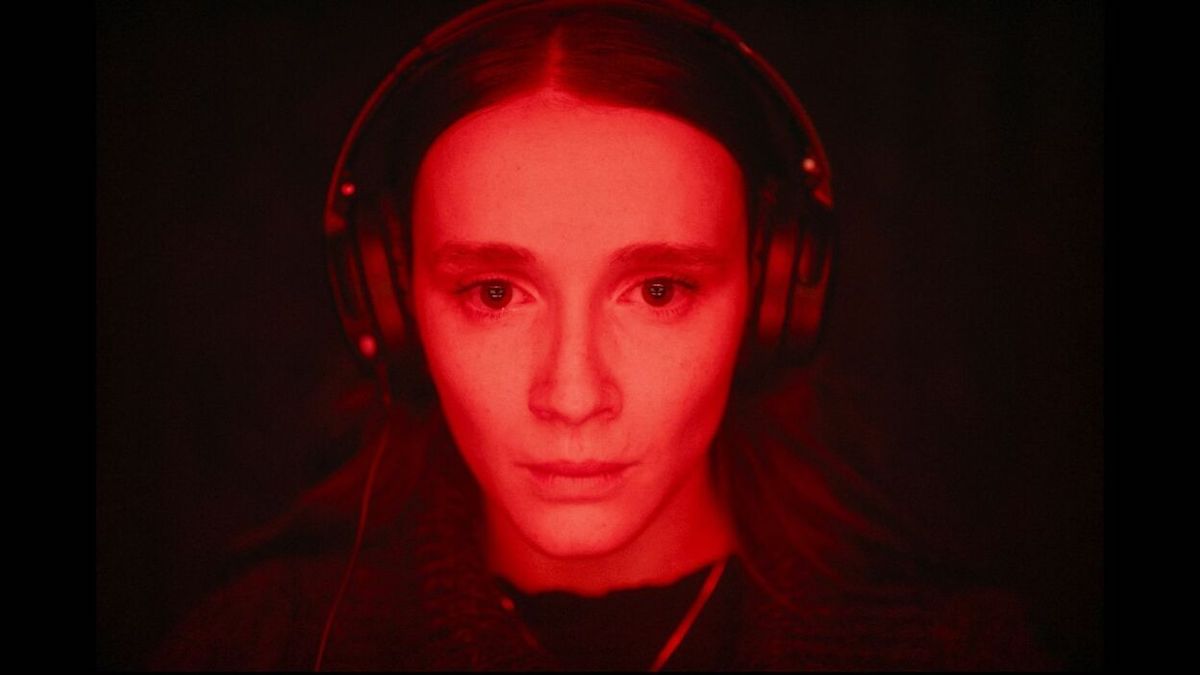
The film 'Red Rooms', a Canadian thriller about the darknet and a big hit in narrow cinephile circles, has been released. About why this movie about maniacs, their fangirls, and online poker lives up to its quiet fame—in our review.
Kelly-Anne (Juliette Gariépy, outstanding), a young woman, spends nights at the courthouse to get in line for the hearing of a high-profile case. A maniac tortured, killed, dismembered teenage girls and filmed it all. And not just filmed, but streamed it on the internet. The darknet, to be precise. He has been found, it seems, and is now on trial. Dominick Chevalier (Maxwell McCabe-Lokos), a balding middle-aged man with sad eyes, will spend the entire film in a glass cage while a cunning lawyer and an active prosecutor argue about his fate, and the jury prepares to decide it. From the corner of the room, Kelly-Anne and other curious onlookers watch.
The very first court session is stretched by director Pascal Plante to twenty minutes to make clear the main thing that a trial can teach: evil is banal and boring. Especially when it is described rather than shown. The events then unfold not too swiftly either, but the meditative narrative style proves captivating, as was customary in giallo cinema. Like Dario Argento and Lucio Fulci, director Plante professes a love for blood red, though he finds its shades more on the monitor screen than in violent scenes.
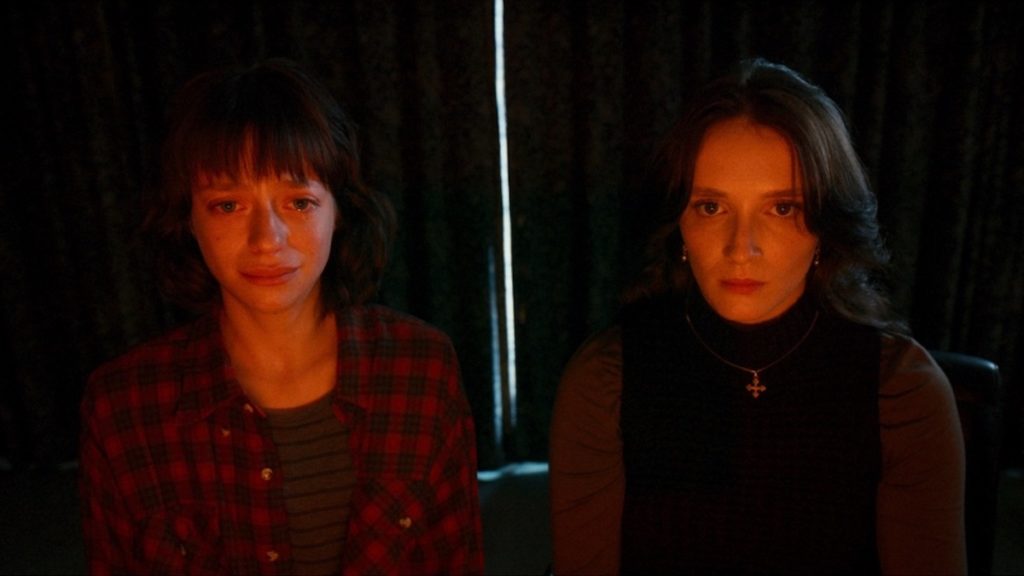
A significant part of the film, Kelly-Anne spends in the darknet, only emerging into the real world with visible effort. And that world, characteristically, is significantly darker than even the darkest corners of the internet. And it is just as easy to get lost in it. The jury must seek truth in a labyrinth of contradictions. The girls killed by the maniac simply turned the wrong way at some point. Chevalier's groupies look for errors and forgeries in the prosecutor's work to justify the dear murderer (and he has a fan club like a seventies rock star, which seems an important thought for Plante). Clémentine (Laurie Babin), with whom Kelly-Anne becomes friends in the courtroom, also, generally, didn't come from a distant city with loving eyes to look at a potential maniac out of a good life.
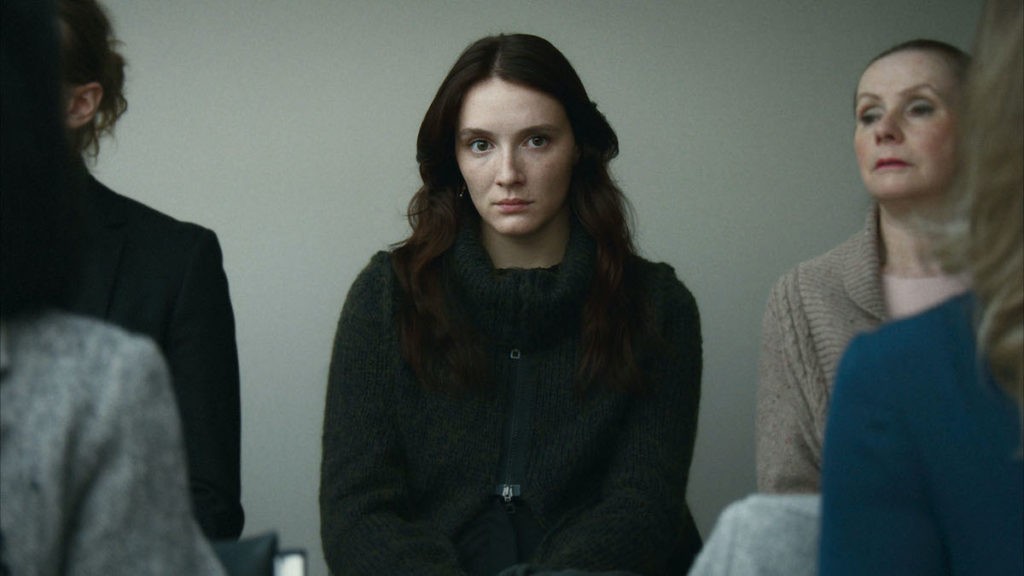
The problem of the gaze is generally central to the film; here, both the dead and the living are all staring at something. Understanding that the power of a thriller lies in omissions, in the impossibility (at least until a certain point) of deciphering the plot's logic, Plante does not seek to impose his interpretation, does not rush to reveal his cards, and is not particularly fond of scattering meaningful hints. 'Red Rooms' as a thriller surprises precisely with its formalist seriousness; it is rare cinema about the nature of observation that truly has the patience to look at its characters rather than explain them.
And the viewer is also quite free to choose how to watch (at) this film. One can analyze its genealogy in cinema. There were, for example, films like 'Videodrome' and 'The Demon Lover', and they too were about snuff videos in open access. Good films, of course, but Plante is still not Cronenberg. And not Argento, although giallo is indeed actively recalled. Argento himself would have run wild on such paranoid material and on 'Blood Red Rooms', especially since both the main character and her friend are typologically from his golden period.
One can trace the roots of the symbolic images used by the director. The surname Chevalier, for example, translates from French as knight, the voice assistant Guinevere shares a name with King Arthur's wife, and the heroine has on her computer the painting 'The Lady of Shalott' based on Tennyson's poem. The sorceress Shalott sat in a tower and wove, because a mysterious curse prevented her from looking out the window, and she could only see the world through a mirror. One day she couldn't resist—after all, Sir Lancelot was riding by—and looked at the world, so to speak, without filters. Her yarn broke, the loom broke, the mirror cracked. She got into a boat, sailed away, and soon died.
This is a slightly more promising direction for analysis—the film indeed has, firstly, the motif of isolation, the heroine's detachment, and secondly, a general feeling of the world's impenetrability to knowledge. In the darknet, everything is not what it seems. In the courtroom, most often too. Television lies, video is easy to fake, no testimony is entirely reliable. At the same time, not only the heroine but also the viewer finds themselves in Shalott's position. We are never shown what everyone gathered for—the coveted snuff videos. We see torture, murder, and dismemberment only in reflection: as horror in Clémentine's eyes, as curious longing on Kelly-Anne's face.
However, it is unlikely that Plante simply wanted to retell a favorite poem; it is even more doubtful that it was love for the Arthurian epic that ensured the film's rather fantastic popularity for a low-budget French-Canadian thriller.
Plante made primarily a detective story, but perhaps not quite an ordinary one. A classic detective novel is built on the mirroring of the criminal and the detective; they are both floating elements in a social structure that is quite rigid for others. The foreigner Poirot is always, as it were, disconnected from his surroundings; Holmes deals with English aristocracy in one case and American Mormons in another. But criminals too most often seem to renounce their social status, tearing the fabric of social order. The popular idea that to defeat the dragon, one must become it, is fully revealed in detective fiction: there would be no criminal more terrible than Holmes, only his good will keeps the world afloat. Plante quite unexpectedly turns this scheme of things around.
To prove Chevalier's guilt, to defeat the maniac, Kelly-Anne becomes not like him, but like his victim, takes her place, assumes a weak position. Only by playing the victim does she succeed as a detective. The principled refusal to take the place of the maniac, to use his means even on a symbolic level—this, if you think about it, is a rather astonishing model of investigation, something you don't expect from the notorious male gaze.
And it is precisely in this context that the motif of isolation, the doom of communication with the outside world from the story of Shalott, truly becomes relevant. Kelly-Anne can overcome the position of an observer, step out of the tower, so to speak, but not in her own capacity. To participate in the plot, she must adopt someone else's narrative. Perhaps not become a victim, but play one. There is no place for her in the world as herself. The melancholy of the final frames seems to be precisely this: everyone eventually fits into predetermined life lines—from prison to the psychologist's office—while Kelly-Anne, having played someone else's role in someone else's life, distances herself from the screen. And in this uncertainty, there is surprisingly little hope.
Comments
0No comments yet.
Sign in to join the discussion.