

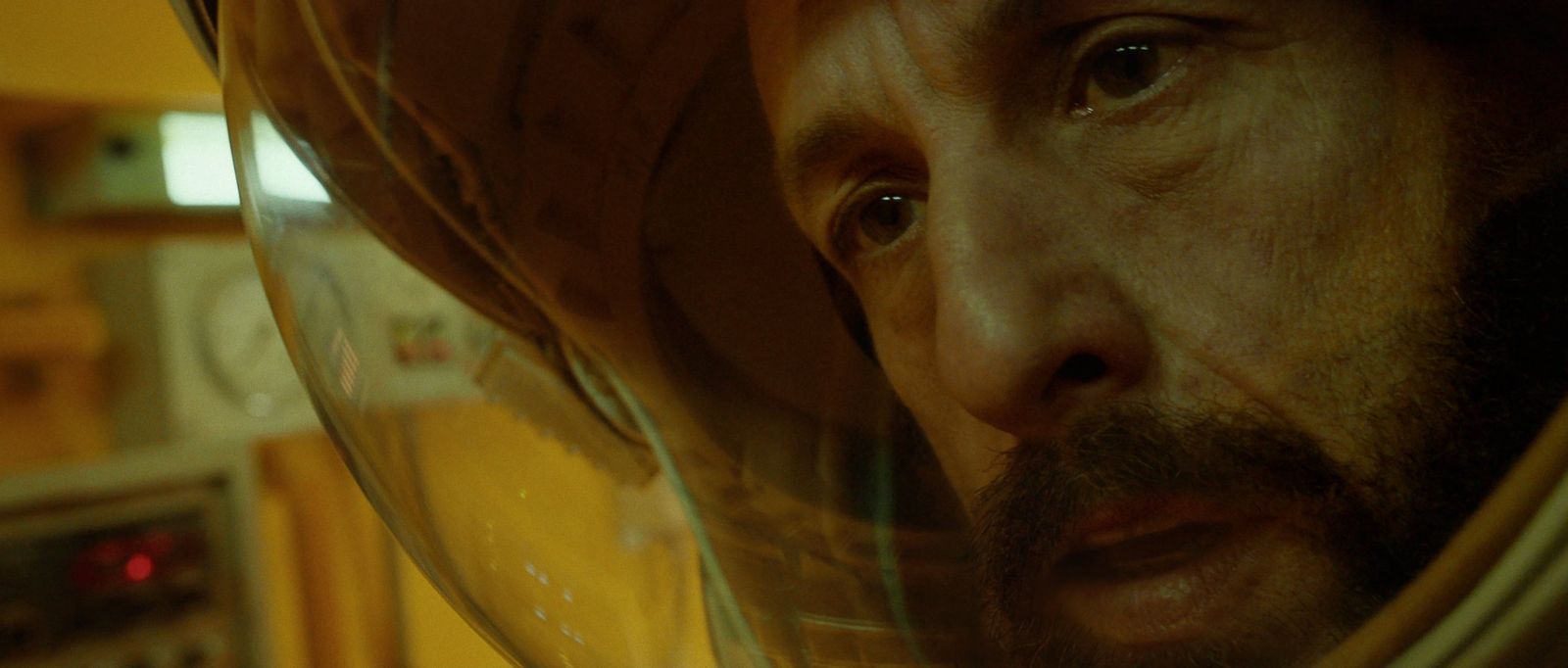
In the new film from 'Chernobyl' director Johan Renck, Adam Sandler plays a deadly tired cosmonaut who, together with an alien spider, tries to comprehend the mysteries of the universe. But it doesn't quite work out.
A certain utopian, temporal nothingness – that's probably how one could characterize the time setting of the film. The reality is neither future, nor past, nor present, but in any case alternative (the Czech Republic suddenly becomes the leader of the world space program).
Czech cosmonaut Jakub Prochazka () is on a space mission and has been alone in orbit for six months. The thing is, not long ago, a strange, frightening, and incredibly beautiful lilac cloud was spotted above the planet's surface, consisting of either constellations or nebula clusters. In any case, it was necessary to urgently find out what it was and whether the cloud posed any threat to Earthlings. After a long competition, Jakub became the sole participant in the space program. Nearly a year later, his mission is coming to a successful conclusion: the Czech ship has overtaken the South Korean one, data about the cloud will soon be collected, and Jakub will return home.

Adam Sandler, in collaboration with Netflix, presents the film 'Hubie Halloween'. A family comedy on the theme of Halloween and a magic thermos in our spoiler-free review.
Open material
Six months of solitude, however, do not pass without a trace. Jakub is deadly tired, he sleeps little and suffers from nightmares, the toilet on the ship is malfunctioning, and the cosmonaut cannot get in touch with his wife Lenka (Carey Mulligan), who decides to break up with him. And most importantly: an alien suddenly appears on the ship in the form of a giant spider (the insinuating voiceover in a languid half-whisper by Paul Dano), who calls Jakub a 'skinny human' and asks to become the object of his observation because 'he is drawn to people and intrigued by the loneliness of a human far from home.'
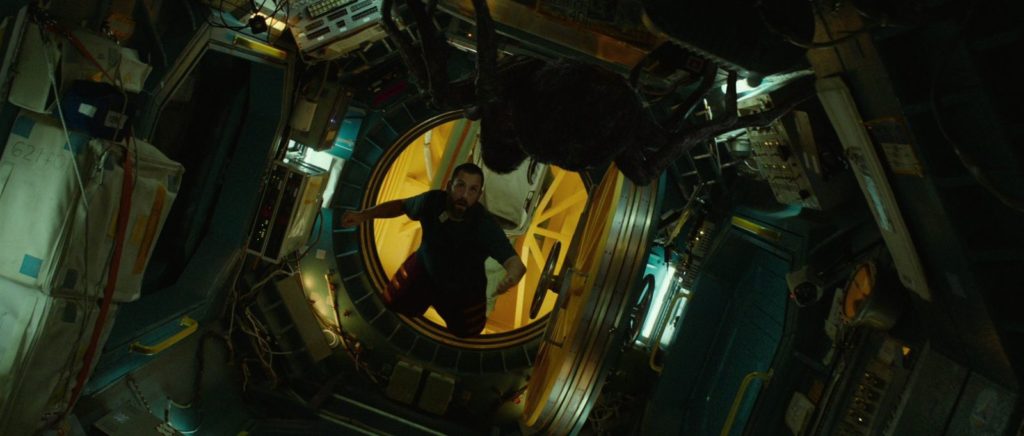
Johan Renck, who previously directed the acclaimed HBO series 'Chernobyl', transferred the late USSR setting from his hit project to the film 'Spaceman', so Jakub's ship has no touch technology, all equipment is button-operated, the mission control center is decorated like a General Secretary's office, and semi-dark brown tones dominate the frame.
But what's more interesting here is this: Renck decides not to pit the protagonist against another monster in space, as many directors from classics to moderns have done before him, but instead delves deeper into the story of global loneliness, when around you there are only stars and dead cosmic silence, taking a closer look at 'the loneliest man in the Universe' (as a young admirer of his feat calls Jakub during a teleconference).
At some point, this works, and the picture, like a huge and inexorable black hole, pulls you deeper and deeper, partly thanks to the timely switching of plot registers and the brilliant cinematography by Jakob Ihre ('Chernobyl'). His lens smoothly follows the hero around the ship, softly and precisely emphasizing the director's thoughts up to a certain point. And that point comes when the director needs to pinpoint what will be the center of his story.
While other directors in this context have always tried to choose sharpness, social, political, philosophical context, or at worst, straightforward genre action, Renck unexpectedly veers onto the tracks of a distilled family drama, where scientific research (never revealed), answers to questions of the universe, Kafkaesque spiders, and even the mysterious lilac fog have no place: Jakub urgently needs to go home, he has realized he was wrong and will never leave his wife alone for so long again.
This narrative is further oppressed by the performance of the talented Adam Sandler, who has proven more than once that he is capable of big roles. But in 'Spaceman', he is so caught up in weary emotionlessness that he meets any event with a stone face: whether it's another toilet repair or an encounter with an alien. The film clearly lacks an irreconcilable rebellious spirit, nonconformist aestheticism, or even just ordinary humor built on the first meeting of two lonely cosmic wanderers. Not at the level of 'Alpha', of course, but something along those lines. But Renck consciously avoids this.
'Spaceman', for all its visual-psychedelic splendor, is a parable about an unnecessary discovery and yet another cosmonaut gone mad in orbit. Strangely, this time the always-working story of temporary insanity, introspection, and the sacred knowledge of the Universe has misfired, turning into a rather tedious spectacle.
Comments
0No comments yet.