
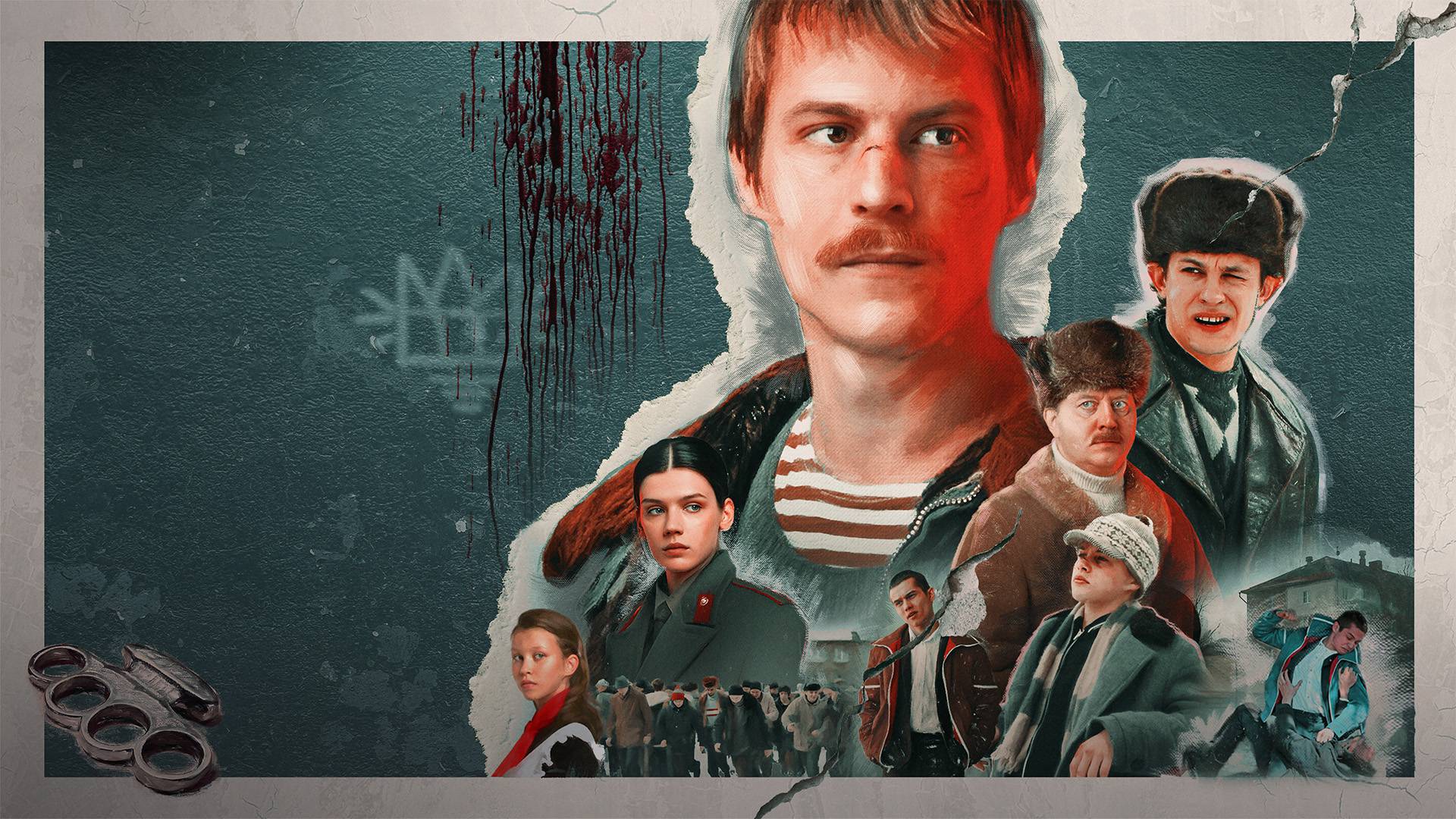
On December 21, 2023, the final episode of perhaps the most popular series of the past year, 'The Boy's Word: Blood on the Asphalt,' was released on START and Wink. Now that the full official story is available for viewing and the hype has subsided a...
Before the series premiere on November 9, hardly anyone could have predicted the frenzy it would stir up by the third episode. Of course, the creators expected success, but on such a colossal scale—unlikely. The furor raised by the project can even rival 'Barbenheimer' (naturally, on a CIS level, not global), but did the series deserve all its laurels and high ratings (8.5/10 on Kinopoisk and 38th place in the '250 Best Series' list at the time of writing)? We'll try to set aside the veil of flattery and talk about both the quality of the series and the media bomb it created.
What's the Plot?
1989, Tatar ASSR, Kazan. A decent guy Andrey (Leon Kemstach) practices playing on drawn piano keys before school. Leaving home, the hero witnesses a scene where a young man in a blue jacket is being chased by several other guys with clearly malicious intent. Andrey hurries to the bus stop, where he meets his friend Iskander (Grigory Dudnik). The schoolboys board the bus, but at that moment, the same youth in the blue jacket runs in with a bloody head, and a stone hits the vehicle's window. Instantly transforming from victim to hunter, the guy harasses Andrey and Iskander, resulting in the first getting hit in the face and the second losing his pocket change.
Later at school after lessons, a teacher singles out Andrey in the hallway and asks him to 'tutor the boy in English.' How ironic, when the struggling student turns out to be the same hooligan from the bus, named Marat (Ruzil Minekaev). Naturally, no serious English lessons are in store as the plot progresses, but there will be joint hooligan pastimes, including theft, looting, smoking, begging, appropriating others' belongings, and other legally punishable acts—so a kind of friendship begins to form between the guys. However, Andrey's relationship with Iskander takes a 180-degree turn: his former friend, for some reason, now attacks Andrey with other guys and demands some unclear three rubles from him.
The young man has no intention of paying and tells Marat everything. Marat supports the decision but refuses to 'step in,' all because Andrey is a chushpan (a young man not belonging to any street gang, i.e., 'not a lad'). Additionally, Marat suddenly starts distancing himself, and Iskander harasses him a couple more times, so our hero decides that to get protection, he must 'attach himself' to one of the gangs. He goes to the 'Universamovskie' (where Maratik is a member). After a test of being a lad, Andrey is accepted into the 'office,' and his new street life begins, which bodes nothing good.
Lad's Flex
Over the past two months, the phrase 'the boy's word' has been unheard only by the very lazy, those living off the grid, or the deaf-mute. The first two episodes of the new series by Zhora Kryzhovnikov were released on START and Wink on November 9, and within a week, the series began to spread through memes and edits. By the finale, it had generated so many news hooks that word of it flew from all sides.

What didn't happen during this time: they wanted to ban the project, Roskomnadzor checked the show, linked it to a schoolboy's murder, leaked a demo version of the last two episodes online, reshot the finale, and every song from the series hit the charts (and even more, because thanks to 'The Boy's Word,' an old track by rapper 1.Kla$ 'Sukiny Deti' entered the top, under which videos were made on TikTok). In short, the project became a real phenomenon, as did the events it tells about.
The script is based on a phenomenon called the 'Kazan phenomenon' (though some might think it's an adaptation of the first part of the track 'Biography' by Krovostok). This is a collective name for street gangs formed in the 1970s-1980s in the Tatar ASSR (mainly in Kazan), mostly consisting of minors. The 'Kazan phenomenon' is also described in journalist Robert Garayev's book 'The Boy's Word: Criminal Tatarstan 1970-2010s' (the print run quickly sold out amid the series' popularity), but despite the similar title, the series is not an adaptation, although the author participated as a consultant.

There has been a lot of talk about the series over these months, and it continues, so there's a high chance our review will get lost among many other materials and podcasts, but we decided not to lag behind trends, and a project of this scale always invites discussion. Moreover, the audience has essentially split into two camps: the first consists of those who fawn over and idolize the show, while the second includes those who fiercely hate and despise it. This happens almost always when something very popular comes out, so the reaction is quite natural. Although this time, it's hard to say which camp is more right, as 'The Boy's Word' has both serious pluses and equally significant problems.
What's Up, Dude, You're True. Did You Forget?
Let's start with the series' positives. First and foremost, its atmosphere. 'The Boy's Word' immerses you in the times when Kazan was territorially divided between gangs. The creators did everything to plunge the viewer into the dangerous environment of late-80s Tatarstan (though filmed in Yaroslavl), showing the lives of gang members. True, sometimes plastic windows and high-rises flash in the background, and some details are not historically accurate, but you want to ignore such trifles, because overall, the setting does its job perfectly.

I don't know who and where saw the romanticization of violence in the project, but it's completely absent. On the contrary, the show practically screams in plain text that such a life leads to nothing good, and the outcome in the vast majority of cases will be very sad. Honestly, it's not entirely clear how shortsighted one must be to want to transport themselves to those times and become one of the participants in these events or a girlfriend of a gang member after watching. What's the point of such a desire? Constantly getting beaten by your own and others? Daily attending some gatherings and obeying harsh 'lad laws'? Risking freedom and life? And for what? For one atmospheric disco under 'Sedaya Noch'? That's too expensive for a dance, don't you think?
No, of course, there is a chance that immature young minds might succumb to influence and see some coolness in what's happening, but the series has an age restriction of 18+. Here, characters smoke, drink, swear, beat each other up, and commit crimes. The creators were clearly aware of the audience for which the show was made. Moreover, explaining to a child what is right and what is wrong is the responsibility of their parents, not a fictional series about the criminal past of our country. If after watching, your child decides to take money from a classmate or beat someone up with friends, that's a question for you first.

Speaking of discos, it's worth noting that the soundtrack of 'The Boy's Word' is truly magnificent. Retro hits by Laskoviy May, Mirazh, Allyans (performed by Basta), and Kombinatsiya have taken on fresh colors, gaining new life, and the title track 'Pyala' by the duo AIGEL simply exploded the charts, becoming a real discovery for many listeners. Each track fits so organically into the narrative that it's now impossible to imagine a different song list for the series. A perfect match, no other way to put it.
I'd also like to highlight the amazing acting performances. Every role is gold. Both the 'old-timers' and the youth look great. Ivan Yankovsky appeared on the small screen for the third time this year (previously 'Fisher' and 'Volunteer's Playlist') and again played excellently (the surname obliges).
It's always a pleasure to watch Sergei Burunov, whether in comedic or dramatic roles. And Nikita Kologrivy, who transformed into Kashchei, is the real diamond of the series. It's amazing how unlike himself the guy is from the recent fairy tale. Such a textured and fitting character for the actor that watching him is more interesting than many others. So when Kashchei disappears from the screen, it becomes a bit duller, and you truly await his return.

The Russian box office continues to be conquered by Alexander Voitinsky's fairy tale 'By the Pike's Command.' We also got to the film and decided to talk about its weak and strong points in our re
Open material
Among the 'newcomers,' the most shining are Maratik, nicknamed Adidas Jr. (Ruzil Minekaev), Turbo (Slava Kopeikin), Zima (Lev Zulkarnaev), and Zhelty (Andrey Maksimov). The guys were very lucky with characters that helped them talentedly reveal themselves. Leon Kemstach, Elizaveta Bazykin, Anna Peresild, and Yaroslav Mogilnikov (who got probably the best, most touching, and dramatic storyline in the entire series) also look decent, but in comparison with their colleagues, they still lag behind. Most likely, the reason is that some simply lack experience, while others got an underdeveloped character in the script, so some managed to stand out more despite roughly the same level of acting.
From a technical standpoint, 'The Boy's Word' is also quite good, although it's completely unclear why Zhora Kryzhovnikov chose such a strange editing style with cutting out unnecessary pauses. It looks as if the frames jump and the project was cut in a hurry and on the fly. Otherwise, there are no complaints about the camera work, direction, or fight choreography. Plus, there's excellent color grading, which also positively affects the previously mentioned atmosphere.
Don't Run, Lads, Your Mothers Still Need You
However, it can't be said that 'The Boy's Word: Blood on the Asphalt' deserved all its laurels. At some point, the series had a viewer rating of 9.1/10 on Kinopoisk, and in the '250 Best Series' list, it was in 4th place between 'Game of Thrones' and 'The Sopranos.' Naturally, the project is not that good, because even with all its considerable pluses, it has quite serious problems. And the main problem is the script. It's funny how Zhora Kryzhovnikov and Andrey Zolotarev managed to create such a cool story with such major blunders.

First, the project hasn't even decided on the main character. Initially, it seems to declare that it's the diligent boy Andrey, who joins a gang, gets the nickname Palto, and begins his journey from a good person to a complete scumbag. We've seen this before, and some of the brightest examples are 'Breaking Bad' and 'The Godfather,' but not only do the creators forget about the hero at some point, his storyline also turns out to be extremely weak.
Leon Kemstach's character seems far from the criminal world and hasn't encountered all the 'lad stuff' for 14 years, but as soon as he joins the 'Universamovskie' gang, he immediately fights coolly, knows all the laws, and doesn't stand out from the thug mass. That's simply impossible. The intelligent young man doesn't even doubt the correctness of his action, doesn't reflect, and doesn't ask questions like, 'Am I a trembling chushpan or do I have a say?' Andrey just stupidly becomes a hooligan at the snap of a finger, denying the chaos around him. Mother gone crazy? Clearly not because of me. Constantly beaten? Such is life. Sister taken away? Definitely not because of my behavior. And so on throughout the season.

Not only that, but they also forced a maximally absurd love line with the juvenile inspector Irina (Anastasia Krasovskaya), who, according to the plot (and in real life), is about ten years older than him. What's the motivation? Why does she care specifically about him, and why does she flirt with him? The viewer was not given any explanation. She just liked him, he chases after her, and she doesn't set boundaries, even though she even has a boyfriend, John (Ivan Makarevich).
The storyline devolves to the point where, during very harsh events with other characters, Palto cringingly (but supposedly romantically) sings in a cafe for Irina. As a result, Andrey's entire storyline, which started so briskly, loses interest by the middle of the series and becomes the most banal and uninteresting by the finale.

The second 'main character' doesn't appear in the first episode (only mentioned), but appears in person in the next. Vova Adidas (Yankovsky) returns to his home courtyard from the war in Afghanistan, and all the lads are incredibly happy to see him. It's immediately noticeable that the young respect him, and the older ones take him into account (though Kashchei is a slippery bastard). His storyline also had enormous potential, but the character wasn't fully developed (though against the background of Palto, he's great).
They could have made Adidas a war victim with PTSD, who struggles with the loss of his comrades, and chooses the lifestyle of lads because of laws similar to war, like 'us/them.' But it turned out to be some kind of carbon copy of Danila Bagrov, without the proper depth like Balabanov's. Although Yankovsky looks great, his character sometimes lacks refinement, though Vova has several extremely strong scenes in the plot, but there are also blunders. His love line is better than Andrey's (you'd have to try hard to make it worse), because there's no age difference between Yankovsky's and Bazykin's characters, so their relationship doesn't look cringey and is at least logical.

The third 'main character' (though almost no one here can be called a hero) is Marat, and his story and transformation as a character turned out to be the smoothest and most interesting. Over 8 episodes, he goes from a notorious hooligan to a person disillusioned not only with 'lad principles' but with life in general (they lost the lad, as they say). His love line is the strongest and most emotional. First love with a tragic finale makes viewers watch the plot with interest, making Minekaev's character the favorite among the trio.
And in these competing conditions, 'The Boy's Word' cannot push one character to the forefront, thereby turning the narrative into chaos from time to time, confusing the viewer. And yet, the project for some reason does not make the absence of a central hero its feature, which would greatly help it in this situation. So in the end, the plot jumps from one line to another, successfully completing three by the finale (one of which is very forced) and abandoning all other secondary characters, like Turbo, Palto's mother (Yulia Alexandrova), or Ildar (Anton Vasiliev), whose fates are completely unclear in the ending.
Perhaps the show will get a continuation and the abandoned lines will be picked up again, but for now, most characters look like unnecessary leftovers that were only needed to set up the finale of our trio.

The second major problem of 'The Boy's Word' was the leak of the two final episodes and the parallel reshoots of the last episode. The fact that viewers had the opportunity to compare the original (though unfinished) version with the final one did not reflect well on the rating (after the finale, the viewer rating began to drop).
And it's not at all that everything was completely different in the original version, and in the official finale, all fates were redone to extend the series for a second season. No, it's just that each version had good scenes, and the director couldn't mold one 'finished' version out of two 'raw' ones. The finale essentially remained the same (Palto's line wasn't touched at all), but with some additions. Marat's line was undoubtedly refined, but Adidas's, although a lot of cringe was cut, could still have been better, considering how good a scene with his father he lost.

In the conditions of leaked materials and reshoots, the director was assembling a puzzle, and with his strange editing style, he cut out some pretty good details, while not abandoning half of the dubious material and forgetting about almost all secondary characters, leaving them undeveloped and empty. Even Kashchei, who appeared for a minute (the only one who got a happy ending), did not save the final episode. As a result, the emotions after watching the series remained somewhat blurred and not as positive as they could have been. It's a pity; such potential was there.
What's the Verdict?
'The Boy's Word: Blood on the Asphalt' is a cool and atmospheric project, but it's impossible to deny that behind all the hype and memes, the series has a number of serious script problems that cannot be ignored. Of course, it's gratifying that a show has appeared in Russia that has so captivated viewers and maintained an incredible level of interest throughout the entire distance of 8 episodes.
Moreover, thanks to Kryzhovnikov and 'The Boy's Word,' there is a chance that domestic streaming services and film companies will start taking more risks and creating more original projects without looking back at the West and subsequent copying. However, on the other hand, this phenomenon may spawn not only new seasons but also its own clones, eager to grab a piece of the success, and then there will be no talk of risk and original projects. At this stage, the series is definitely worth attention and time spent, although denying that it is very foolish in the world of Russian series.

After several delays, Warner Bros. has finally released their summer blockbuster 'Barbie' digitally, so now you can enjoy the film at home (ahem, and in theaters). We are keeping up with trends
Open materialBy the way, subscribe to our Telegram channel 'After the Credits' (here's the link). There we post posters, trailers, and various interesting and funny news from the world of cinema.
Comments
0No comments yet.