
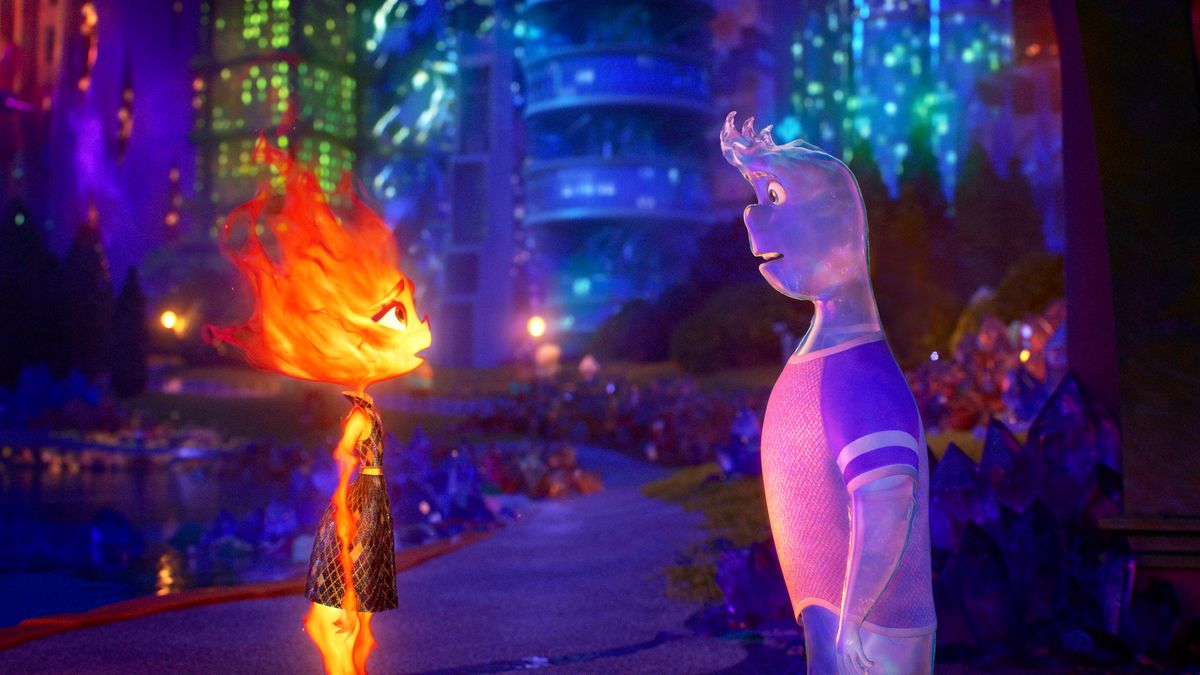
For more than a week now in theaters, 'Elemental' has been trying to squeeze out of the viewer if not a tear, then at least the money to recoup its costs—a limp, like a flower grown under the armpit of one of the characters, animated project from Pix...
If you haven't heard anything about the animated film "Elemental" except whispers of its failure, or are at least superficially aware that the main characters are the elements of fire and water, that's already a substantial amount of knowledge for those who don't follow every move of the major studios. The film simply didn't have a bright advertising campaign, and the bet on Cannes and critical acclaim that would place the film in the same league as the Pixar mastodons of yesteryear didn't pay off. And while critics are burning Peter Sohn's project ("The Good Dinosaur") to cinders, and audiences are sluggishly drifting towards cinemas, having heard about it at least through word of mouth, let's figure out why Pixar has delivered one of its worst releases.

Remember the times when Pixar was a guarantee of quality? When, without delving into the intricacies of the plot in advance, you could believe in its originality. But all that was in the magnificent 'before'. Before Pixar became part of Disney, before the meticulous John Lasseter was asked to leave his post. We won't dig into the behind-the-scenes intrigues, but let's sum it up: Pixar is ideologically impoverished, lapsing into self-repetition mixed with agenda, which there's no desire to watch any other way than online over dinner.
The action unfolds in the city of Element City, where representatives of the elements water, earth, and air live. The people of the fire element, though living within the city limits, keep to themselves in a kind of ghetto. Bernie, the father of a family of immigrants, opens a shop selling various treats and household items that meet the needs of fire residents. Bernie wants to pass on his life's work to his grown daughter, but being very hot-tempered, Ember increasingly loses her composure when dealing with customers, and then a 'water' inspector 'finds violations' that could potentially shut down the shop.

'Elemental' resembles several predecessors at once: Element City seems copied from Zootopia, the elements with a set of clichéd characteristics reference the emotions of "Inside Out", and the main character's conflict with herself is associatively linked to the inner turmoil of the hero of "Soul". And for this alone, the film can be accused of unforgivable secondariness. Why unforgivable? Because none of the components are explored deeper than superficially. The physics of processes in the city doesn't work under close scrutiny; the elements interact with each other and the environment according to script necessity, which also undermines basic laws of logic.

Let's say the viewer turns a blind eye to this and focuses on issues of migration, segregation, interracial love, and self-discovery. Ember's parents settle in a conditional ghetto because none of the landlords rent housing in the city to potential 'fire-starters'. But is life bad for them on the outskirts? Well, apparently not. Are fire people outcasts? They are not driven out of public places (with one exception). Through Ember's example, the viewer understands that even a job in Element City can be found. Thus, the first ideological seed remains unrealized.
And how about the rom-com? Closed-off Ember and emotional Wade are drawn to each other. The guy patiently helps his beloved look within herself and understand what she would like to do with her life. But behind the caricatured nature of one and the absolute characterlessness of the other, the emotional perception perishes, like fire extinguished by water. Only by the residual smoke does the viewer intellectually understand—a drama was kindled here.

Ember, driven by the obligations placed on her by her father's expectations, cannot leave the family business. The problem of self-determination and separation from parents—a powerful conflict—sags from the first minutes. It's unclear since when the viewer has been considered a cold-blooded fool, but conflicts that previously in the studio's films could be set up without words, through imagery and poignant music, are now spoken aloud over and over again, becoming so tiresome that by the middle you're responding to the screen: 'We get it!'
And even the music pours its bucket of decay into the animation pool of boredom, where, apart from the graphics (like bright inflatable rings on the surface), the rest is the drearily oscillating water of script laziness. Despite the fact that Sohn grew the plot from a seed of personal experience (Sohn's parents are immigrants), the longing for home does not touch the viewer at all, who is oversaturated with a theme that has been explored many times and seems to have bored even the writers.
The film cannot boast of being tailored to a specific age audience or having coherent content. Alas, the elements of 'Elemental' are simply played out.
Comments
0No comments yet.
Sign in to join the discussion.