
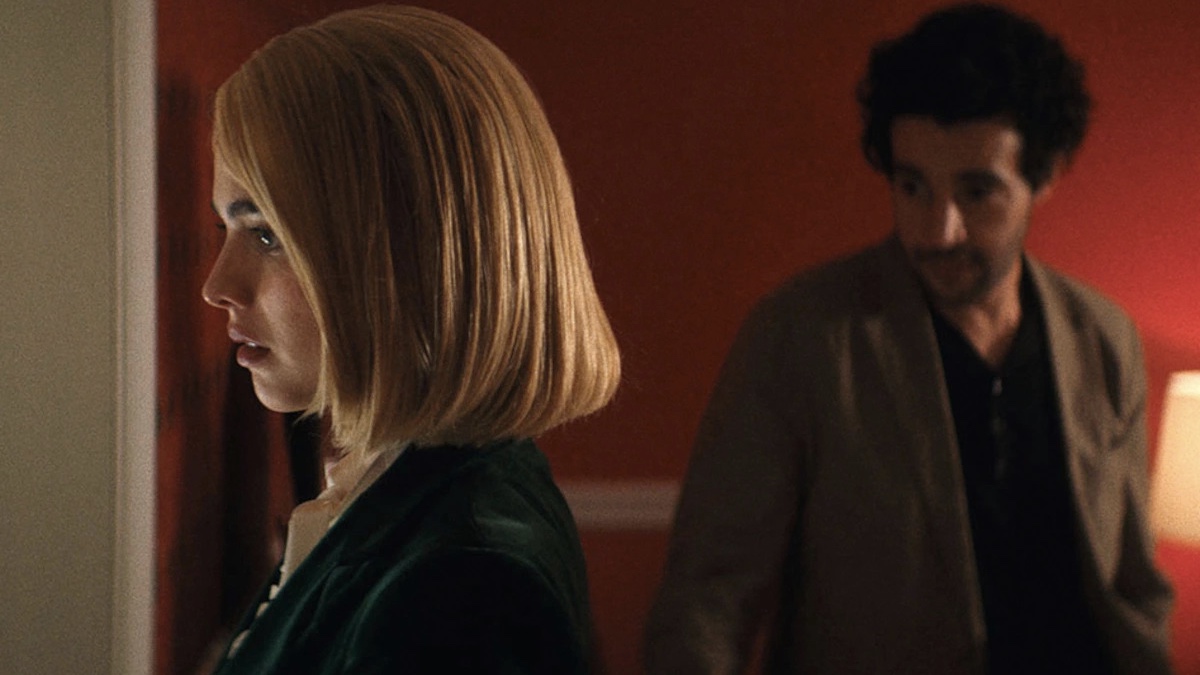
An erotic comedic thriller starring Margaret Qualley is being released. This is already the second erotic film with the actress in a few months, but without Claire Denis in the director's chair, neither the eroticism nor the thriller worked out. And...
As we know, Margaret Qualley is a great actress and our shining star, and her mother (actress Andie MacDowell) can be proud of her, so any film with her is a must-see. In this case, she is primarily who you want to watch. 'Stop-Loss,' which from its flashy trailer could be mistaken for a not-so-elegant prelude to porn, turned out to be, overall, a touching, even slightly overly sentimental melodrama. The action takes place in a confined space, the plot unfolds in less than a day, there are many jokes, but the conflict is, of course, no joke.
Hal (Christopher Abbott), not too confident in himself, is waiting for someone in an expensive hotel. He prepares carefully, checking his watch. And then, at the door, a young lawyer, Rebecca (Qualley), with whom he is supposed to fill out a questionnaire for the board of directors of a large company — Hal is being recruited as a top manager. They argue, she wins, he undresses and scrubs the toilet, and generally humiliates himself completely, deriving visible (though at the most, so to speak, opportune moments, blurred) pleasure. There is no big mystery here: he is the client, she is the dominatrix, and this is just one of hundreds of their sessions.
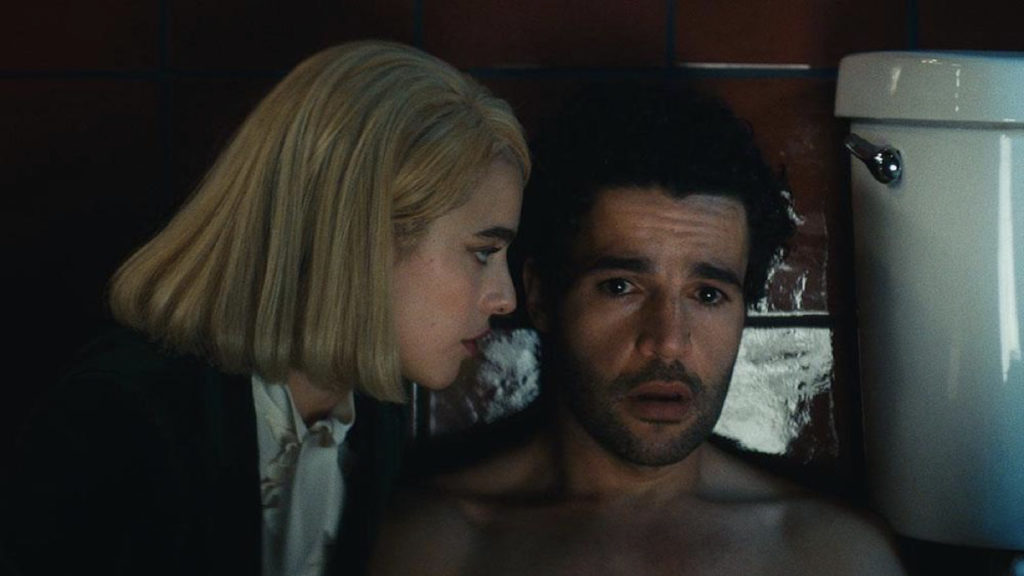
After a wild non-contact BDSM session, they have a peaceful dinner, chat amiably, and generally behave like those friends who are about to start dating. But rom-coms (don't believe anyone who says this is a thriller; it's a rom-com, albeit an eccentric one) aren't made about such friends without a reason, and of course, there is a reason.
It surfaces quickly — Hal's father died, and now he can't scrub toilets as a form of sexual pleasure; he has to earn millions (his father's hotel empire passed to him — the one where the action takes place, plus 116 others, all his). Rebecca doesn't understand why (Hal doesn't understand either, but he quotes his deceased father) and demands, as compensation, half of her now-former client's annual income. The income, if you have any doubts, is substantial. The girl even has her own arguments — it was thanks to her that Hal is ready for this position, it was she who helped him grow psychologically and step out of his father's shadow, and so, it turns out, it is she who is entitled to some portion of his earnings.
Hal resists, she blackmails him, and at this point, the most interesting part of the film should have begun, but instead, the most boring part follows. 'Stop-Loss' is only the second film by director Zachary Wigon, and he is, generally speaking, no Hitchcock yet. Nor Paul Verhoeven. The suspense that should have developed within the confines of the hotel room remains mostly just an idea — it's clear that one should be worried, but it's decidedly unclear why.

The film is not helped as a thriller — especially an erotic one — by its unexpected chastity. Qualley, of course, is an actress of exactly the caliber to keep anyone from getting bored for an hour and a half, even in a full pantsuit (with a wig and without), but in the absence of a coherent plot development, their non-contact BDSM with Hal is still more amusing. Generally speaking, non-contact sex in cinema is like Bruce Lee in 'Enter the Dragon' offering his opponents assisted suicide instead of fights. That is, revolutionary, of course, but there is probably room for improvement.
At the same time, the film has its merits, albeit in not the most obvious moments (the dinner scene, for example, is extremely successful), but there are, overall, flaws. They don't exactly outweigh the merits, they just stand out. And since you won't have to close your eyes during this film, not even for children, it's immediately noticeable that the narrative is disjointed, the pathos of what's happening is not fully justified, the middle clearly sags, the intrigue approaches zero, and the main question arises — why in a film about BDSM is there only talk about someone else's father. But why not, after all. This ultimately says quite a lot about them, and about us, and about Western culture in general.
Freud, whose ghost in such films, like the ghost of Hamlet's father, always looms nearby, wrote that the social contract is when children kill the father, and then suffer and try to build a life with this feeling of guilt. Hal, of course, did not kill his father; he died on his own, it seems, out of boredom, but his son suffers from it, as do other people's children. Everyone suffers, in fact — the film has an unexpectedly strong motif of orphanhood, abandonment, the impossibility of finding one's way in a world where signposts have long since given way to either advertising banners or tombstones.

Hal initially tries to navigate his tangled life using his father's autobiography — a business book about success and confidence (that is, both a banner and a tombstone at the same time, like a phone number instead of an epitaph) — but it all quickly devolves into something biblical. Father, why have you forsaken me? And more importantly, why did you leave me self-help literature?
The ending, of course, is ridiculous, but one could say it's also instructive, and overall, it's a film about the main thing: late capitalism is bad, privileges need to be checked, life needs to be changed. All of this is not exactly new, but actress Qualley's eyes are at least worth the money spent.
Comments
0No comments yet.
Sign in to join the discussion.