
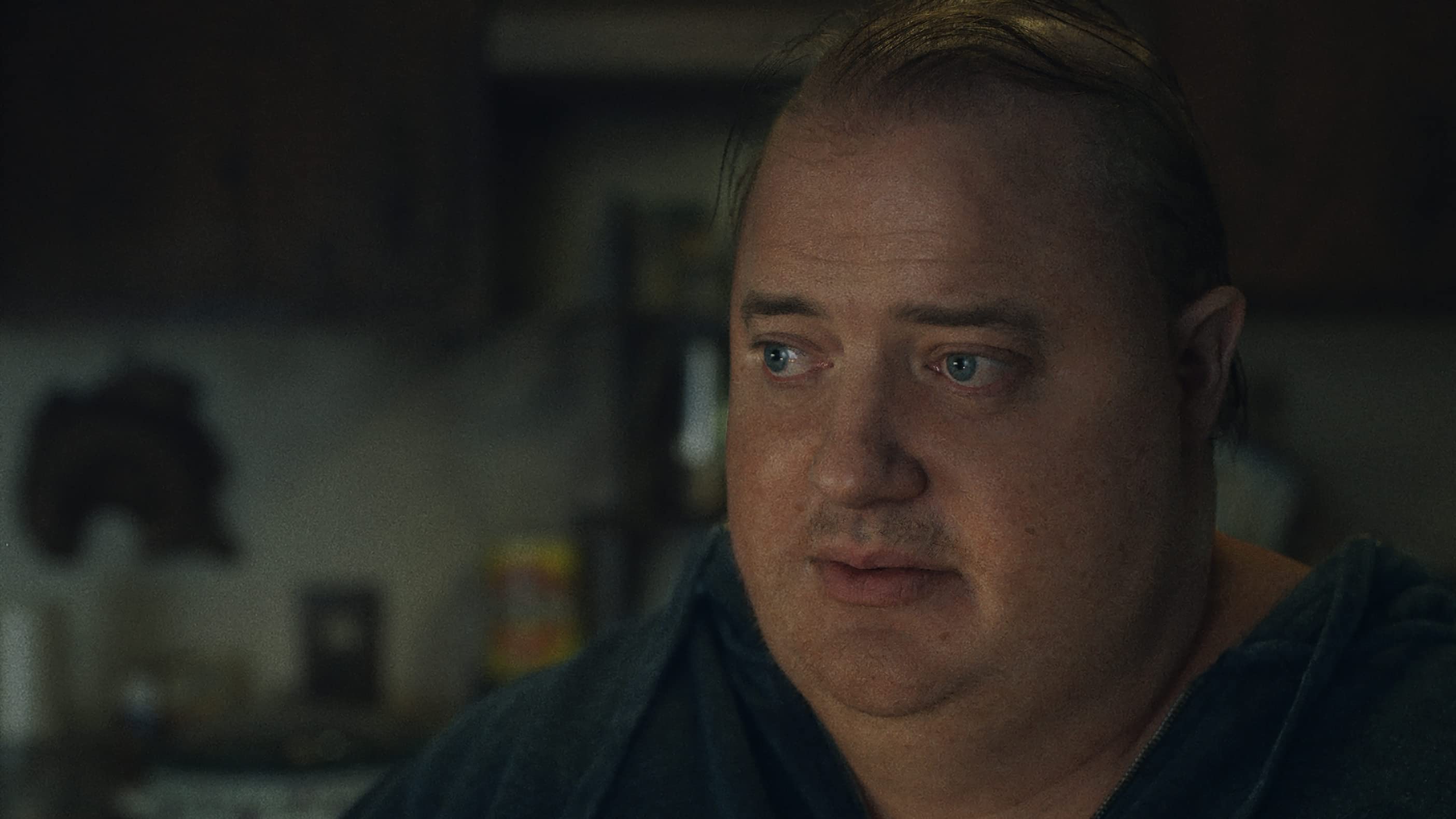
On February 21, the digital release of Darren Aronofsky's new film 'The Whale' starring Brendan Fraser took place. We tell you about the cinematic comeback of the star of 'The Mummy' in an unusual role for everyone.
'The Whale' premiered on September 4, 2022, at the Venice Film Festival, where Brendan Fraser received a six-minute standing ovation for his performance. Critics immediately began discussing possible nominations and awards for the actor in the upcoming season. And they were right. To date, Fraser has been nominated for Best Actor at the BAFTA Awards and the Golden Globe, and the SAG even awarded him the prize, but the crowning achievement is his nomination for the Oscar. The competition is, of course, very tough (he needs to outshine at least Colin Farrell and his eyebrows), but he still has a chance to take home the statuette. We'll find out the winner on March 12, but for now, let's dive into the ocean of Aronofsky and A24 studio.
What's the Plot?
Charlie (Brendan Fraser), an English literature teacher suffering from obesity and depression, never leaves his apartment and conducts all his classes with students online, without turning on his camera. The hero drove himself into this state after the death of his boyfriend, which he never came to terms with. Charlie's only friend in life is the deceased's [nurse] — Liz (Hong Chau), who helps him as much as she can. She takes care of the poor man, provides medical assistance (the kind the character agrees to), brings food, and cleans the apartment.
One Monday, after an unsuccessful act of masturbation to gay porn, Charlie suddenly becomes very ill. He is rescued by Thomas (Ty Simpkins), a missionary from the Protestant cult 'New Life,' who accidentally enters the apartment. At his request, the boy reads an essay by an unknown author on Herman Melville's book 'Moby-Dick; or, The Whale,' and the attack subsides. Soon, Liz arrives at the apartment and is surprised by the presence of a stranger and her friend's physical condition. After measuring his blood pressure and seeing catastrophic readings of 234/138, the woman starts scolding him and insists on immediate hospitalization. But Charlie flatly refuses, even though he has congestive heart failure, hyperhidrosis, severe wheezing in his chest, and stage three hypertension.
While the stubborn patient steps away to the bathroom, the nurse drives the missionary away and asks him never to come back, especially before the weekend. According to Liz's prognosis, with such health, the hero is unlikely to survive until then. But even facing death, Charlie flatly refuses to go to the hospital. Instead, he decides to try, for the last time, to mend his relationship with his teenage daughter Ellie (Sadie Sink), whom he hasn't seen in eight years — since the moment he left her and her mother (Samantha Morton) for his lover.
My Sea, I Beg You, Don't Spit Me Out on the Shore
Darren Aronofsky has a special relationship with the Venice Film Festival. Throughout his career, the director has brought his works there five times, but he left with the 'Golden Lion' only once. That time, he also 'revived' the declining career of a once-popular actor. Mickey Rourke shone anew after the premiere of 'The Wrestler.' Naturally, 'The Whale' couldn't avoid comparisons to that situation, but instead of the main award, it only received the prize for 'Best Film in a Foreign Language.'

The basis for the film was the eponymous play by Samuel D. Hunter. Aronofsky changed almost nothing in the script and made the film, almost entirely trusting the text. That's why all the action in the film takes place no further than the threshold of Charlie's apartment (flashbacks and the opening scene are exceptions). In essence, 'The Whale' is a two-hour theatrical production, divided into five acts (days of the week), translated into digital format and shown in theaters. Minimum sets, minimum actors (only 7 people appear on screen throughout the entire time), maximum dialogue and acting. And at the head of the project is the director as an ordinary craftsman, simply doing his job.
Darren Aronofsky's regular cinematographer, Matthew Libatique, has almost no room to maneuver within the walls of the small apartment, so throughout the film, you can only notice a couple of beautiful camera moves that reflect his cinematographic skill. Libatique, like the main character, and along with them, us, feels stuffy and cramped in the confined space. We are constantly next to Charlie, spying on him in the last days of his life, encountering first some guests, then others (and once, all of them at the same time).

The straightforward metaphors referencing Walt Whitman and the novel 'Moby-Dick' in the film are a bit jarring. Couldn't the content have been packaged more elegantly? The director practically chews and puts into the viewer's mouth what he wants to say. The film's title itself, the character's favorite essay on Melville's book, the protagonist's obesity, the flashback with the ocean as the best memory of his family, and even the colors of the t-shirts all scream that the whale doomed to death is Charlie. Yes, Darren, we get it. What else?
And we also have the Bible! The allusions to it are, of course, more elegant than those to the literary works. So to speak, it's clear where the heart lies. And in this regard, there will be plenty to dig into and find interesting interpretations of the film. Aronofsky often drifted into parable-like storytelling in 'mother!' and 'Noah,' so 'The Whale' looks quite logical and natural in this series. The question is different: how smoothly does it all look?
The religious metaphors hit the viewer right in the face. The storyline with the missionary seems completely forced by the finale. But all this is necessary for Aronofsky to complete the plot about the salvation of the character's Soul. The salvation of the body does not interest the director at all. Charlie is a pure martyr who, by the finale, simply must ascend, which means everyone around must accept his refusal of hospitalization (no one will even resort to deception to save his life). Such a predominance of the religious component over the logical content turns the film from a parable into a sermon.
I Have Weight, and It's Heavy
The main attraction here is undoubtedly Brendan Fraser. After overcoming a difficult period in his life, the actor is fully returning to his profession. In recent times, he has had to endure sexual assault, divorce, and the death of his mother. Fraser fell into depression, paused his film career, and, like his character, gained weight. Thank God it didn't reach 272 kilograms and Charlie's fate doesn't threaten him, so let's just be glad that the childhood hero of many was able to recover and get back in the saddle.
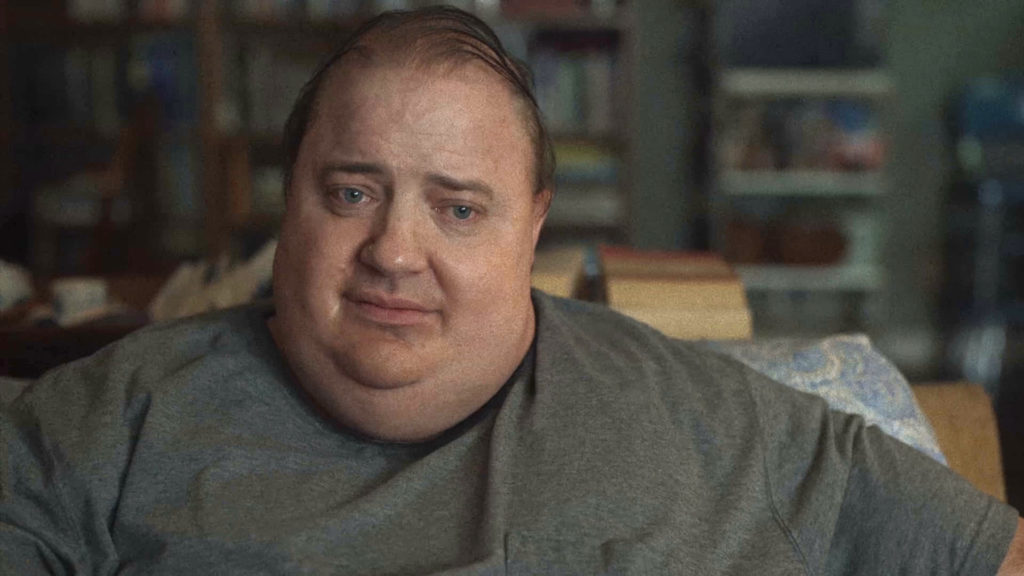
Most viewers remember Brendan Fraser for his roles as brutal men in 'The Mummy' or 'Journey to the Center of the Earth,' but 'The Whale' reveals the full dramatic potential and talent of the actor. Fraser's character evokes a huge range of emotions. Through scripted speculations, the director will spend all two hours extracting the necessary reaction from the viewer. And if you give in to these manipulations, you definitely won't avoid shedding a tear a couple of times. Charlie will disgust you with his greedy eating of pizza and greasy breaded wings, irritate you with his stubbornness, and ultimately, you will feel sympathy for him in moments of interaction with his daughter, especially in the finale. Beneath the thick layers of makeup (and a bit of CGI graphics — it's the 21st century, after all), incredible acting skill is evident, worthy of all the praise and six-minute standing ovations.
Of course, it's astonishing that, even facing death, Charlie cannot give up junk food with the same ease with which he refuses hospitalization, but for the sake of the script, we will dive headfirst into the character's inner world, full of grief and despair. After his boyfriend's death, he never learned to live on. Or rather, he did learn, but not as he should have. Loss consumes him with the same appetite with which he devours the sandwiches Liz brings. The hero has accepted his fate and come to terms with it, but in the end, he decides to do one important thing, in his view: to show his daughter that people are not such assholes as she thinks, and that Ellie herself is a wonderful person, despite hiding under the skin of a rebel due to her psychological trauma.

Incidentally, 'The Whale' is not only about Brendan Fraser's superb performance. The film masterfully interweaves various contradictory character images. Liz, who still hasn't recovered from her brother's death (for which she blames her family), yet supports and helps Charlie with all her might, without having any real ability to save him from imminent death. Ellie, resentful of her father who abandoned her and her mother, and risking not getting her diploma due to her terrible behavior. The runaway missionary, disillusioned with the effectiveness of his work and stealing money for survival from his own mission. Mary, who became addicted to alcohol after breaking up with Charlie and is convinced of her daughter's incorrigibility.
All this colorful array of characters collides on screen with an optimistic but grief-stricken man, and through dialogue, tries to convey to the viewer the idea that if people are more honest and merciful, this world still has a chance to become better before the Second Coming of Christ and the cleansing of the Earth by fire.
What's the Verdict?
'The Whale' is an intimate and even slightly claustrophobic auteur statement with a religious subtext. If you expect any dynamism and scandalousness in the spirit of 'Black Swan' or 'Requiem for a Dream,' you risk being greatly disappointed. It's easy to get tired of the film and even easier to want to turn it off, but if you develop sympathy for Charlie's story and for him himself, the film will incredibly move you and, most likely, bring you to tears.
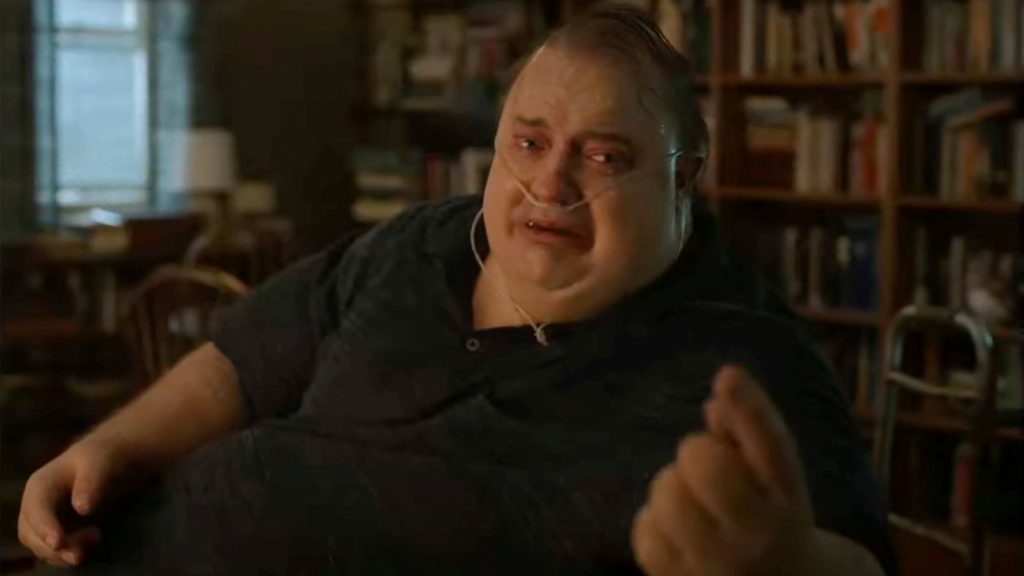
Darren Aronofsky's films haven't always been parable-like, but they have always become a byword after their premiere, and 'The Whale' is no exception. A lot is already being said about it (and how much more will be said), and different things are being said. But essentially, the viewer has two options. Either you (like me) give in to the creators' manipulations and, accepting all the flaws, straightforward metaphors, and biblical allusions, fall in love with the film, imbued with sympathy for Charlie. Or you turn it on, get tired of the slow pace and lack of dynamism, realize that you feel stuffy and bored in Charlie's small apartment, turn it off, and put off watching it until better times or the right mood. The main thing is to do it before the Second Coming.
Comments
0No comments yet.
Sign in to join the discussion.