

In mid-December, the long-awaited (truly long-awaited) 'Avatar: The Way of Water' was released worldwide — the sequel to the highest-grossing hit of thirteen years ago. Director James Cameron returned viewers to Pandora to introduce them to the beaut...
'The Way of Water' has truly overcome a thorny (though here it's more accurate to say reef) path to the big screen. Director James Cameron officially announced the development of the sequel back in the fall of 2010. Since then, 12 years have passed, and the premiere date was changed six (!) times. Some viewers even began to think that the second part would never come out, but no! Here it is! The real deal! Though it depends on how you look at it.
What about the plot?
14 years have passed since the events of the first part. The 'Sky People' were sent back to Earth (except for friendly individuals), and Jake Sully (Sam Worthington) has fully assimilated into the Omaticaya clan (he now even calls humans like a true Na'vi). The hero and his wife Neytiri (Zoe Saldana) have started a family. They now have two sons — Neteyam (Jamie Flatters) and Lo'ak (Britain Dalton) and two daughters — biological Tuk (Trinity Bliss) and adopted Kiri (Sigourney Weaver). Also, a human boy nicknamed Spider (Jack Champion) constantly hangs around the Sully family, whom Neytiri could never accept because he is an outsider and, moreover, the son of the main antagonist of the first part.
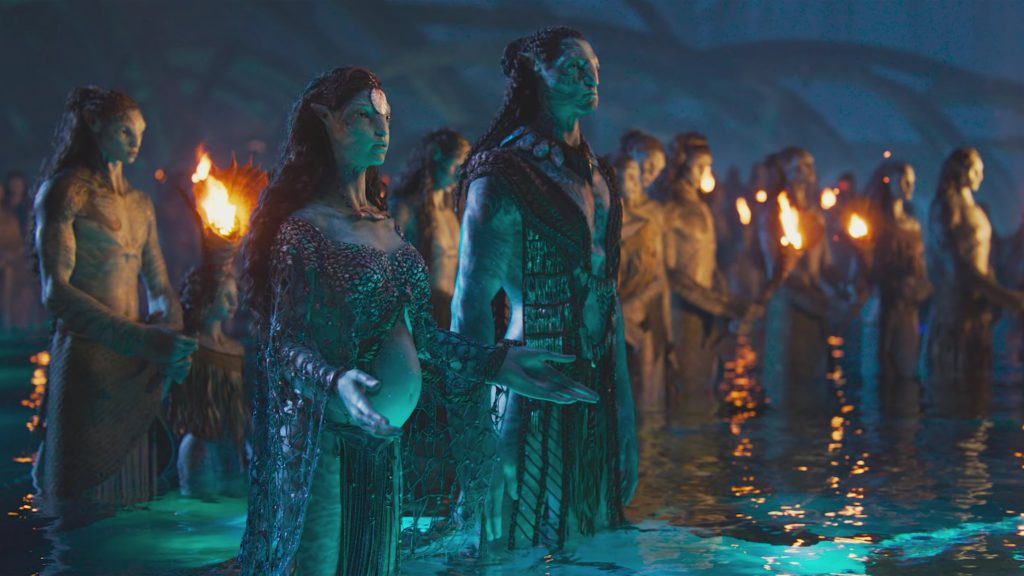
One fine day, the 'Sky People' return to Pandora again to make another attempt to harm it. It turns out that Earth is dying, and the Na'vi planet has been chosen as a colonization target, meaning all hostile natives need to be eliminated, particularly Jake Sully. For this purpose, a group of the best marines, including Colonel Quaritch (Stephen Lang), were resurrected in avatar bodies, with their memories from their past lives uploaded. Learning of the enemy's return, Jake and his entire family decide to relocate, trading the mountains for the sea, where the water clan Metkayina resides, led by Tonowari (Cliff Curtis) and Ronal (Kate Winslet).
The locals are not particularly happy about the forest Na'vi, but eventually allow the Sully family to stay. Because the newcomers are not adapted to the living conditions of the water tribes, they will all have to go through adaptation and learn to live by new rules, learning the way of water. However, Colonel Quaritch is not going to give up and throws all his forces into finding the former Toruk Makto.
I'm tired of waiting! Thirteen years I waited! In the cinema!
In the years it took 'The Way of Water' to reach theaters, much has changed in the film industry. The 3D revolution, launched by the first 'Avatar', blossomed and faded. The Marvel Cinematic Universe, which then consisted only of 'Iron Man' and 'The Incredible Hulk', managed to grow to three dozen films and start releasing series. At one point, 'Avengers: Endgame' even knocked Cameron's film off the top of the historical box office, but a re-release returned the Pandorans to first place.
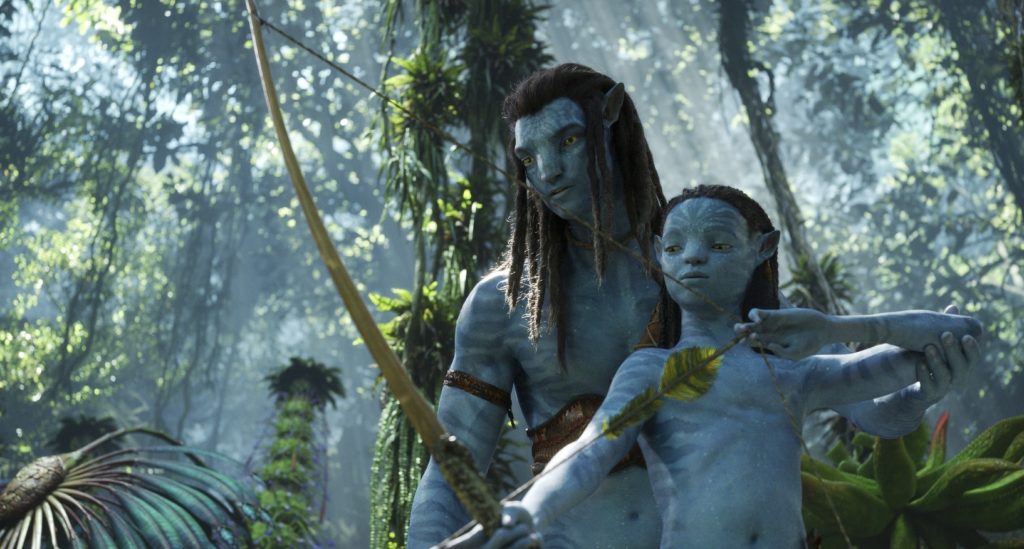
Despite the prolonged production, the sequel was still awaited. Many had already forgotten the names of the main characters and the plot, but no one forgot that the first part's earnings were nearly three billion dollars. James Cameron fueled the premiere with loud statements that this was a new level, but only a warm-up before the main event. He descended to the bottom of the Mariana Trench to create the water world of Pandora. And much more.
So 'The Way of Water' was released and confidently sailed across the planet, raking in money (at the time of writing, the film sits at 7th place among the highest-grossing films in history with earnings over $1.7 billion). Viewers rushed to see what visual attraction Cameron had prepared this time. And judging by the ratings, many are satisfied, but the sequel, akin to the original, is not without its problems.
Firstly, in terms of the script, 'Avatar' still suffers greatly. And if the simplicity of the story could be excused the first time by the fact that the director's task was to make viewers rejoice at the defeat of their own species (supposedly, it was necessary to use a familiar plot to make people fall in love with the alien Na'vi), now everything has become even simpler: the bad guys invade the good guys again —> the good guys want to avoid war —> the bad guys will still oppress everyone —> the good guys and bad guys will have to fight.
Secondly, Cameron creates his universe while criticizing humanity, so he doesn't even have time to properly flesh out the characters. His humans are evil for the sake of evil. Poaching, environmental harm, wars, and oppression — all of this is justified by the fact that Earth is dying somewhere out there, and Pandora has valuable resources and can be colonized (even if you ignore that a human can't even breathe here without a special mask).
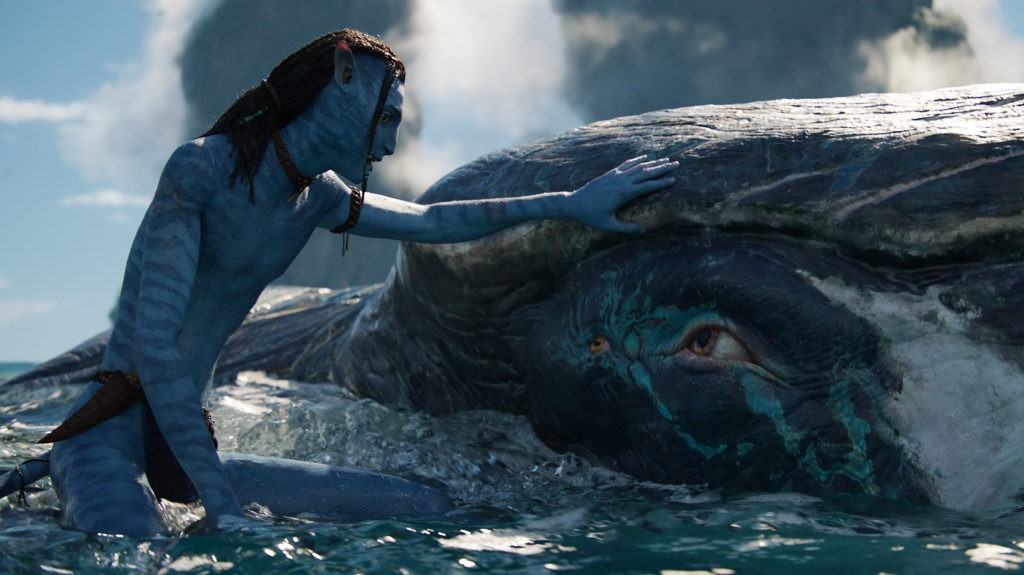
In the previous film, the Resources Development Administration (RDA) mined the valuable mineral unobtanium on Pandora, but 'The Way of Water' conveniently forgets about this, introducing a new substance called amrita, found in the brains of tulkun (very intelligent whales that even have mathematics and philosophy). These creatures are spiritual relatives of the water Na'vi, and the bad poachers kill them for the liquid, dumping the carcasses into the sea. Dramatic, but very on the nose. Plus, the liquid appeared for two minutes in the middle of the film and then disappeared. And this already leads to the third problem.
James Cameron knows perfectly well that a continuation is 100% certain, regardless of how much 'The Way of Water' earns. Whether it's 500 thousand or 3 billion, we will return to Pandora at least one more time (in case of a box office failure, the director was ready to end the story with the third film). And this fact greatly freed his hands in terms of 'setting up hooks' for the continuation. Many storylines are completely unexplored over the 192-minute runtime, leaving questions and mysteries for the third part. On the one hand, this is cool, as it will make the viewer more involved in the universe and anticipate the next films, but on the other hand, there are so many of these lines that Cameron forgets about what is happening now.

Jake and Neytiri have taken a back seat. They now have almost one function — to be parents. Moreover, the mother doesn't even spend much time with the children. The main time is devoted to the offspring of Mr. and Mrs. Sully, but there are four of them (not counting Spider), so even three hours is not enough for everyone. There is also no time for conflict. The Colonel and his squad regularly disappear from the screen for half an hour or even an hour. But there is plenty of time for admiring the sights of Pandora.
And finally, fourthly, this is a very weak and flat antagonist. Not only is Colonel Quaritch always one step behind Jake Sully, but he also has an incredibly weak motivation in the second part. In the original, the disabled corporal was in an avatar body, which gave him an advantage over the colonel, who was only a human in a robotic suit. Agility, strength, speed — Jake was better in every way. Plus, he flew on a leonopteryx, the largest flying animal on Pandora.
In the sequel, Quaritch is transferred into a Na'vi body, raising his danger level to match his opponent, but now Jake has learned the way of water and is still cooler than his enemy. While the Colonel flies on a banshee, Sully has a creature capable of flying and diving underwater, and Worthington's character himself swims at the level of the water tribes.
Moreover, the Colonel's team is presented as the best marines on Earth, which is why they were transferred into avatar bodies, but each of them falls with incredible ease to Neytiri and Jake, posing no problem. So what makes them the best if they look like ordinary extras, offering almost no resistance? And why was it even necessary to spend millions of dollars to transfer their consciousness into Na'vi bodies and transport them to Pandora? Just so they could eliminate Sully? A dubious idea for a capitalist corporation focused solely on profit. Was there no other mission, and all the costs were only for the Colonel's revenge? It looks unconvincing. A new, more layered antagonist could have been invented.
Especially since Jake almost immediately renounces the title of Toruk Makto and flies away, leaving the Omaticaya tribe behind. Do the 'Sky People' see him as such a messiah that they are ready to expend so many resources and lives for his death? Moreover, the old tribe is not mentioned again. They are forgotten. It's unlikely the forest settlement was simply left alone. The matter is not just about the former corporal. It's about the value of the entire planet.

These are the most basic script problems of the film 'Avatar: The Way of Water'. There are other questions, but I won't address them, hoping that the guns will fire in the sequels. And summarizing the above, I would like some escalation of the conflict 'here and now', rather than a prologue to the future. In 13 years, one could have worked more fruitfully on the plot. After all, this is one of the main film franchises in the world, which is planned to be developed for a very long time. If it continues like this, you can safely forget about the records.
I see you, Pandora, and I want to watch endlessly
Despite all the script problems, it cannot be said that 'Avatar: The Way of Water' is a bad movie. It is an excellent spectacle that must be watched exclusively in a cinema on the largest screen. When watching at home, the impressions will differ enormously. Not only will the flaws become more apparent, but you also won't be able to fully enjoy all the beauty of the landscapes.
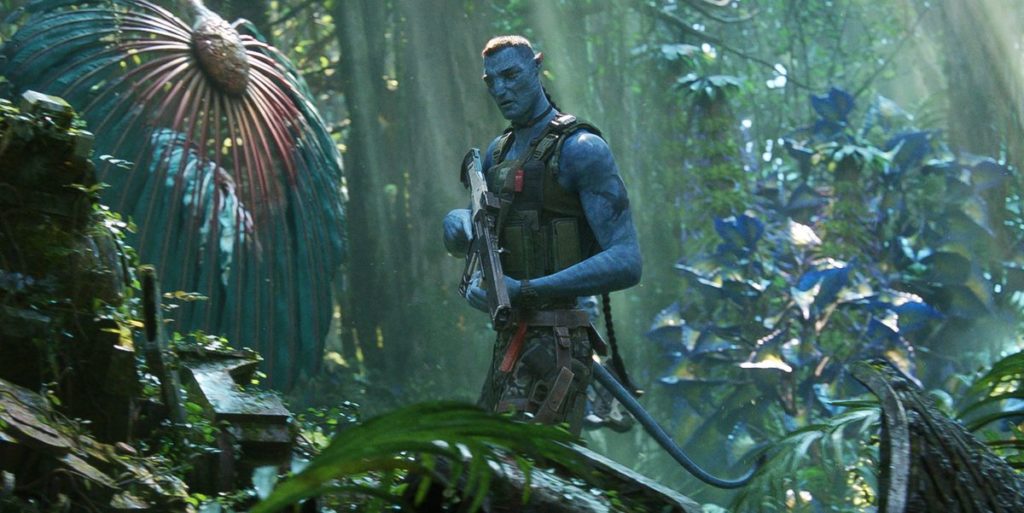
James Cameron did an incredible job with the visuals. Honestly, it's hard to believe that the film is almost entirely animated. It feels like the thirteen years were needed to fly to another planet, shoot all the material on location, and then return and edit everything on Earth. The graphics are so smooth and stunning that you can watch the screen endlessly.

The film spends a lion's share of its runtime on the flora and fauna of Pandora. From the very first frame, the viewer is shown the scale of the film. Huge stone islands with green jungles float in the sky. It immediately becomes clear what kind of movie is about to be shown. The visuals are five times more pleasant and better than the original film. It uses the maximum of today's technological progress in the industry.
Long camera flyovers, grand wide shots, high-quality motion capture. The eye rejoices for all three hours. And when the plot moves away from the conflict, and the viewer watches the Sully family's adaptation to the aquatic lifestyle, the thought arises: 'To hell with it, show me the vast waters of the ocean, the majestic jungles, the unusual inhabitants of the planet, I'll watch everything. Let 'The Way of Water' turn into a documentary for National Geographic on the big screen. I am very interested in this world.'
The cinematography by Russell Carpenter is also amazing. Sometimes such angles are chosen that it's not even clear how it was filmed. The grand underwater shots, for which Kate Winslet learned to hold her breath for 7 minutes and 14 seconds (it's a shame we didn't see the acting behind the graphics), are mesmerizing. The film is simply a visual masterpiece, and if the viewer doesn't care much about the story, the impressions will be indescribable.
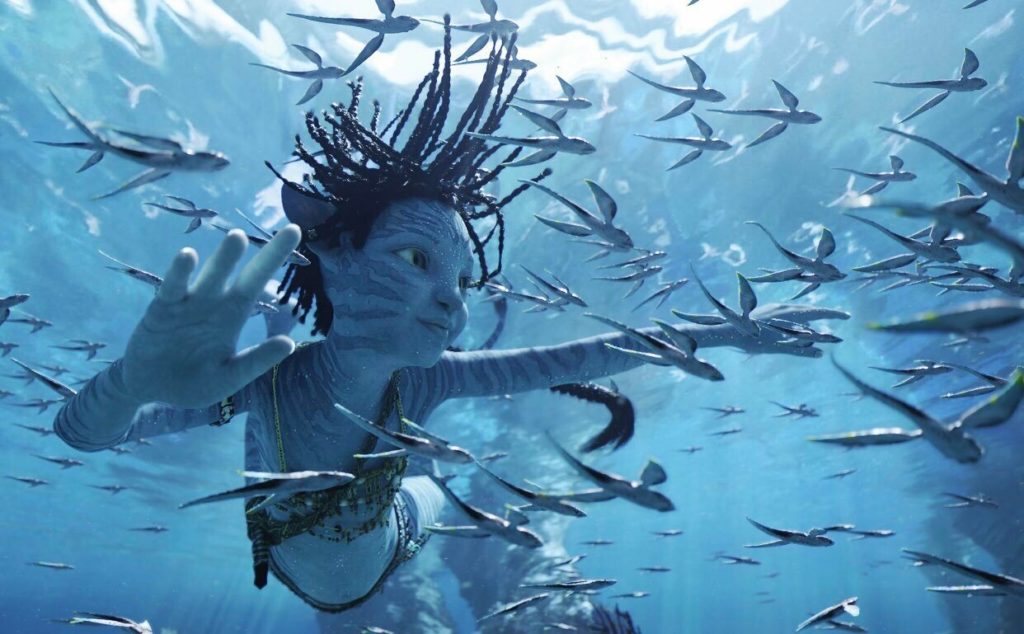
James Cameron is an experienced director and knows which points to hit to evoke the desired emotion, so during viewing, admiration, sadness, awe, and sorrow come when the director wants them to. Purely emotionally, the film hits the bullseye. Even though the raised themes look crude, as if the creators are chewing over for children what is good and what is bad, they fulfill their purpose, and that is definitely a plus.
It's even hard to imagine what they are preparing in terms of graphics for the sequels. 'The Way of Water' is so perfectly polished that it feels like it can't be done any better, but nevertheless, we are assured that what's next is something transcendent. We hope the plot will also see improvements.
What's the bottom line?
James Cameron has once again given many viewers a visual delight. This time for over three hours. Every frame of the film 'Avatar: The Way of Water' makes you want to examine it endlessly. But, unfortunately, the already simple story of the original has become even simpler, and one wants something more complex and multi-layered. In terms of water level, the film resembles a student's term paper written at the last moment but formatted according to all the points of the manual.
Nevertheless, the film is worth recommending for viewing, and it's best to go to the cinema (if possible). Overall, the film is similar to , where fan service and vivid impressions overshadow a weak plot. So 'Avatar' can be classified as a 'good film', but with a pencil and hope for improvement in the future. Especially since Cameron promises to show evil Na'vi and good humans, so we believe in the best. We await the fire tribe (Cameron himself said this ) and the earth tribe, after which Jake Sully will learn all four elements and become a true Avatar.

On December 15, 'Spider-Man: No Way Home', the main Marvel blockbuster of this year, was released. The most anticipated project of the winter. The most ambitious Spider-Man film. The most, most
Open materialP.S. There are no post-credits scenes in the film, so if you don't want to pay tribute to the creators, you can skip them.
Comments
0No comments yet.
Sign in to join the discussion.