

Recently, Netflix released "Copenhagen Cowboy", a new series by Nicolas Winding Refn, which, like his previous television experience, mixes in interesting proportions noir, giallo, superhero story, and the ravings of a madman. About why, like any rea...
The girl Miu (Angela Bundalovic), whom everyone calls a "lucky coin" because she brings good luck just by being nearby, ends up in a Danish brothel run by an Albanian-Serbian mafia consisting of a hysterical pre-retirement woman, her cruel brother, and his charismatic daughter. Somewhere around the second episode, Miu gets out of there and ends up, well, not even in Copenhagen, but in a Chinese eatery, where she comes to sit sadly until closing time, but eventually stays to live there. Then she gets entangled in a criminal story of the Chinese mafia and takes on the Danish family of ghouls who drink blood, eat hearts, sleep in coffins, and are obsessed with their own genitals (the director cast his own daughter as the daughter in this family, which is, of course, especially charming).
At the same time, the first episodes look as if Dario Argento had a bad mix with Béla Tarr, the third episode seems like a remake of the film "The Stoker" (in Balabanov's iconic film, the hero burned the bodies of gang war victims; here, they are fed to omnivorous pigs with the same level of humanity), and from the fourth, a free retelling of "The Bodyguard" begins, as usual, slowed down three times and with a silent medium instead of a dashing samurai. And if everything is clear with Kurosawa, then Nicolas Winding Refn's acquaintance with Alexei Oktyabrinovich's films raises doubts.
Therefore, the most logical explanation for the similarity is also the simplest – the motifs of "Copenhagen Cowboy" are so archetypal that they simultaneously refer to everything and nothing specific. Refn essentially adapts his dreams, and since he is a well-read and well-watched person, he mostly dreams of Greek mythology, Albanian porn, selected esoteric plots of Jodorowsky, gloves from giallo, and drug wars from his own early films. All this, plus revenge tragedy, is the whole "Copenhagen Cowboy", but this is that (increasingly rare) case where the whole is somewhat greater than the sum of its parts.
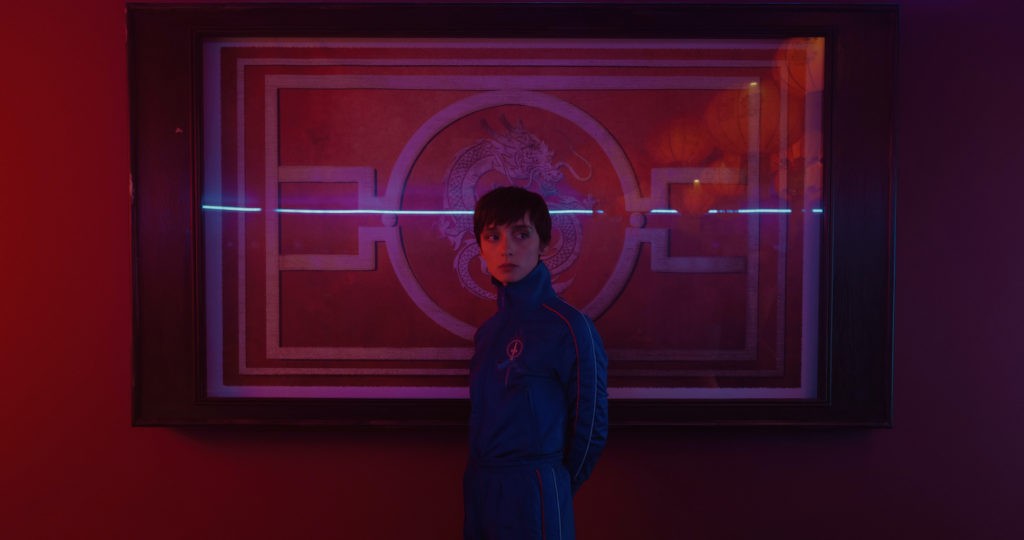
Of course, the series does not contain any special semantic revelations – the fact that the world is bad can shock only a preschooler in Russia – but at the same time, Refn manages to both surprise and amuse (for a revenge drama about Albanian human traffickers and Serbian drug barons, this is perhaps even too funny, but that's why we love it), and by about the fourth hour, make you think. Not again about the world being bad, but about, for example, how beautifully Refn shoots, how interestingly he implements either the mechanics of a computer game or a Dantean plot structure (the fact that each scene in the forest marks a descent into new levels of the criminal world is tempting to interpret as one continuous "Divine Comedy"). And in general, over four hours of close-ups of silent people, you can think about many things.
Especially if all the components of the director's visual style are already known to you, because nothing really changes: neon, tracksuits, slow camera turns, and periodic pauses in action. If a field is waving, pigs, into which, in the best biblical traditions, neon demons have entered, are grunting, the camera slowly rotates around its axis, like at a New Year's party shoot (with the difference that instead of Santa Claus, Satan came to the children), and so on for fifteen minutes: this is not a bug, it's a feature.
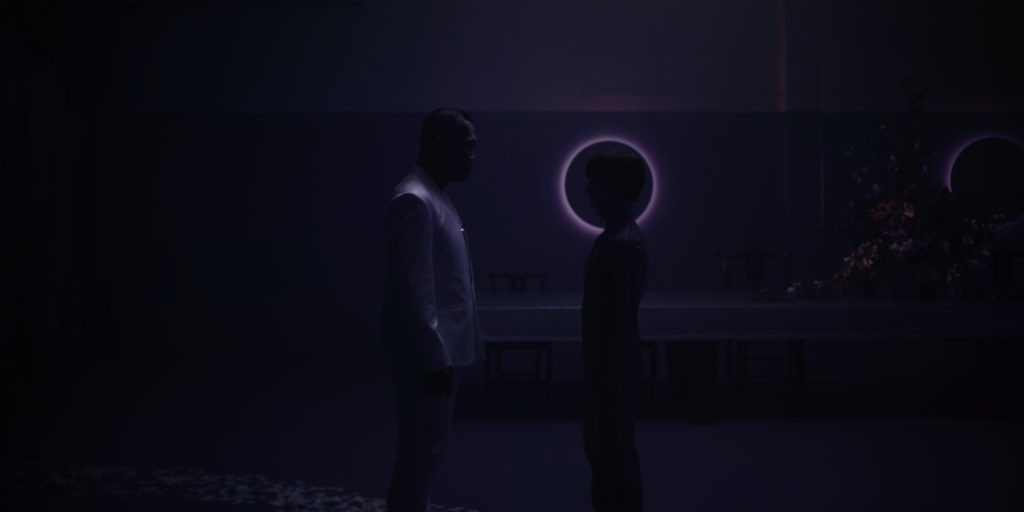
Overall, "Copenhagen Cowboy" resembles a film adaptation of selected posts by Dmitry Medvedev – grunting pigs as plot drivers and the main metaphor, the lord of darkness, a general feeling of apocalypse, all with some hangover clarity in absolute darkness, occasionally interrupted by flashes of neon illuminating the battle of the bad against the very bad, watched from their large family castle by truly bad people. In "Cowboy", the simplest story – not even a story, but its template – is placed in a dark room and acquires a strange, mythological appeal in this setting. Yes, in Refn's myth, instead of fire, Prometheus brought people a neon disco ball, but that didn't change the essence: his heroes still look into the abyss, the abyss looks into them and says: "grunt."
And everyone grunts, basically – there are no positive characters in the series. Except maybe the Chinese mafia is a bit better than the Albanian slave traders, but that's also a matter of perspective. Somewhere out there, a Balkan crime boss ( Zlatko Burić , the only bright spot in the rather unbearable ""), drug dealers, manufacturers of phallic prosthetics, and a few more completely incomprehensible characters are lurking, about whom, apparently, there will be a second season. Or not.

In an age of censorship based on the principle of tolerance for all possible and impossible parameters, cinema free from prejudice and light in its comedy and openness is worth its weight in gold.
Open materialRefn's previous series "Too Old to Die Young" was an interesting experiment in narrative construction – you could start it anywhere and not lose anything. "Copenhagen Cowboy" is an even more interesting experiment in this sense; you can not turn it on at all (some optionality of "Cowboy", by the way, only enhances it – it's nice to watch Refn have fun), so the continuation is also an optional question. But if you do turn it on, you will understand a lot – not about the series, but about yourself. And that, in general, is wonderful.
Comments
0No comments yet.
Sign in to join the discussion.