
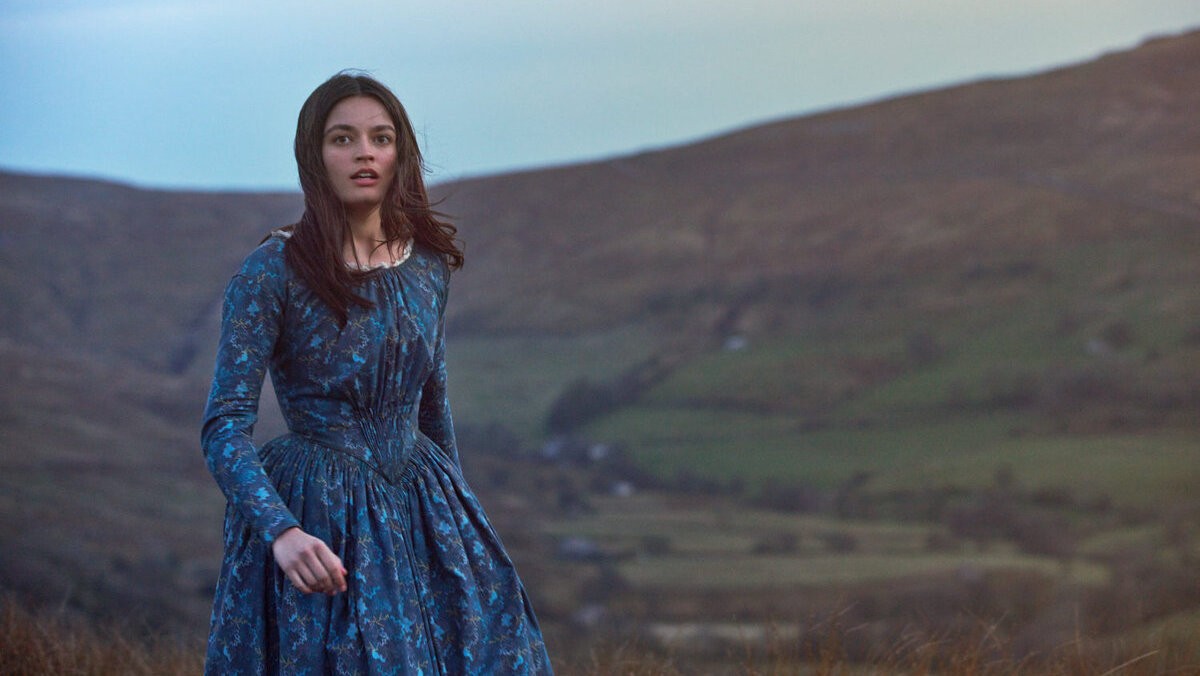
The gothic melodrama 'Emily', based on the biography of Emily Brontë, the darkest and most talented of the writing sisters, has been released. About why this film will be interesting not only to those who sleep with 'Wuthering Heights' under their pi...
Dreamy Emily (Emma Mackey, the best part of 'Death on the Nile' and the star of 'Sex Education', rapidly outgrowing that status) imagines love – her own and that of some heroic captain. Her daydreams, which replace studying French, are interrupted by her sister's arrival. Charlotte is older, more settled, and seemingly more loved by their father. Emily is supposed to go with her to the countryside to become a village schoolteacher like her sister, but she ends up returning – social interactions don't come easily to her, and school, even for complete extroverts, is a dangerous place. But Emily's melancholy on the moors is interrupted by the arrival of two men – her brother Branwell (Finn Whitehead) with a tattoo reading 'think free' and the vicar William Weightman (Oliver Jackson-Cohen).
With the first, Emily quickly becomes inseparable – both have been ill-served by patriarchal society: it has addicted him to drink, opium, and eternal melancholy due to the gap between desire and reality; it has shackled her on the moors with vague prospects (here the script seems to diverge somewhat from reality: Emily herself returned to Yorkshire, loved these places, and there is no confirmed evidence that her father was a domestic tyrant). Brother and sister find their own dreams in each other – he sees in her a talent he lacks, she sees in him a freedom hard to achieve in the 19th century (and indeed at any time), and at some point they reach a line that might disturb virtuous viewers (incestuous motifs of the Gothic novel are not exactly close to our culture), but nothing of the sort actually happens.
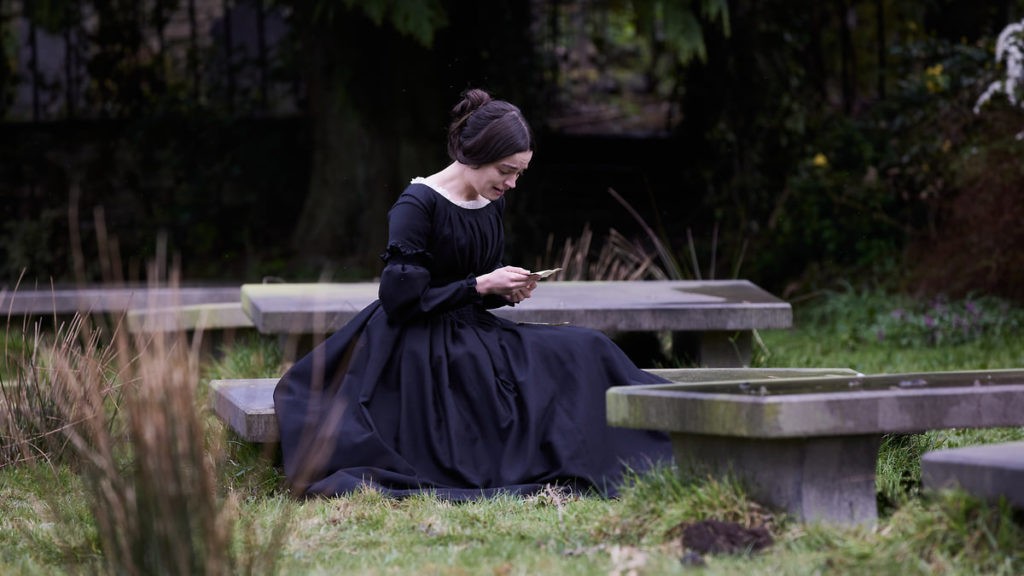
With William, things are more complicated – he is a hero from Jane Austen's novels rather than the Brontë sisters': there is no restlessness, no torment of a terrible secret, nor, as it might seem, any particular metaphysical depth, which Emily (and this is a great credit to Mackey, who conveys something slightly otherworldly even in her gaze) has in abundance. Moreover, he is blond, which is not favored in Gothic fiction. But it is with him that Emily begins a passionate and somewhat doomed romance, during which she fears losing him, and he fears losing God. In the end, of course, in the best traditions, everyone loses everyone.
Most likely, none of this happened in the real Emily's life. At least the romance with the clergyman is attributed to her younger sister Anne, the sad fate of brother Branwell was reflected in one way or another in all the sisters' novels, and Charlotte wrote 'Jane Eyre' before 'Wuthering Heights' was published. But this, of course, is completely unimportant. Within the first half hour, it becomes clear that the film is not so much a biopic as a peculiar novel of ideas, an attempt to imagine how Emily could have written 'Wuthering Heights', what experiences could have given birth to such a text. Director Frances O'Connor, an actress known for costume dramas, turns out to be least concerned with costumes and seriously interested in what lies beneath them. The short and sad life of the middle Brontë becomes a conceptual framework for examining the era, the Gothic genre, and the nature of talent.
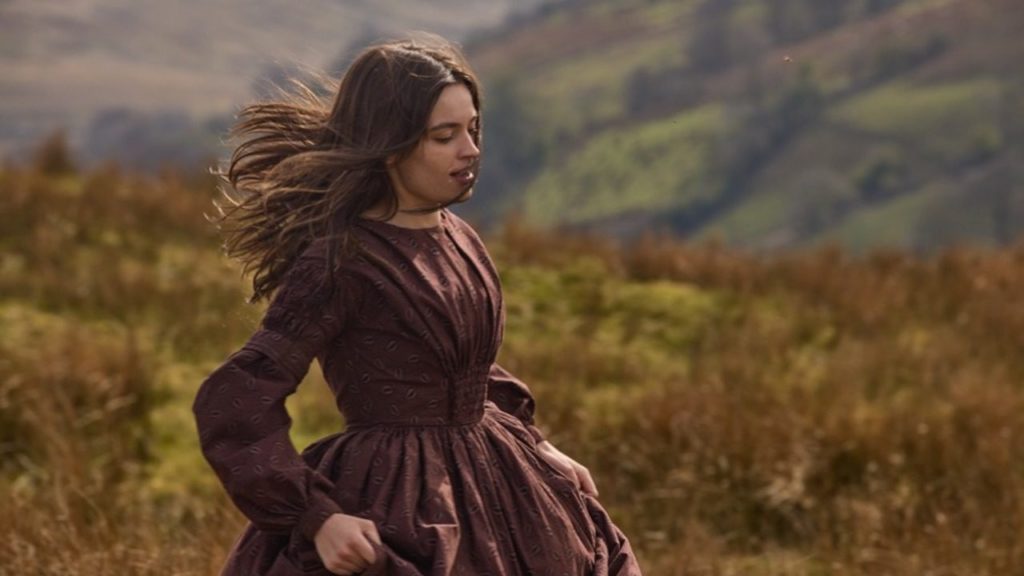
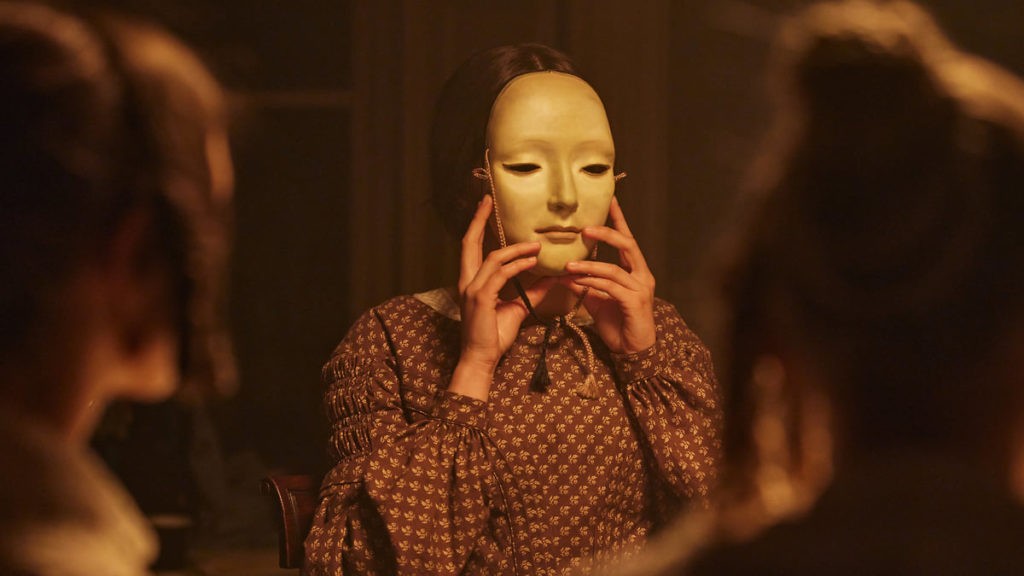
At the same time, O'Connor avoids vulgarity and colorful allegory in these themes; she manages to sometimes reshoot 'Wuthering Heights' as if it were a masterpiece of socialist realism, while imbuing the most ordinary scenes with the horror potential of 'Picnic at Hanging Rock'. People haven't sat at a table so poetically in a long time. And so creepily, too. Perhaps the unique sense of creepy poetry is the charm of O'Connor's talent, who (in her debut film, no less!) only occasionally takes the obvious path, more often choosing unexpected angles and perspectives. For example, the scene with the mask is delightful, and in principle, the film could be watched just for that, even if there were nothing else interesting.
But 'Emily' is first and foremost a film about creativity, and in that sense, it is one of the best films of the year (certainly in Russian release). It is a film about a bad, evil, and unjust world, whose meaning, according to O'Connor, may lie not so much in the world itself as in creativity. Emily did not just suffer for two hours of screen time; she suffered to produce a classic of world literature. And in our latitudes – climatically similar to Yorkshire, and not too different in morality – a film about how the world is not always ruthless, suffering is not always meaningless, and when the pain passes, something great may remain, resonates more sharply than, say, in the UK, where they understood this back in the Brontë era.
However, the main merit of O'Connor's film is not even that after watching it you want to sigh sincerely and Google Mackey's filmography, but that the director does not settle for simple solutions and does not give simple answers. The men in the film offer Emily three paths – her father with his submission to rules and the importance of social integration, the poetic vicar with his fervent fear of God, and the wayward brother who communicates in quotes from 2010 VKontakte – all of them paint the swamp and see a perspective, but none of them turns out to be right in the end.
Life turns out to be more complex than the parable of Job, more complex than William's tweet-like sermons, and even, dare I say, more complex than the motto 'think free', and neither the brother's simple recipes nor the pastor's harsh self-restraints clarify much in it. In life, it is generally difficult to clarify anything, and even more difficult to say anything coherent about it. Once, Brontë succeeded; now, debutant O'Connor has succeeded.
Comments
0No comments yet.
Sign in to join the discussion.