
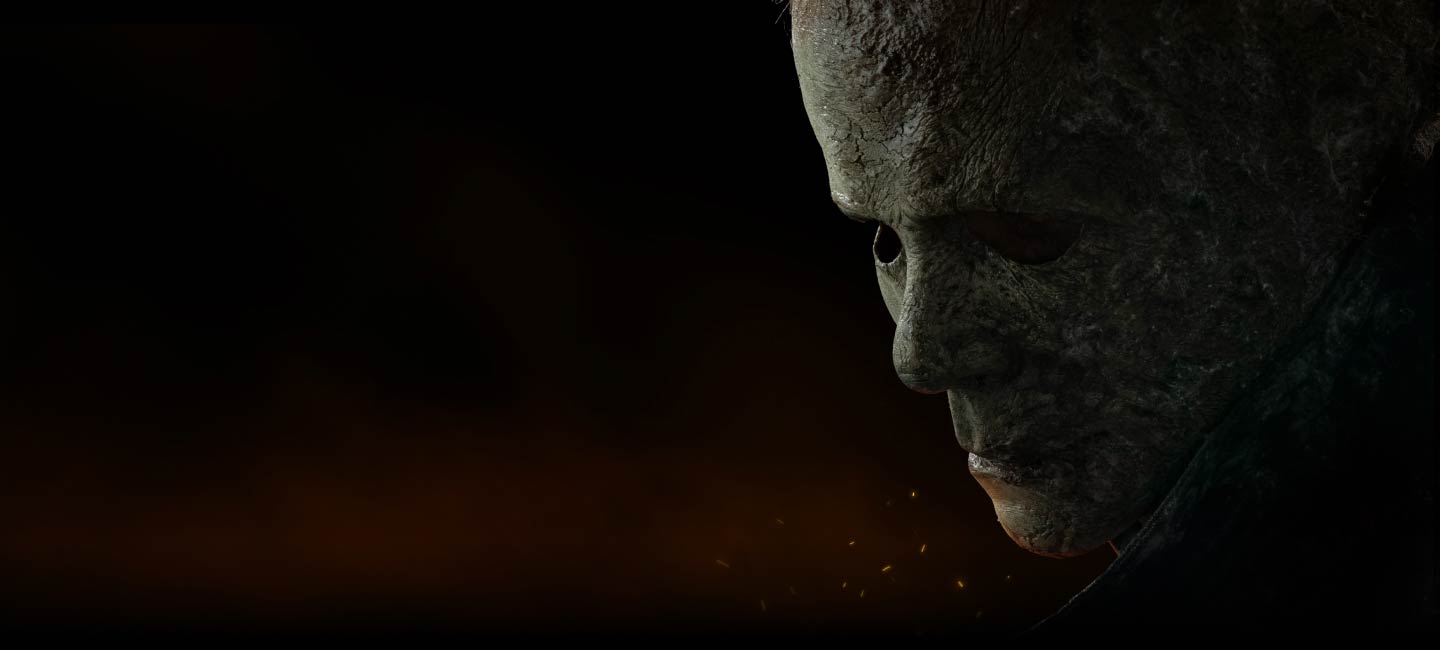
On October 14, the film 'Halloween Ends' — a new installment of the cult slasher franchise — premiered in foreign theaters and on the online service Peacock. The third film by David Gordon Green assures viewers that Michael Myers is saying goodbye to...
'Halloween Ends' is already the eleventh time (and that's not counting the two remakes by Rob Zombie). Over eleven films, the franchise has been through a lot, but now we're promised that's it, Michael Myers is retiring for good (after all, 65 is a venerable age, even legally time to go).
In 2018, David Gordon Green reset all the killer's achievements and left only the original by John Carpenter, released in 1978, as canon. To celebrate the fortieth anniversary, Green launched a new trilogy about the killer in the white mask (and auto mechanic coveralls) with a kitchen knife. The return to Haddonfield four years ago was received rather positively by the press and audiences (79% critics' rating and 71% audience rating on Rotten Tomatoes), but by 2022, just like forty years ago, we're again watching a 'Halloween' that's not about Myers (except with him and without killer masks) and wondering how by the third part it all went downhill again.
What's the Plot?
'Halloween Ends' (how strange that sounds) begins with a prologue. In Haddonfield, no one has heard about Michael Myers (James Jude Courtney and Nick Castle) for a year. He disappeared that very night when the residents decided they could carry out vigilante justice against him. The town is slowly recovering from the shocks, but the name of the Boogeyman is still on everyone's lips. On the eve of All Saints' Day, babysitter Corey Cunningham (Rohan Campbell) accidentally becomes involved in the death of the child he was watching. And although the incident is a pure accident, Haddonfield does not forgive the guy and makes him an outcast, turning him into a new object of hatred.
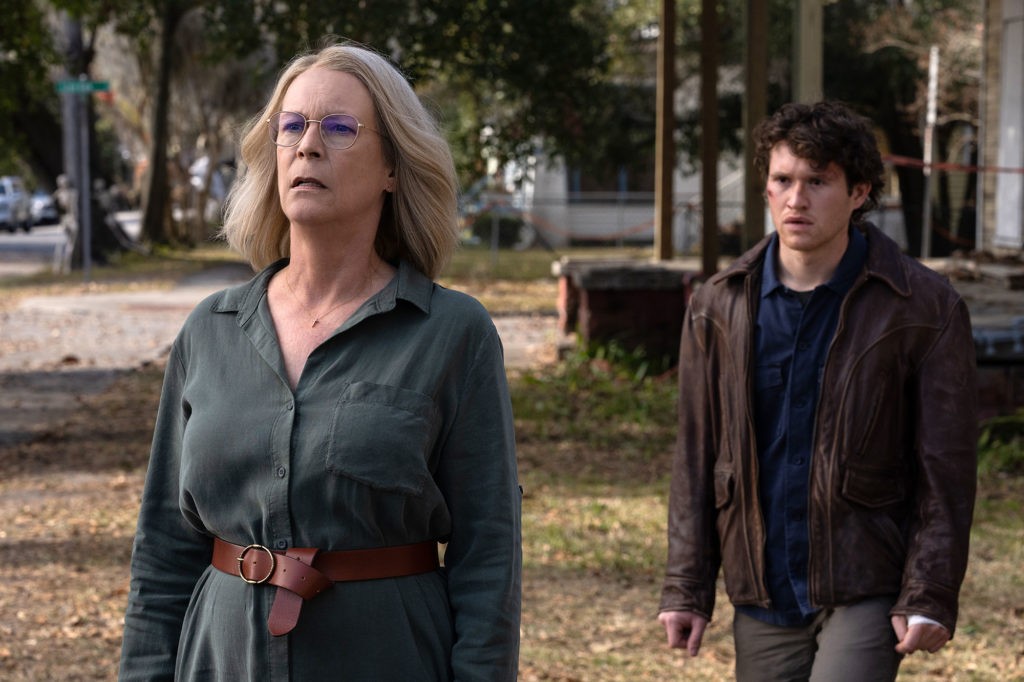
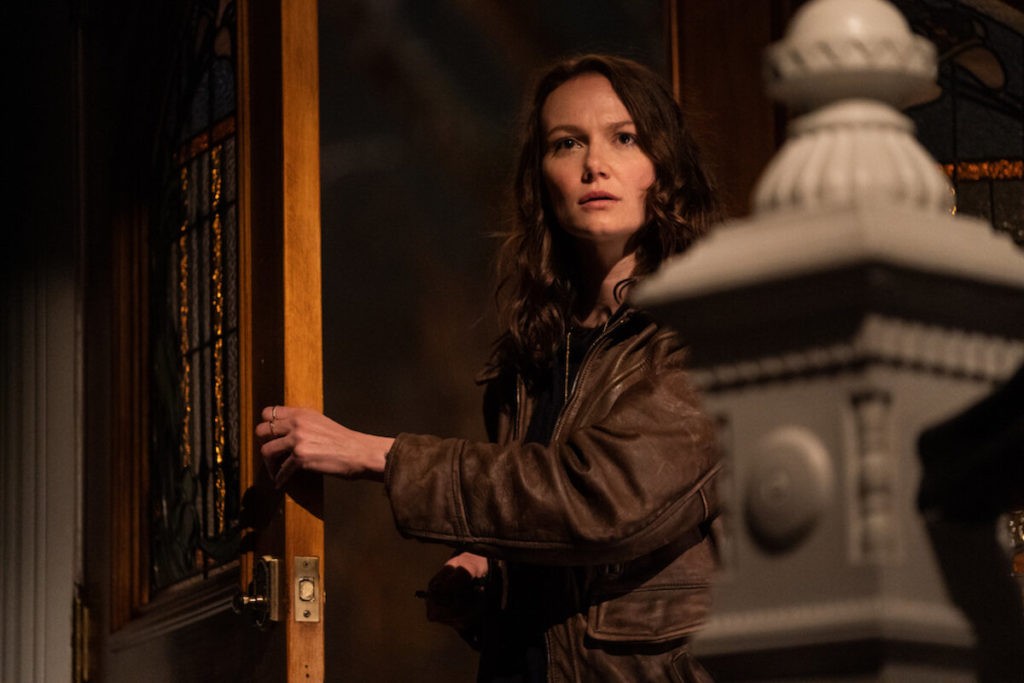
Three years later, a withdrawn and reserved Corey works as an auto mechanic (hmm) and tries to avoid contact with anyone as much as possible, until local thugs ask him to buy beer. The guy refuses, but the insolent teenagers start pressuring Corey. Laurie Strode (Jamie Lee Curtis), passing by, comes to the rescue. The schoolkids leave the 'psycho' and 'freak' alone and clear off, and Laurie decides to introduce the wounded guy to her granddaughter Allyson (Andi Matichak), who works as a nurse at the local hospital.
After the events of Halloween 2018, Laurie bought a cute little house, moved in with her granddaughter, and tries to live a peaceful life without preparing for another encounter with Michael Myers. Grandma bakes pies, spends time with a friend, and writes a book where she tries to work through her psychological trauma after face-to-face encounters with evil (spoiler: it doesn't turn out very well). And Myers has only disappeared, not died. October 31st is approaching, which means evil will return to Haddonfield and remind the residents of itself. And this time, the ruthless (really?) killer does not intend to act alone...
Grandpa, Take Your Pills, or You'll Get...
In his trilogy, David Gordon Green 'cut off' the 7 previous films about Michael Myers, freeing him from kinship with Laurie and the magical explanation of his essence. The killer again became 'The Shape' in the credits, which means 'form'. In essence, Michael is just a random victim, a vessel for absolute evil. A six-year-old boy was simply unlucky a long time ago, and he became the embodiment of human malice and hatred. He doesn't need a story, motivation, or a well-developed character. He only needs a victim (preferably more than one) and nourishment in the form of fear.
Green decided to develop the franchise in this direction. The first part managed to stir up feelings of nostalgia in the hearts of critics and fans, while 'Halloween Kills' was received more coldly. And as a result, 'Halloween Ends' doesn't end on a high note. The concept is certainly worthy of praise, but the original 'Halloween' was not intended to be anything deep. It's a classic slasher horror that cemented the subgenre in the film industry market. Carpenter created a terrifying story, setting the trend for a new wave of horror movies. Perhaps the director wasn't entirely interested in the characters' motivations, but he managed to make a cult film on a small budget (the original's budget was only $325,000) and scare the whole world. The story seemed quite complete, albeit with an open ending. After that, John Carpenter lost interest in Michael and left him in the care of the studio, returning only when financially necessary.
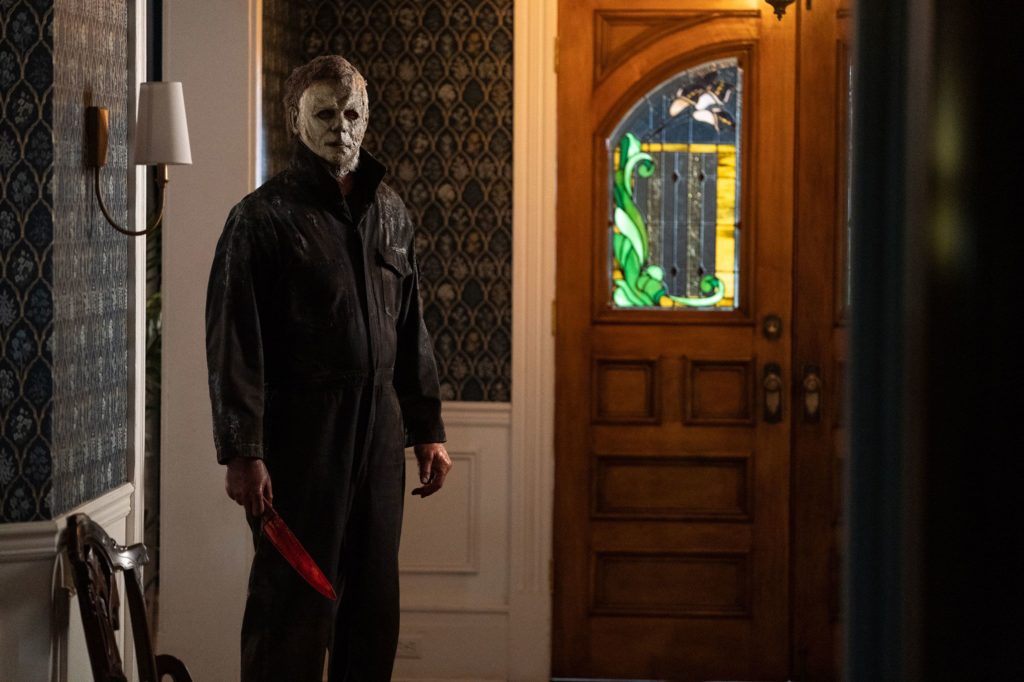
Having returned the franchise to its roots in 2018, four years later Green arrived at the same absurdity as the creators of the sequels 40 years ago. It turned out that Michael Myers' evil can be transmitted almost by airborne droplets, the main thing is that the environment is suitable. And if anywhere, the atmosphere of evil in Haddonfield is one of the most favorable. Perhaps only more favorable in Maine, in some Castle Rock.
On his home turf, Myers, hiding in the sewers, lives quietly and occasionally kills, dragging victims to him through a pipe, until he encounters Corey. Their eyes meet, and... Spark, storm, madness. Michael decides not to kill the guy. Why? What sudden bout of humanity? No one will explain anything, but the boy becomes infected with evil. He becomes so saturated with it that Laurie can sense the presence of the Boogeyman just by looking at him.
In the end, Cunningham brings the maniac new victims, and then even starts working with him as a team. Why does Myers suddenly take on an imitator apprentice and kill with him in tandem? Had to change principles after 44 years? Apparently, grandpa realizes that 'Halloween Ends' and it's time to retire, and the business needs to be handed over to reliable hands that will be up to their elbows in blood.
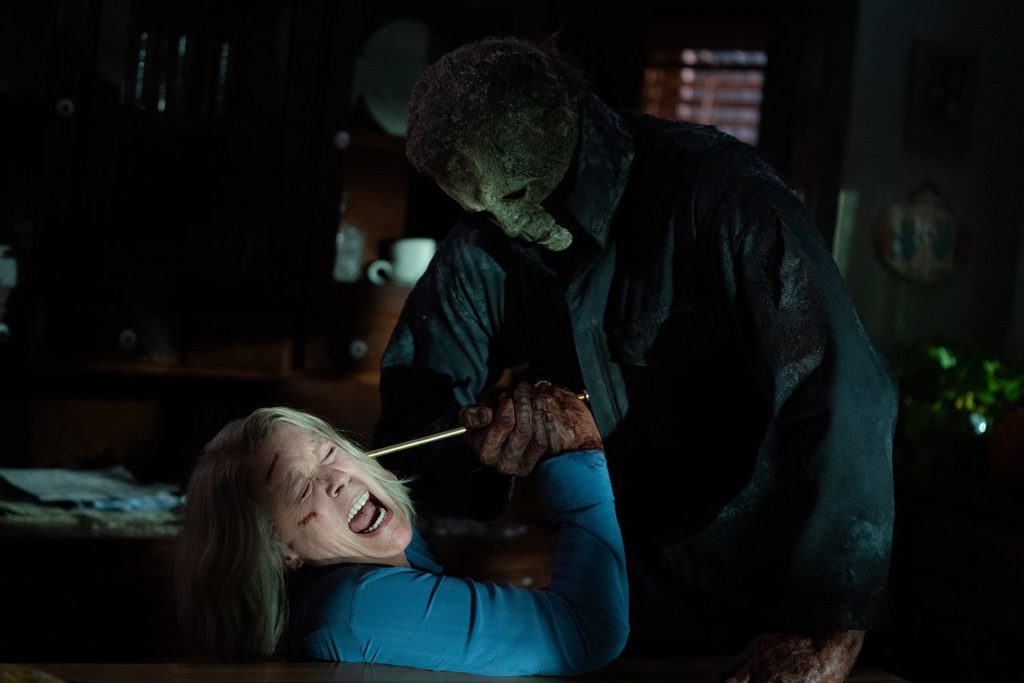
The years have taken a toll on Michael. He has become noticeably weaker. At one point, one of the victims almost overpowers him, but murder gives him life force. So, Michael Myers is some kind of vampire who also turns people into his own kind? Now that's a twist. After a couple of victims, grandpa gets back in shape (but not his former shape). He has significantly fewer victims this time, and he kills them reluctantly. As if the management (in the person of director Green) is forcing him to do it under duress. And the grand finale is just a fight between two old people, which is already laughable to watch. 'Grandpa and daddy got into a drunken brawl and ruined everyone's holiday, same thing every time.' There's no other way to describe it.
The Mask! The Mask! The Mask!
'Halloween Ends' is no longer a story of confrontation between Laurie Strode and Michael Myers. Formally, the film concludes their story, but the focus has now shifted to Corey and Allyson. The franchise is clearly saying goodbye to its former heroes. It's not the first time for Jamie Lee Curtis's character, as she spent almost the entire 'Halloween Kills' lying in a hospital bed, but for Michael, this move is new. The bright confrontation is in the past, and the number of Myers' victims has significantly decreased. Moreover, every other person now tries to tear off his mask, and with it, as in 'The Mask', part of his power evaporates.
The film tries to explore the nature of evil and seem like something more than just a slasher, albeit a cult one in the past. Every frame screams at us that 'Halloween Ends' (I won't stop inserting the title into the context). The peak has long passed, and the studio has turned the franchise into a cash cow under the holiday brand. The creators understand that by releasing a film shortly before All Saints' Day, they can collect a nice 'patty', recouping the budget and making a profit. But even in this, they seemed to have doubts about the last part, as they released the film simultaneously in theaters and on the online platform.
Of course, people still went to see it. Firstly, John Carpenter's soundtrack is an immortal autumn classic that always pleases the ear while watching and brightens up any atmosphere of what's happening on screen. Secondly, viewers are told that we are saying goodbye to the franchise, so we need to find out what ultimately happens to Laurie and her eternal pursuer. And so in the cinema, they try to show us not an ordinary attraction in the form of a bunch of murders and chases, but to convey some idea about the nature of evil without substantial grounds for reflection.
Frankly speaking, 'Halloween Ends' is not an authorial statement on the issues of the day, but an ordinary horror film (and it's no longer clear exactly which category: 'A' or 'B'). Trying to extract a serious drama from it is a dubious endeavor. Especially since almost all the murders in the film are committed not by Michael, but by his 'imitator'. In essence, at the price of a branded item, they are trying to palm off a well-made, but still a replica. To wear it or not is a matter of principle for everyone, but personally, I wouldn't. There are plenty of reasons, but the main one is that it's not the original, you understand that, and you yourself feel uncomfortable with that fact. That's it.
So What's the Verdict?
The finale of David Gordon Green's trilogy turned out to be frankly controversial. The director tried to add drama to the franchise and talk to the viewer about the essence of evil and its contagiousness, but it all turned out somehow not entirely successful. The point is that the film ended up being neither here nor there. For a drama, the script is too weak and the conflict unconvincing, and for a slasher, there are too few spectacular murders (certainly relative to previous parts). What did they want? What was it all for? And the open ending and the idea that anyone could become Michael Myers makes even the film's title unconvincing. Maybe 'Halloween Ends', but there's a strong feeling that it doesn't end.
Comments
0No comments yet.
Sign in to join the discussion.