

The new musical “Dear Evan Hansen” by Stephen Chbosky turned out to be a bad standalone film and a bad adaptation, but for different reasons. We'll try to explain what went wrong and how it could have been avoided.
Synopsis
To simply get through the day, Evan Hansen (Ben Platt) has to take a lot of medication and constantly push himself at school. He can't make a single good friend or even talk to Zoe Murphy (Kaitlyn Dever), the girl he really likes.
Everything changes when Zoe's brother Connor (Colton Ryan) commits suicide, and Connor's parents, by a twist of fate, start to think that he and Evan were best friends. Evan is in no hurry to correct the misunderstanding and spends more and more time with the Murphy family, who pay him more attention than his workaholic mother (Julianne Moore). Will Evan be able to tell the whole truth, or will he prefer the comfort and convenience of his new position?
“Dear Evan Hansen” as a Bad Film
So, we'll start with why the very reason for making this film hinted that something very strange would come out. Among the main producers is Marc E. Platt, who is the father of the lead actor and really wants to help Ben with his film career. Despite the fact that Ben is undoubtedly talented and sings wonderfully, we can still call this move nepotism. Why?
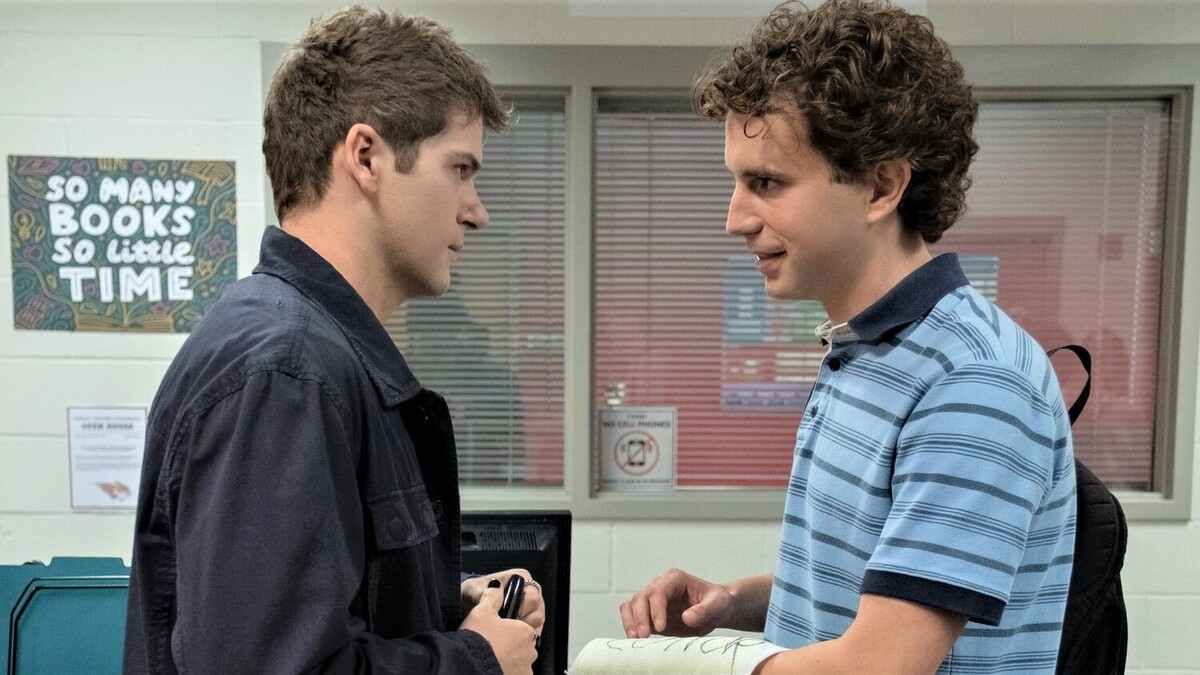
According to the script, Evan goes to high school. Ben Platt was 27 at the time of filming, and he is by no means one of those stars who create the impression of being eternally young (let's cite Thomas Brodie-Sangster and Timothée Chalamet as examples, who bathe in the blood of virgins). In every frame, Ben's age is obvious – due to a thick layer of makeup, a terrible hairstyle that just ages him, and clumsy attempts to emphasize the protagonist's nervousness.
Unfortunately, you can't get used to his appearance because the camera constantly shoots Ben in close-up, and he finds ways to repeatedly make such facial expressions that you see all his wrinkles. And if in the theater this effect is mitigated by the fact that such things are not so noticeable from the auditorium, here there is no hiding. About how the conventions of theater make it easier to believe in what is happening, . And “Dear Evan Hansen” shoots itself in the foot by again striving for realism, which is why we have spent so much time now on Ben's mismatch with his character.

The best way out would have been to go and shoot Ben in a good cameo, giving the lead role to some young and promising up-and-coming actor.

And then there's the staging of the songs themselves. I have nothing to say to a director who thinks that when filming a musical, the best move is to simply place the performer in the center of the frame. There is no variety in the filming of the songs – so “Evan Hansen” becomes so boring and dull that I started catching myself wanting to check my phone every five minutes. Musicals are such fertile ground for inventiveness and artistry, and here we have only one song where the characters try to dance. Where is this going?
“Dear Evan Hansen” as a Bad Adaptation
Before we start picking apart the film, we should pay attention to the musical itself. In 2017, “Dear Evan Hansen” won a whole bouquet of Tony Awards (the highest theater award in the US), including Best Musical and Best Leading Actor. Such success for a simple school story could not help but lead to the purchase of film adaptation rights.
However, the problem is that in the original, the musical is practically a black comedy, which is especially evident in the light and cheerful song “Sincerely, Me,” performed by a character who has already died. But in the film, we got a quasi-drama with no room for jokes or jabs, where teenagers are not allowed to act like teenagers – we're aiming for an Oscar, after all, and dramas are loved more there.

Another mortal sin of the film is the exclusion of several vitally important songs. The first number of the show, which draws parallels between the two families and reveals the motivations of Evan's mother and the Murphy parents, no longer exists. Now they are just cardboard characters revolving around the all-important Ben Platt. The same happens with the song “Good for You,” in which Evan faces the consequences of his actions, essentially the emotional center of the entire work. Now it's simply gone, and the main character looks like the last jerk who gets away with everything. Just two songs, and how the overall meaning is distorted!
Conclusion
The story of the musical “Dear Evan Hansen” is quite simple, so you had to really try to misunderstand and distort it to such a state. Well done, what can I say.
Comments
0No comments yet.
Sign in to join the discussion.