
On December 10, the New Year's rom-com 'The Hating Game' premieres on online streaming services. Trying to understand how interesting the genre still is to viewers in 2021.
'The Hating Game' is an adaptation of the debut novel of the same name by Australian writer Sally Thorne. The book first saw the light of day 5 years ago. Initially, the work didn't attract many readers, starting from only 37th place on the USA Today bestseller list. Gradually gaining momentum, the book earned a spot on The Washington Post's list of '20 Best Romantic Bestsellers,' which helped it reach the top of The New York Times list and stay there for 9 months. A decent track record for the original, but how does the adaptation fare?
What's the Plot?
Two publishing houses in New York decide to merge into one company to stay afloat in business. The merger happened in a rather strange way, as it divided the employees of the newly formed Bexley&Gamin into two warring factions. In this cold war, two employees — Lucy Hutton (Lucy Hale) and Josh Templeman (Austin Stowell) — must share an office, split exactly in half (hello, Two-Face from 'Batman Forever').
Josh and Lucy 'shoot' barbs at each other daily. Pranks, irritation, toxicity — an inseparable atmosphere of the workplace. In short, these two simply hate each other. Or do they? A series of events casts doubt on the fact of their animosity. First, management announces a promotion competition, where Templeman and Hutton are the main candidates for the position of Chief Operating Officer. Due to this circumstance, the 'hellish pair' makes a bet, like, 'neither can live peacefully while the other lives,' but in the work sphere. In short, the conditions are simple: one gets promoted, the other quits.
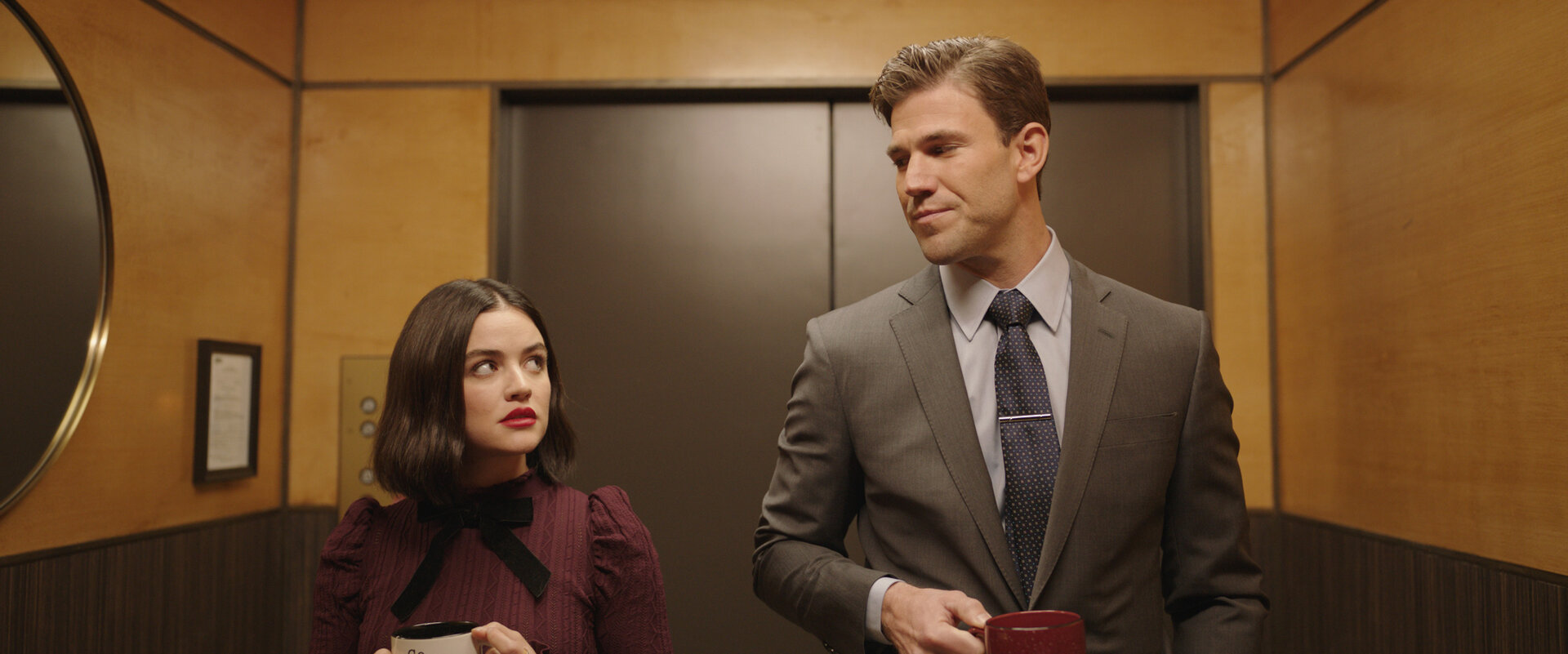
Then the irreparable happens. The characters passionately kiss in the elevator at the end of another workday. What does this ill-fated kiss mean? Genuine attraction? Demoralizing the opponent? Sexual bribery of a rival for the position? A lack of intimacy in both characters, bursting out simultaneously? You'll have to untangle this tangle of confusion with feelings and work. There you have the merger of two publishing houses. Fiction, no less.
I've Seen This a Thousand Times, a Thousand Phrases...
The rom-com is an extremely worn-out genre. Coming up with something new and interesting within the framework of a romantic comedy is an incredibly difficult task. Most films released nowadays are either outright bad or on the border of good/mediocre. Today, viewers turn on such films to switch off their brains, relax, laugh, and forget about problems for the duration of the runtime. That's exactly the task most rom-coms set for themselves at the moment. Unfortunately, or perhaps fortunately (the viewer decides), 'The Hating Game' is no exception.
The film's characters are typical mirror opposites. Lucy is creative, smart, charming, but with chaos in her life. Josh is cold, pedantic, obsessed with perfectionism, but not as simple as his colleague thinks. Both characters are important employees for the bosses and co-chairs of the company. Naturally, it's inevitable and unavoidable that they will fall in love with each other. I have no idea what would have to happen for the romance not to occur.
In the love line, however, one thing doesn't add up. Why did the main character hide his feelings under hatred? Why torment his partner? Deliberately annoy, tease, and insult her hobby? (Lucy in the film has a simply magnificent, in my humble opinion, collection of Smurf figurines). Why, at their first meeting, did Josh choose a stony, arrogant face expressing indifference and hostility instead of a smile and a pleasant introduction? There is a perfectly reasonable answer to all questions. Without Templeman's coldness and hostility, the 'war' in the office wouldn't have started, and consequently, the film (and, most likely, the book) wouldn't exist at all.
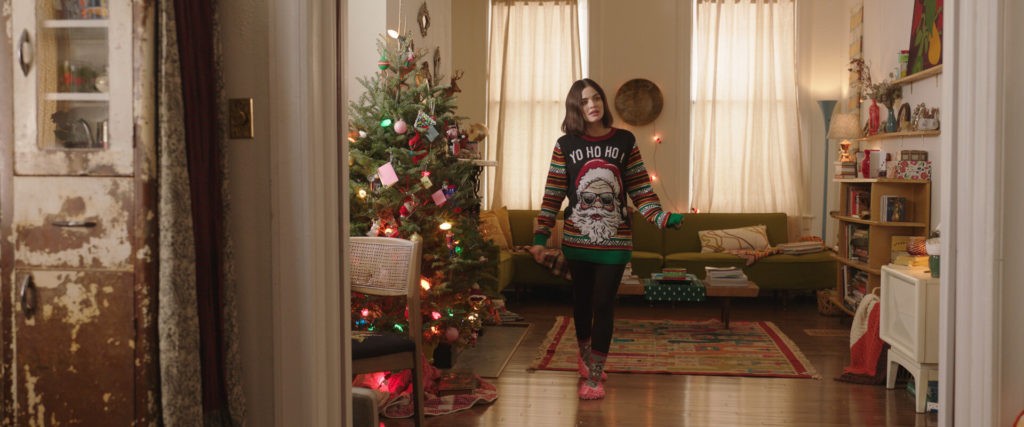
The film's components are no less hackneyed than the genre itself. Including 'The Hating Game,' you know what will happen in advance. Everyone has seen this film, but with different actors and different settings (here, by the way, the production designers did an excellent job, I won't hide it), but the basis itself is invariably familiar down to the last detail. All words have been said, ideas have been realized, but rom-coms keep coming out, changing only some nuances. The question is: how interesting is the genre to viewers at the beginning of the third decade of the 21st century?
Given that some films still recoup quite well (though budgets, as a rule, are far from the range of superhero movies) and are tailored to a specific calendar event (New Year, Thanksgiving, Valentine's Day), there is still an audience for such projects. So, as long as there is minimal demand, there will be supply. 'The Hating Game' is the clearest confirmation of the above argument.
The long-awaited Bond film 'No Time to Die' is coming to screens soon. We figure out what it turned out to be like.
Open materialNew Faces, but an Old Play
The film is packed with templates and clichés, but that doesn't prevent the duo of actors Lucy and Austin from shining brilliantly. Surprisingly, the pair looks really great together. There's wonderful chemistry between the characters, which is incredibly pleasing to watch. It's a huge plus for the film. It would seem that such emotions are mainly evoked by familiar Hollywood stars on screen, but in 'The Hating Game,' the bet on not the most popular actors really paid off. Perhaps the project will be a significant step towards the big screen for both director Peter Hutchings and the 'hellish pair' (although Hale is already familiar to fans of 'Pretty Little Liars,' conquering new heights certainly won't hurt her).
The secret of such chemistry lies in the fact that Lucy Hale and Austin Stowell are friends in real life. A light and comfortable atmosphere reigned on the set, helping the actors open up. Additionally, from Austin's interviews, you can learn that the film duo's off-screen communication is built through friendly teasing. All these facts together clearly explain the wonderful interaction between the characters on screen.

The supporting cast, unfortunately, won't receive the same praise as the leads. Damon Daunno's character (Danny) is maximally absurd, and his role in the film is to be a comparison to Josh. In one scene, the character succinctly described himself as the 'mayor of the friend zone.' The most relatable character for many guys. You feel sorry for the guy with all your heart because the creators treated him the most unfairly.
Danny is a bore who constantly talks, feels awkward around the girl, and throws in random facts from YouTube videos. Such videos are usually the end of a chain at 5 AM, when you initially went to watch a new interview or an episode of your favorite show. As a result, you have information in your head about the 5 most dangerous creatures of the prehistoric period, not including Megalodon, and knowledge of 3 common mistakes when cooking rice.
Besides the 'mayor of the friend zone,' the roster of silly characters also includes Josh's father (Sean Cullen) and one of the company's directors (Corbin Bernsen). It feels like these characters are added just to make the mechanism work. Obstacles on the path to the final formation of the main character's (or rather, the heroine's) personality. Josh's father is a typical tyrant who loves his older son more. Of course, the favorite followed in the old man's footsteps, indulging him and obeying him in everything, while the younger one has his own opinion. Josh didn't become a doctor as his father wanted, so dad constantly spitefully teases his son, tries to hurt him, and when drunk, goes off and lectures him. Naturally, Josh says nothing to his parent and just silently listens to unpleasant things directed at him. Can you guess who should muster the courage to shut up the smug father?
It's the same song with the Bexley director. A maximally caricatured boss who only cares about sales. The character managing the publishing house was made not only ignorant of books but simply stupid. The man went into business without knowing his own product at all. And okay, you might not know which work Mephistopheles is from, but outright not being able to read? Even for a rom-com, that's silly, don't you think? To make it clear: Bexley read the word 'cable' as 'label,' and consequently came up with a lustful cover for a book without deigning to read the synopsis. So what awaits the insufferable director in the finale? The viewer understands perfectly.
No Chuckles, No Laughs
Frankly speaking, the humor in 'The Hating Game' was a bit disappointing. With an 'R' age rating, there was room to let loose. No, of course, I'm not telling the writers to go hardcore (we're not on a show where you need to tell a story), but the scope for humor was considerable. The sexual aspect of the film is perfectly explored under the stated rating, and thanks to this, the viewer believes in the on-screen relationship of the characters. The word 'Romantic' unconditionally justified the MPAA system, but the word 'comedy' didn't quite.

I don't know who in 2021 laughs at characters falling and being clumsy. Have we really regressed a century back to Charlie Chaplin films? (meaning that such humor was new to the viewer 100 years ago, not diminishing the value and watchability of Charlie Chaplin's films today). Again, I understand that the boundaries of humor in the modern world vary enormously, and walking the line between a joke and an insult is no easy task, but the adaptation of the novel didn't even include gags a la 'Marvel.' A couple of funny jokes, caricatured falls, and accidental head bumps on the table. Such techniques are funny when watching 'City Lights,' not the film 'The Hating Game.'
What's the Verdict?
Summing up, I want to say that I don't rule out my own grumpiness regarding the film. It's quite possible that I shouldn't have approached watching a film that does its job of distracting from worries and setting the mood for the New Year holidays with such seriousness. If you think about it, you could spend two hours of free time much worse than watching the film adaptation of Sally Thorne's novel. For director Peter Hutchings, this is his first big project, and for the lead actors, it's a step towards the big screen in the Hollywood struggle for roles, but sorry, I'm used to at least laughing at comedies.
Yes, 'The Hating Game' doesn't try to pass itself off as something grandiose, doesn't strive to seem bigger than an average New Year's rom-com. The film will undoubtedly attract its audience (fans of the book + lovers of romantic comedies + people who want to relax in the evening after work). But simplicity and lightness do not exclude problems in the film, even within the framework of a worn-out genre.
Most likely, viewers who want to watch a simple pre-New Year story will like the film. They will turn a blind eye to all of the above, but 'The Hating Game' will remain the most ordinary 'one-time watch' film and is unlikely to stand on par with 'The Holiday' or 'Love Actually,' which many rewatch on the eve of the winter holidays.
Comments
0No comments yet.
Sign in to join the discussion.