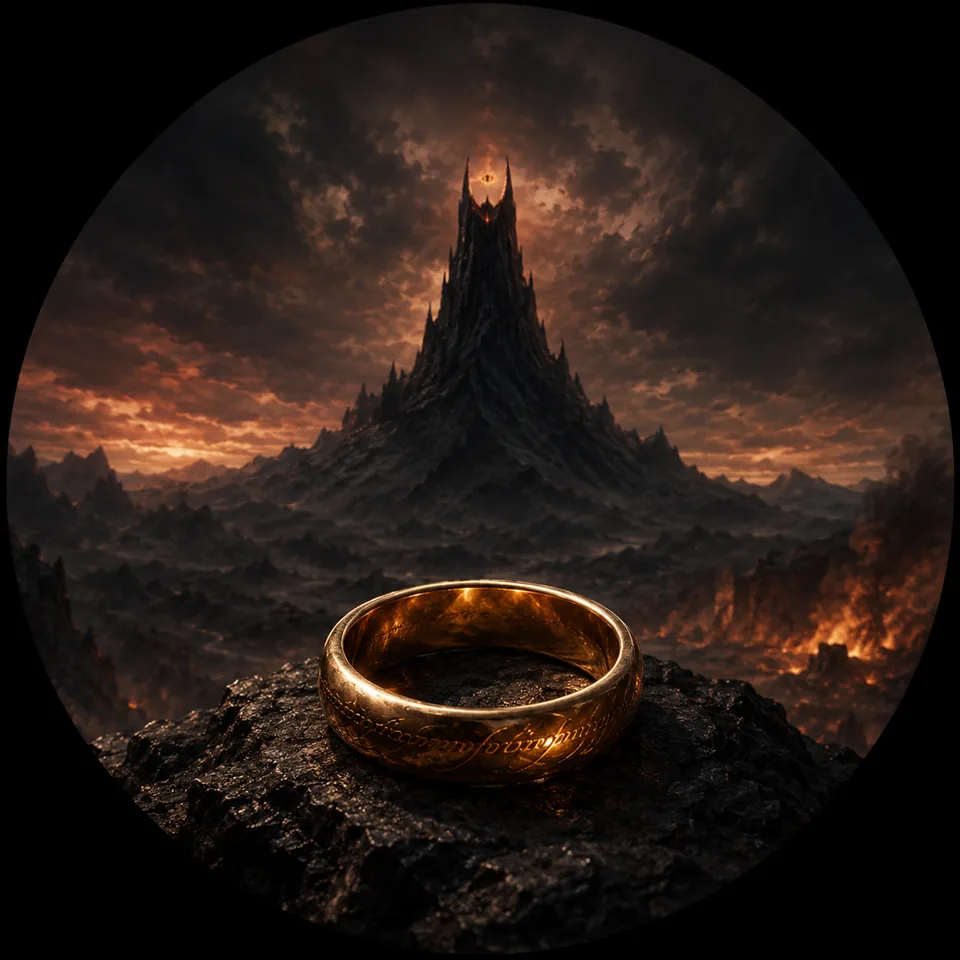
…in Utumno he gathered around him his demons — those spirits who first joined him in the days of his greatness and became most like him in their fall. Their hearts were of fire, but they themselves hid in darkness, terror went before them, and in their hands they held fiery whips.
Balrogs (Sindarin Balrogs), also known as Valaraukar (Valaraukar), are among the most powerful servants of Morgoth. Originally they were Maiar — immortal spirits created by Ilúvatar before the world began. Yielding to Melkor's influence, they turned into demons of fire and darkness, becoming symbols of destructive power and terror. Among the most famous Balrogs are Gothmog, the lord of Balrogs, and Durin's Bane, which Gandalf fought in Moria.
Origin
Before the creation of Arda, the Balrogs belonged to the Ainur — spirits created by Eru Ilúvatar. Most likely, they were among those who supported Melkor during the Music of the Ainur, when he tried to distort the Creator's design.
After entering the world, they became Maiar — lesser spirits serving the Valar. However, many were captivated by Melkor's greatness and voluntarily went over to his side.
“Many of the Maiar were attracted by his splendor in the days of his greatness, and remained faithful to him even when he fell into darkness. Others he later corrupted with lies and treacherous gifts. The most terrible among them were the Valaraukar — the scourges of fire, which in Middle-earth were called Balrogs, demons of terror.”
Over time, these spirits took on a terrifying form: their bodies were shrouded in flame and deep shadow, their hearts burned with fire, and their main weapons became fiery whips and great swords.
Service to Morgoth
After the destruction of the Two Lamps, Morgoth gathered the Balrogs in his first fortress — Utumno. When the Valar overthrew Utumno, the Balrogs managed to escape and hid in the dungeons of Angband, awaiting their master's return.
Many ages later, Morgoth fled from Valinor with Ungoliant, having stolen the Silmarils. When the monstrous spider tried to kill Morgoth himself, he let out a cry that the Balrogs heard. They burst forth from Angband like a fiery storm, cut Ungoliant's webs with their fiery whips, and forced her to flee.
Balrogs in the First Age
The first encounter of Elves with Balrogs occurred during the Dagor-nuin-Giliath — the Battle under the Stars, shortly after the return of the Noldor to Middle-earth.
After defeating Morgoth's army, Fëanor pursued the enemy too far and became cut off from his host. It was then that he was surrounded by Balrogs led by Gothmog. Fëanor fought them for a long time, but was mortally wounded by the lord of demons. Although his sons managed to recover his body, he soon died of his wounds.
During the Wars of Beleriand, Morgoth almost never left Angband in person. The main striking force of his army were the Balrogs, who led assaults and instilled terror in their enemies.
During the fall of Gondolin, two Balrogs were destroyed:
- Gothmog, the lord of Balrogs, fell in single combat with Ecthelion;
- another Balrog fell by the hand of Glorfindel, who at the cost of his own life cast it into the abyss.
After the War of Wrath
When the Valar finally defeated Morgoth in the War of Wrath, Beleriand was flooded. Most of the Balrogs perished, but some managed to hide in the deepest bowels of the earth, where the victors could not reach.
For millennia, nothing was heard of them.
Durin's Bane
The only Balrog appearing in the events of the Third Age is the creature later named Durin's Bane.
While mining mithril, the Dwarves of Khazad-dûm accidentally awakened the ancient demon. The Balrog killed King Durin VI, then his son Náin I, after which the Dwarves were forced to abandon Moria.
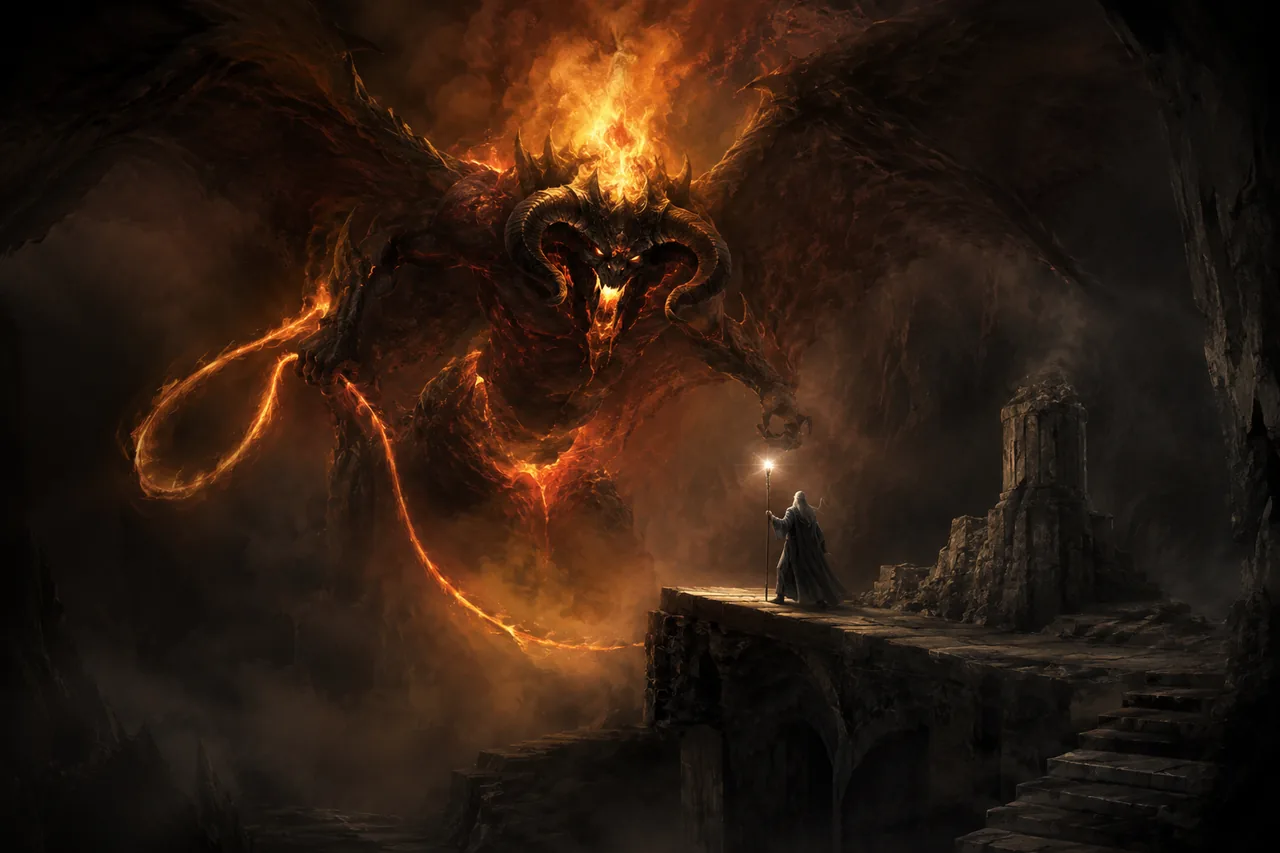
Almost five hundred years later, the Balrog encountered the Fellowship of the Ring. On the Bridge of Khazad-dûm, Gandalf stood in its way.
The wizard's famous words:
“You shall not pass!”
marked the beginning of one of the most famous duels in the legendarium. The Balrog destroyed the bridge, but managed to ensnare Gandalf with its fiery whip, and both opponents fell into the abyss.
The battle lasted many days: first in the depths of Moria, then on the Endless Stair, and finally on the peak of Zirakzigil. In the end, Gandalf destroyed the Balrog, but himself died of exhaustion. He was later returned to life as Gandalf the White.
Appearance
Tolkien never gave a completely full description of Balrogs, but from various works a fairly coherent image emerges.
Main features of Balrogs:
- bodies surrounded by flame and deep shadow;
- a heart of fire;
- enormous physical strength;
- a fiery whip as the main weapon;
- a long sword;
- the ability to instill panic terror by their mere presence.
The question of wings remains one of the most famous topics of debate among Tolkien fans. The texts repeatedly state that the Balrog's shadow “spread out like two great wings.” Some scholars consider this a poetic comparison, others as an indication of actual wings. After Peter Jackson's film adaptation, the image of the winged Balrog became the most recognizable, although there is no definitive confirmation in the books.
How Many Balrogs Were There
Tolkien's ideas about the number of Balrogs changed significantly.
In the earliest versions of the legendarium, they numbered in the hundreds or even thousands. For example, in the early version of “The Fall of Gondolin,” heroes destroyed Balrogs by the dozens.
Later, the writer significantly revised the concept. As the legendarium developed, Balrogs became much more powerful and rare beings.
In the margins of one of his later manuscripts, Tolkien left a note:
“It should not be supposed that there were more than three or at most seven of them.”
This note is generally considered the author's final opinion on the matter, although the exact number of Balrogs is never stated in the published works.
Known Balrogs
Gothmog
The most famous Balrog and the supreme lord of all Valaraukar. He mortally wounded Fëanor and led Morgoth's armies in many battles of the First Age. He died during the fall of Gondolin in single combat with Ecthelion.
Durin's Bane
The Balrog awakened by the Dwarves of Moria while mining mithril. Its appearance led to the downfall of the great kingdom of Khazad-dûm. It was destroyed by Gandalf on the peak of Zirakzigil.
Lungorthin
Mentioned only once in the poem “The Lay of the Children of Húrin”, where he is called “lord of Balrogs” and strikes the captive Húrin. According to Christopher Tolkien, this was a separate Balrog, not another name for Gothmog.
Origin of the Name
The word Balrog in Sindarin means “demon of might” and is derived from the root bal (“strength”, “might”) and rog/raug (“demon”).
In Quenya, Balrogs are called Valaraukar, and the singular is Valarauko.
In early versions of the legendarium, Tolkien used other forms of this word, but later settled definitively on Balrog and Valaraukar.
Balrogs in Adaptations and Games
The image of the Balrog has appeared multiple times in films and games based on Tolkien's works.
Most notable appearances:
- “The Lord of the Rings” (1978) — the Balrog is depicted as a winged demon with a lion's head.
- “The Lord of the Rings: The Fellowship of the Ring” (2001) — Peter Jackson's film shaped the most recognizable modern image of the Balrog: a huge creature with horns, a tail, hooves, and massive wings.
- The Lord of the Rings Online — besides Durin's Bane, the game features the Balrog Thaurlach.
- Middle-earth: Shadow of War — the player encounters the Balrog Tar Goroth.
- “The Lord of the Rings: The Rings of Power” — the first season shows the awakening of Durin's Bane in the depths of Khazad-dûm.
Comments
0No comments yet.
Sign in to join the discussion.