
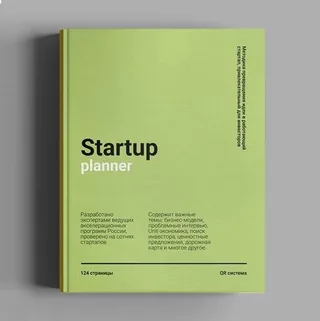

A value proposition is the foundation of marketing and a startup as a whole. It answers the question of why customers should buy a particular product. If a marketer or entrepreneur cannot formulate a value proposition, there is no point in starting sales or promotion. A startup must answer the questions – who is my customer, what am I selling to them, and can I produce it at the right price and in the right form. Therefore, we see that the value proposition is half of these questions. It is the essence we obtain from conducted interviews and hypothesis testing.
When creating a value proposition, you can take two paths – first make it, then test and edit. Or you can study the processes and problems of the target audience, find a specific pain that customers want to “cure,” and then formulate a value proposition for it. Both methods work well, but most often everyone uses the first one.
What is a Value Proposition
A value proposition is a message that explains why customers choose your products or services. It is like a promotional poster that clearly states the benefits a customer will get if they choose your product.
Each point should show what problems the customer has and how your product solves them. Even better if you can highlight how you are better than competitors.
Based on the value proposition, you can create a brand promotion strategy and come up with advertising slogans. It is like the foundation on which a reliable and safe “house” of marketing is built.
Examples of value propositions from large companies already formatted as advertising slogans:
Stripe – Online and mobile payments built for developers
Dollar Shave Club – A great shave for a few bucks a month
Pagely – We help the world's largest brands scale and secure WordPress
How to Write a Value Proposition
A value proposition is something between the “features” of your product and the description of the consumer's request. That is, to describe a value proposition, you need to understand well what we can give the user with our product, what they want, and in what form.
There is an old example that explains the difference between product features and a value proposition well – hammer drill brands do not sell hammer drills, they sell a hole in the wall. The customer does not actually need a hammer drill – it is a tool that provides value, i.e., the ability to quickly make a hole in the wall anywhere without professional skills.
To start, analyze:
- customer desires — emotional factors;
- needs — rational motivators;
- fears — undesirable outcomes.
For example, try to understand whether the buyer perceives your product as an opportunity to influence their anxiety or reputation at work, what task and problem in their life they are solving, and what emotions arise.
Remember: even if the customer is not an individual but a company, when making a purchase, they may still be guided by emotions rather than rational motivators, since ultimately one person makes the decision.
Use the questions compiled by Harvard Business School. They simplified the process of creating a value proposition to three questions:
- Which customers are you going to serve?
- What needs are you going to satisfy?
- What relative price will provide acceptable value for customers and acceptable profitability for you?
Depending on your product or service, you can start the analysis with the first or second question. Together, the three questions form a triangle that allows you to create a concise value proposition.
When you answer the questions, you will understand which value is most important. For example, cost savings, the best product on the market, or a new experience.
Also consider whether your company expands the market or satisfies an unmet need. A good example is the iPad. Apple created demand that did not exist before this gadget appeared on the market.
Use Steve Blank's formula for “distilling” ideas. Steve Blank is a former Google employee and creator of eight successful startups. He noticed that many startup founders focus on product features rather than its benefits. Blank proposed a simple formula that helps transform brainstorming results into a simple value proposition.
We help X do Y by doing Z.
This is an intuitive template that helps you come up with your own proposition. Often the first thing that comes to mind is the best.
For example, a value proposition for a copywriting business: “I help marketing teams resonate with their target audience by writing accurate and emotional copy.”
A local coffee shop might have this value proposition: “We help our customers feel good and do good deeds by treating them to craft coffee in a socially conscious café.”
The third method works better if each team member comes up with their own value proposition. Then compare them: this can provide useful information about each person's priorities.
Now that you have done the research and understood everything, it's time to try to create a value proposition using our template. It is a bit broader than Steve Blank's model. Therefore, it cannot be immediately used as a marketing slogan, but it makes everything clear and is easier to fill out.
Key Points about Value Proposition
A value proposition is a concise and persuasive text in which a company explains why a customer should choose its products or services.
- Speak the customer's language. Your value proposition should be understandable and relatable to your target audience.
- Review your value proposition. Even if you already have a ready text, set aside time to periodically check and update it. Customers and markets are constantly changing, and your proposition should change with them.
- Listen to your customers. Paying attention to feedback will help you improve your value proposition and better meet the needs of your audience.
- Highlight your differences. Explain how your product or service is better than competitors. This will help customers understand why they should choose you.
- Focus on problems and solutions. Show what problems customers have and how your product or service helps solve them.
- Use the value proposition as a foundation. Based on it, you can build a brand promotion strategy, create advertising slogans, and other marketing materials. It is the foundation of your marketing, on which the success of your business is built.
Task
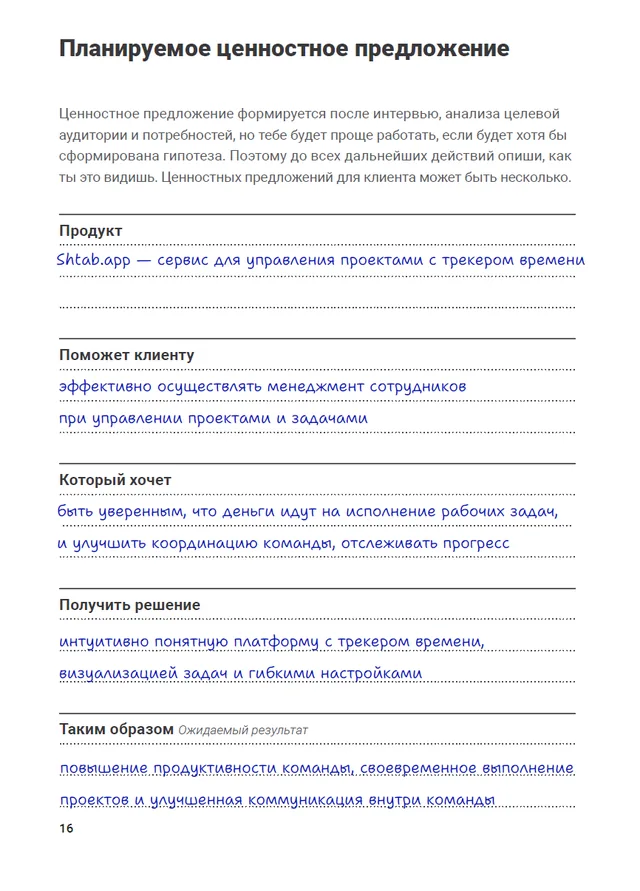
First, you need to create a planned value proposition. As we wrote at the very beginning – it can be created initially as a hypothesis, and then tested in interviews and through experiments. So first make an untested value proposition as your idea. This will indeed make it easier to test. You can do this on pages 16-19 of the planner. We made several pages because a startup may have several value propositions. Each value proposition is one product, one feature, and one target audience.
Example
Comments
0No comments yet.
Sign in to join the discussion.