
TRL 1: Basic principles of technology formulated and justification of its usefulness
Description: At this level, the basic idea and concept of the technology are formulated. An analysis of existing solutions on the market is conducted to determine the need for a new product. A potential technological or algorithmic solution is formed. An expert analysis of the proposed solution is carried out for its value, convenience, feasibility, profitability, demand, and business security.
- Example for a mobile app (B2C): A development team formulates the idea of creating an app to improve sleep quality. They analyze existing apps, identify their shortcomings, and determine that their app can offer unique features for users.
- Example for chemical pipe protection (B2B): A research group formulates the concept of a new chemical composition for protecting pipes from corrosion. They analyze current solutions on the market and find that their composition can provide better protection in the oil industry.
TRL 2: Target application areas of the technology and its critical elements identified
Description: Specific application areas of the technology are identified, a technical proposal is formulated, and a preliminary patent search is conducted. A preliminary technical specification and product architecture are developed, along with modeling and preliminary design.
- Example for a mobile app (B2C): The team determines that the app will be useful for people experiencing sleep problems. A technical proposal describing the main features of the app is developed, and a preliminary patent analysis is conducted.
- Example for chemical pipe protection (B2B): The research group determines that the new chemical composition will be used in oil wells. A product architecture is developed, and modeling of its effect on metal pipes under near-real conditions is conducted.
TRL 3: Mock-up obtained and its key characteristics demonstrated
Description: A simplified laboratory sample (mock-up) is developed, and analytical predictions of key characteristics are confirmed. Proposals for an intellectual property protection strategy are developed.
- Example for a mobile app (B2C): The team develops a simplified prototype of the app and confirms its main functions through laboratory tests and virtual simulations.
- Example for chemical pipe protection (B2B): The research group creates a mock-up of the new chemical composition and confirms its main characteristics in laboratory conditions.
TRL 4: Laboratory sample obtained, laboratory bench prepared, basic functions of interaction with other system elements tested
Description: A laboratory sample is manufactured and tested in laboratory conditions. The main characteristics and interaction with other system elements are verified. An intellectual property protection strategy is developed.
- Example for a mobile app (B2C): The team creates a laboratory sample of the app and conducts tests in laboratory conditions, checking interaction with other devices and apps.
- Example for chemical pipe protection (B2B): The new chemical composition is tested in the laboratory, verifying its main characteristics and interaction with other materials used in pipelines.
TRL 5: Experimental sample manufactured and tested at real scale using semi-industrial technology, main external conditions emulated
Description: An experimental sample is manufactured at real scale using semi-industrial technology, and tested in a laboratory environment with simulation of main external conditions and interaction with other products.
- Example for a mobile app (B2C): The team develops an experimental sample of the app and tests it on a limited group of users, simulating real usage conditions.
- Example for chemical pipe protection (B2B): The research group creates an experimental sample of the new chemical composition and conducts tests in laboratory conditions, simulating real operating conditions.
TRL 6: Full-functional sample manufactured on pilot production line, performance characteristics confirmed under near-real conditions
Description: A full-functional sample is manufactured on a prototype production line and tested in the laboratory under conditions as close to real as possible. Patent applications have been filed.
- Example for a mobile app (B2C): The team develops a full-functional sample of the app and tests it on an expanded group of users, reproducing real usage conditions.
- Example for chemical pipe protection (B2B): A full-functional sample of the new chemical composition is manufactured on a pilot production line and tested in the laboratory, reproducing real operating conditions.
TRL 7: System prototype demonstrated in real operating conditions as part of a system
Description: A prototype is manufactured at real scale on a pilot production line and demonstrated in real operating conditions.
- Example for a mobile app (B2C): The team releases a prototype of the app and tests it in real conditions with a wide audience of users.
- Example for chemical pipe protection (B2B): A prototype of the new chemical composition is tested in real conditions at oil industry facilities.
TRL 8: Final confirmation of sample performance. Development of a functioning real system completed
Description: A full-functional sample is manufactured on a production line and undergoes full testing as part of the system in real operating conditions. The product is released in small series.
- Example for a mobile app (B2C): The team completes development of the app, conducts full testing, and releases it to the market for a limited number of users.
- Example for chemical pipe protection (B2B): A full-functional sample of the new chemical composition is manufactured on a production line and undergoes full testing at oil industry facilities.
TRL 9: Product meets all requirements: engineering, production, operational, quality, and reliability. Modifications for cost reduction, development, and system evolution are possible
Description: The product is fully ready for serial production and operation. Final testing and correction of possible defects are carried out. The product meets all requirements and can be modified for further improvement.
- Example for a mobile app (B2C): The sleep improvement app is fully ready for serial production and mass launch. Final testing and defect correction are carried out.
- Example for chemical pipe protection (B2B): The new chemical composition is fully ready for serial production and operation at oil industry facilities. Final testing and defect correction are carried out, and the product meets all quality and reliability requirements.
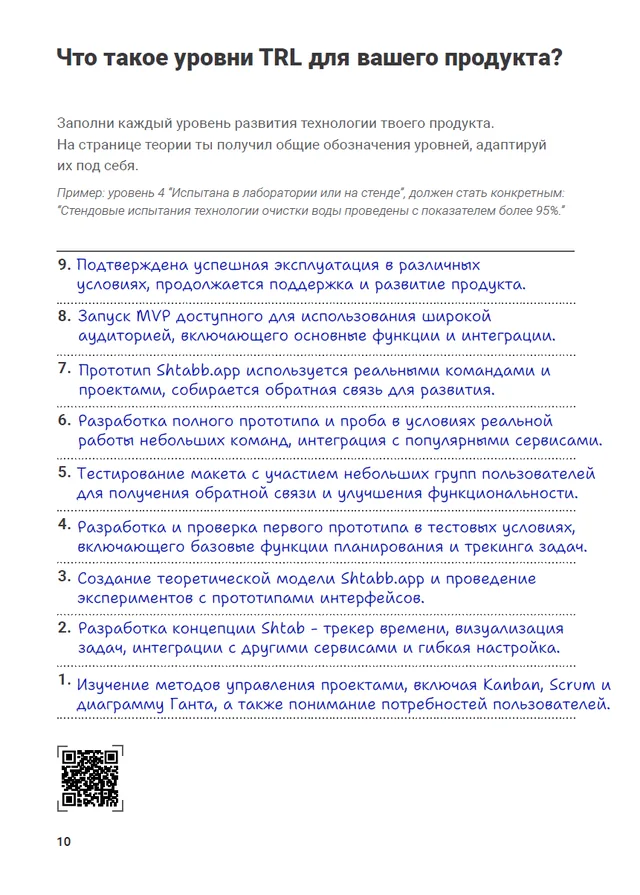
The task is simple but at the same time complex. You need to look at the description of the level and “translate” it for your startup.
That is, describe how you will understand that your product has technologically reached level 4? Not all technologies have laboratories and laboratory tests, but we can translate this using the example of this planner when we created it – the laboratory was the evaluation of experts, the printed planner not in the form of a book, but in the form of a prototype notebook. We gave it to experts and watched how they filled it out, collected feedback, and collected the notebooks for analysis. Therefore, for my product, I would describe technology readiness level 4 as follows:
The prototype is tested under conditions close to reality, experts are given the planner in the form of a notebook without explanations, and during the experiment we make sure that they fill it out without prompts according to the scenario I intended.
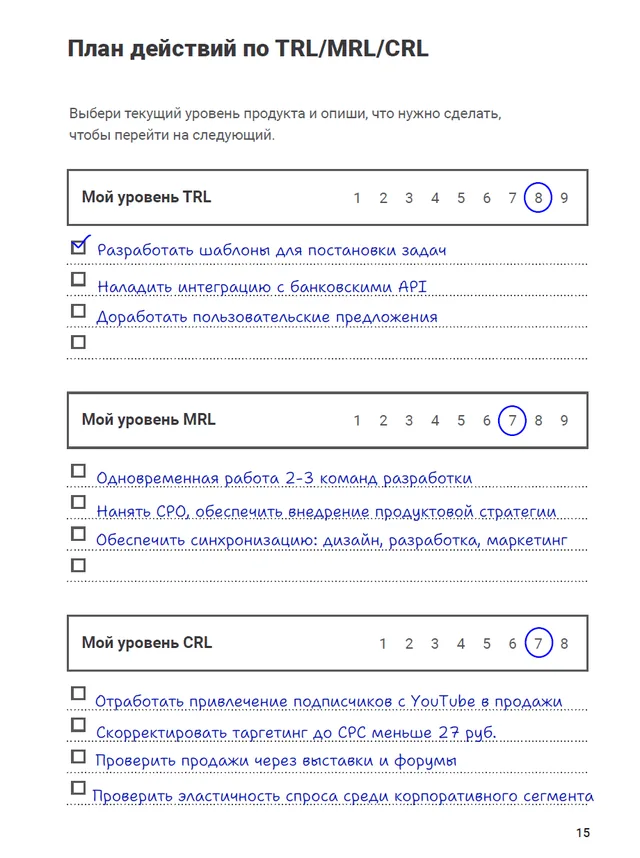
Example of filling out the planner
FAQ
Are TRL levels not applicable to my startup?
To date, no startup has been found that does not have a “Technology for creating value.” Even if you are a YouTube blogger, the very process of creating content is your TRL, and if you sell things at the market, then their selection, evaluation, and placement on the display is also a technology. If you cannot find it, try writing to our chat – the community will definitely help.
Why not use ready-made descriptions?
They are too general, and when you move on to the task of defining a list of actions to achieve the next TRL level, it will be very difficult. It is better to first determine how these levels work in your business, and then build the right hypotheses.
Comments
0No comments yet.
Sign in to join the discussion.