
Manufacturing Readiness Levels (MRL) is an assessment system that helps determine how ready a technology or product is for production. MRL is used to manage risks and plan the production process to ensure that the product will be successfully manufactured on time and with the required quality. For a startup, this is important as it allows assessing and improving its readiness for production, attracting investors, and planning resources more efficiently.
MRL 1: Initial Conclusions about Production Needs
Description: At this level, a general understanding of what is needed to produce the product is created. Basic production concepts are defined and capabilities are assessed at a theoretical level.
- Example for a mobile app (B2C): The development team defines the basic requirements for producing the app, including necessary software, server infrastructure, and databases.
- Example for chemical pipe protection (B2B): The research team assesses basic production needs, such as raw materials, equipment, and technologies required to create a new chemical composition.
MRL 2: Definition of Production Concept
Description: At this stage, a more specific production concept is developed that takes into account the product's application area. The design of the production line begins.
- Example for a mobile app (B2C): The team develops a production process concept, including stages of development, testing, and deployment of the app on servers.
- Example for chemical pipe protection (B2B): The research team develops a production concept, including stages of raw material preparation, component mixing, and packaging of the finished product.
MRL 3: Confirmation of Production Concept
Description: At this level, experimental production processes and laboratory studies are conducted to confirm the developed concepts.
- Example for a mobile app (B2C): The team begins experimental deployment of the app on test servers to confirm the developed production concept.
- Example for chemical pipe protection (B2B): The research team conducts laboratory experiments to confirm the production concept and evaluate the effectiveness of the new chemical composition.
MRL 4: Production in Laboratory Conditions
Description: Production processes are practiced in laboratory conditions, allowing the manufacture of demonstration samples. Also, the resources and materials needed for production are determined.
- Example for a mobile app (B2C): The team creates a demo version of the app and tests it in laboratory conditions, determining the necessary resources and materials.
- Example for chemical pipe protection (B2B): The research team produces demonstration samples of the new chemical composition in laboratory conditions and determines what resources and materials will be needed for mass production.
MRL 5: Fabrication of Component Prototypes
Description: At this level, prototypes of components are fabricated in real production conditions. Materials, tools, and equipment are checked. A cost model is created.
- Example for a mobile app (B2C): The team creates prototypes of individual app components, testing them in conditions close to real, and estimates production costs.
- Example for chemical pipe protection (B2B): The research team produces prototypes of components of the new chemical composition in real production conditions, checking the materials and equipment used, and creates a cost model.
MRL 6: Fabrication of System and Subsystem Prototypes
Description: Prototypes of systems and subsystems are produced using ready-made elements of the main production. Long-term supply chain elements are identified.
- Example for a mobile app (B2C): The team creates prototypes of the entire app, including all systems and subsystems, using ready-made components and identifying long-term infrastructure elements and suppliers.
- Example for chemical pipe protection (B2B): The research team produces prototypes of pipe protection systems, using ready-made components and identifying long-term supply chain elements.
MRL 7: Production in Near-Real Conditions
Description: Production processes are practiced in conditions close to real. The readiness of the supply chain is checked.
- Example for a mobile app (B2C): The team tests production processes in conditions as close to real as possible, checking the readiness of infrastructure and suppliers.
- Example for chemical pipe protection (B2B): The research team conducts testing of production processes in conditions close to real, checking the readiness of the supply chain and interaction with partners.
MRL 8: Pilot Production Line
Description: A pilot production line is created and tested, allowing the start of small-scale production.
- Example for a mobile app (B2C): The team deploys a pilot production line for the app to start its small-scale production and gather user feedback.
- Example for chemical pipe protection (B2B): The research team creates a pilot production line for the new chemical composition to start its small-scale production and evaluate its effectiveness in practice.
MRL 9: Small-Scale Production
Description: The capability for small-scale production is successfully demonstrated. The foundation for full-scale production is prepared.
- Example for a mobile app (B2C): The team successfully demonstrates small-scale production of the app, receiving positive feedback and preparing for scaling.
- Example for chemical pipe protection (B2B): The research team successfully demonstrates small-scale production of the new chemical composition, confirming its effectiveness and preparing the foundation for full-scale production.
Examples
Thus, MRL helps startups at every stage of production, from idea to full-scale product release.
Task
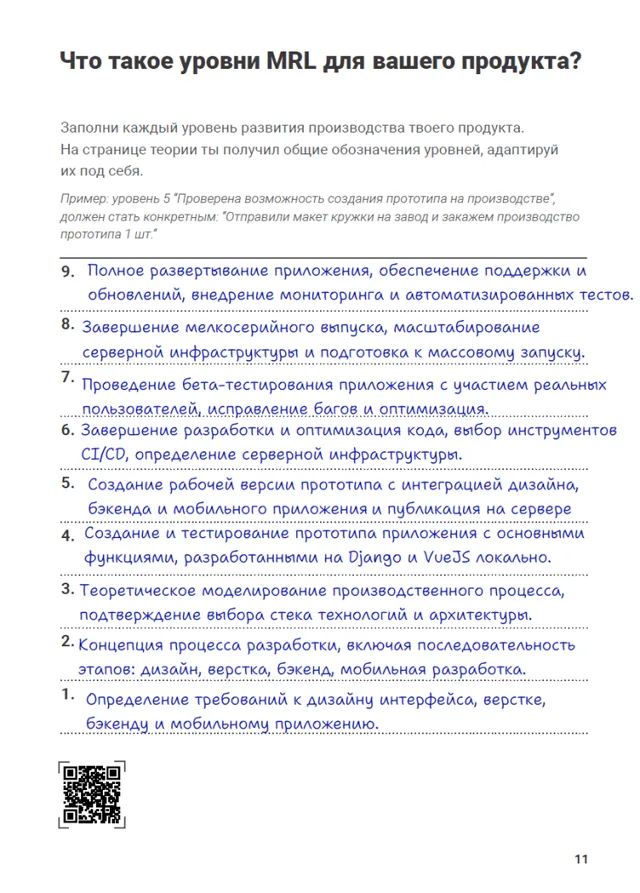
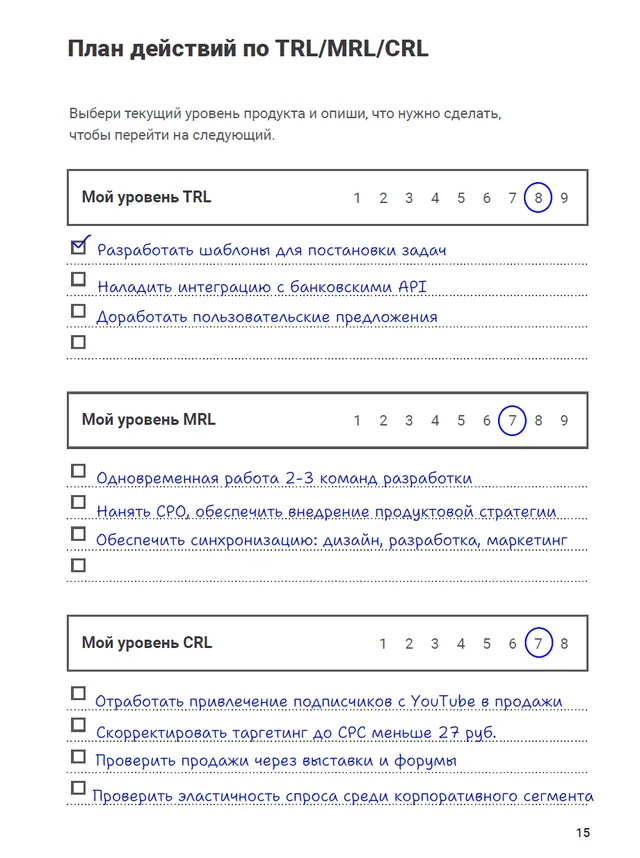
The task is simple but at the same time complex. You need to look at the description of the level and "translate" it for your startup. Do this for each level as you did for TRL. Fill in the template on page 11. Then determine your current level and write down on page 13 the actions that will allow you to step to the next level. Once you have completed all actions and moved to the next level, fill everything again on page 14, and so on.
Example of Completion
FAQ
How often should the Manufacturing Readiness Level (MRL) be assessed at different stages of product development?
The Manufacturing Readiness Level (MRL) should be assessed at each key stage of product development, from the conceptual phase to full commercialization. This helps identify potential risks and issues early and address them in a timely manner, ensuring a smooth transition from prototype to mass production.
How can companies use MRL to improve their competitiveness?
Companies can use MRL to improve competitiveness by ensuring higher efficiency and reliability of production processes. Continuous assessment and improvement of the manufacturing readiness level allow for faster adaptation to market changes and the introduction of new technologies. This leads to reduced time to market, lower production costs, and improved product quality, ultimately making the company more competitive.
How does MRL help minimize risks when launching a new product on the market?
MRL helps minimize risks by providing a systematic assessment and preparation of all aspects of the production process. It allows identifying potential problems with equipment, materials, personnel, and logistics at early stages, enabling timely measures to be taken and preventing disruptions. As a result, product launch becomes more predictable and less prone to unexpected difficulties.
Comments
0No comments yet.