
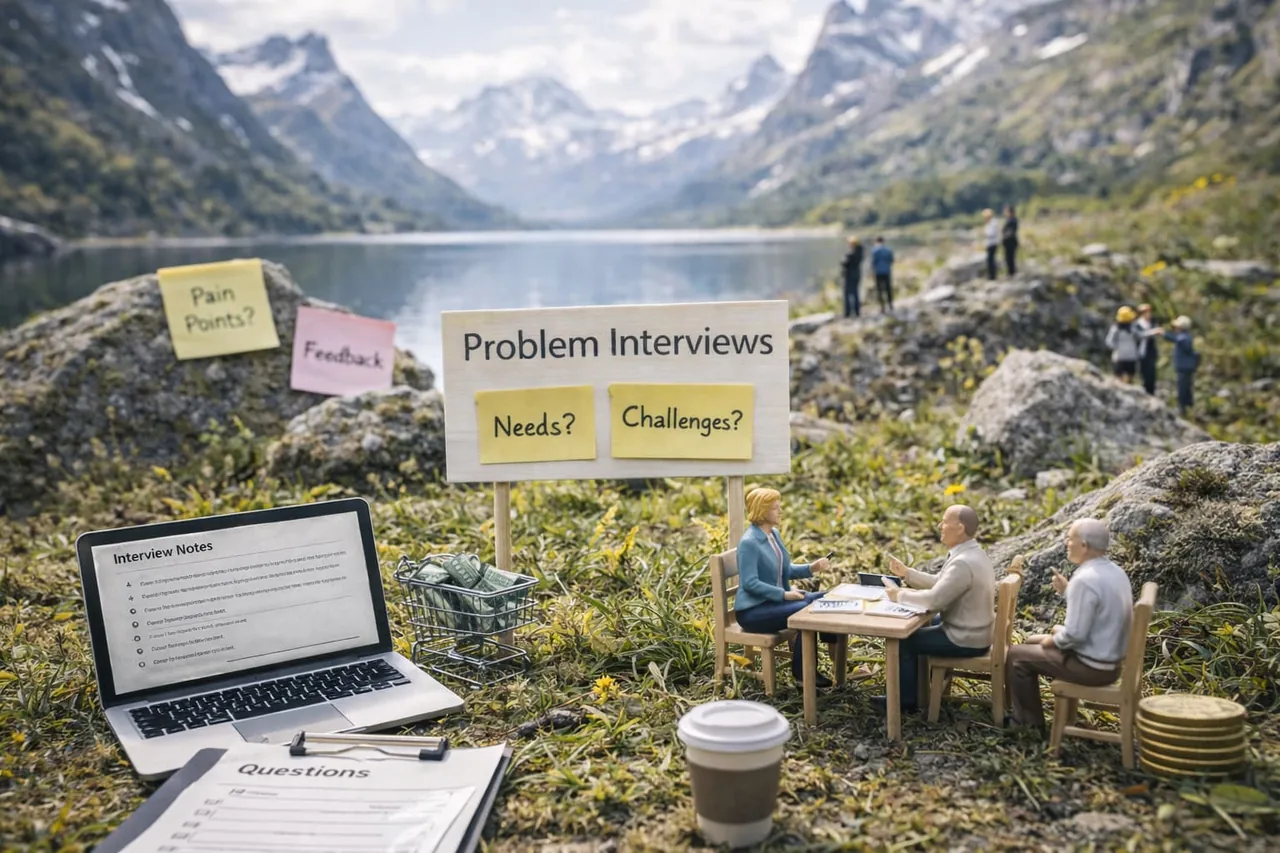
What is a problem interview and a solution interview?
A problem interview is a method of gathering information where you communicate with potential customers to identify their pains and problems. The goal of this interview is to understand what difficulties your target audience faces and which tasks are most relevant to them.
A solution interview is conducted at the next stage, when you already have an idea of the customers' problems. Here you test your hypotheses about possible solutions by discussing them with the same respondents or a new group. The goal is to understand how much your proposed solutions will actually help customers and be in demand in the market.
Why do we choose these methods?
One of the most important tasks of a startup is to understand what task or problem of the user we are solving, whether it is really a problem for them, and whether users are willing to pay for the solution. The easiest way to do this is through a problem interview, and it is also cheaper and faster. Conducting 8-10 problem interviews is a matter of one working day, and as a result you will get all the necessary information. Among the main tasks solved by a problem interview, it is worth noting:
- Deep understanding of the customer: A problem interview allows you to deeply understand the needs and pains of the target audience, which is the basis for product development.
- Hypothesis testing: A solution interview helps to test and refine hypotheses about possible solutions, minimizing the risks of creating an unnecessary product.
- Resource savings: Conducting interviews requires fewer resources compared to launching full-scale tests or prototypes.
- Early adaptations: You can make changes to the product at early stages based on the data obtained, which allows you to avoid major mistakes in the future.
Start with analyzing the results
Before moving on to conducting problem interviews, it is important to analyze what results you expect to get and what decisions you will make based on them. This will help avoid subjective interpretations and hasty conclusions. If you do not set goals, then after the interviews you will start “bargaining” with yourself and the team, trying to defend the work done, so be sure to decide before the interview – what will you do if, for example, you get confirmation in only 2 out of 10 interviews? Will you close the project or change the audience? The analysis process can be divided into the following stages:
Experiment planning
- Setting the goal of the experiment: Clearly formulate what you want to find out.
- Conditions of the experiment: Determine the conditions under which the interviews will be conducted to ensure maximum data reliability.
- Selection of input and output parameters: Determine what data you will collect and which indicators will be key for decision-making.
- Mathematical model of the experiment: If possible, develop a model that will help interpret the data obtained.
- Setting the required accuracy: Determine what accuracy of results will satisfy you.
- Determining the method of data analysis: Decide in advance how you will analyze the data obtained.
- Verification of the obtained data: Prepare methods for checking and verifying the collected information.
- Interpretation of results: Determine how you will interpret the data and what conclusions to draw.
What to do?
- Decisions are made before the interview: Determine what decisions you will make based on various possible answers.
- We must understand what we are looking for before the experiment: Clearly define the goals and objectives of the interview.
- Before conducting the interview, simulate answers and decide what we will do with them: Imagine possible answers and think about how you will react to them.
- Verify any statements: All data and conclusions must be checked for reliability.
- Ignore statistical spikes: Do not succumb to random data that may distort the overall picture.
- Do not give in to emotions: Stay objective and do not let emotions influence your decisions.
Where to find respondents
The most difficult block for most founders. Finding a group of people to talk to. If you show creativity and persistence, you will easily gather people who agree to conduct an interview. It is important – a problem interview is not about “selling” your product, but about researching a person's problems. You can turn a problem interview into a solution interview if the respondent agrees. Usually they agree, because during the conversation they themselves highlighted their “pain”, and you offer a solution.
Warm contacts:
“Warm” contacts are those that are slightly prepared for your call. These can be acquaintances, friends of friends, partners of your organization.
- Friends of friends – post a request for respondents on your social networks, your message will be seen by a couple of hundred people, and they also have a couple of hundred acquaintances, so we have already covered 40,000 people. And if someone also reposts, the circle will expand. Once someone responds, do not just take their contacts, but ask them to introduce you.
- Communities – if you are a member of a professional community, send a request there – people will not perceive you as an outsider and will be more likely to agree to help.
Important! Do not take friends, only slightly familiar people.
You cannot take friends because they will be biased; they may guess where your research is going, and they will try to confirm your hypothesis. But friends can help you find respondents you do not know.
Cold contacts
- Social networks: Groups and forums dedicated to your industry are an excellent source for finding respondents.
- Professional platforms: LinkedIn and other specialized sites can help you find professionals who can provide valuable insights.
- Specialized services: Platforms for finding respondents, such as Respondent.io, UserInterviews, and others.
- Conferences and events: Participate in industry events where you can directly meet potential customers.
Be creative – a company that produces intercoms announced a search for sales managers and invited employees of competitors for interviews, where they thoroughly questioned them about sales methods, amounts, etc., and since the employees really wanted to get the job, they actively told all the numbers, difficulties, and generally all the value propositions that work.
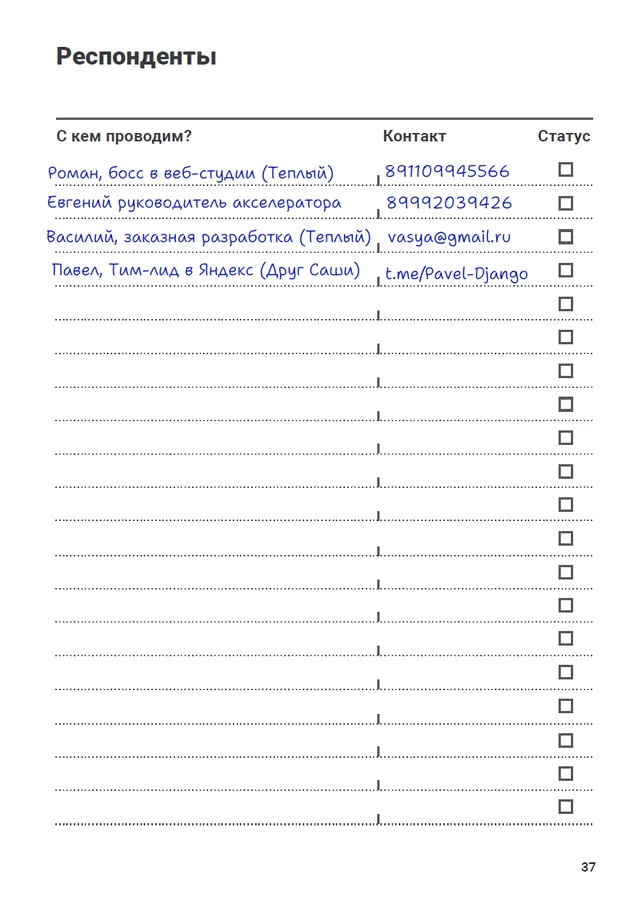
Fill pages 37-38 of the planner with a list of respondents.
What to prepare in advance
- A clear interview plan: Define the goals, questions, and sequence of the interview.
- Question script: Prepare a list of questions, but be ready to be flexible during the conversation. Or better – prepare a list, read it a couple of times, and throw it away. This will help you but will not distract you during the conversation. This needs to be filled on page 39 of the planner.
- Recording device: Make sure you have a way to record the interview for later analysis (e.g., voice recorder, smartphone recording app).
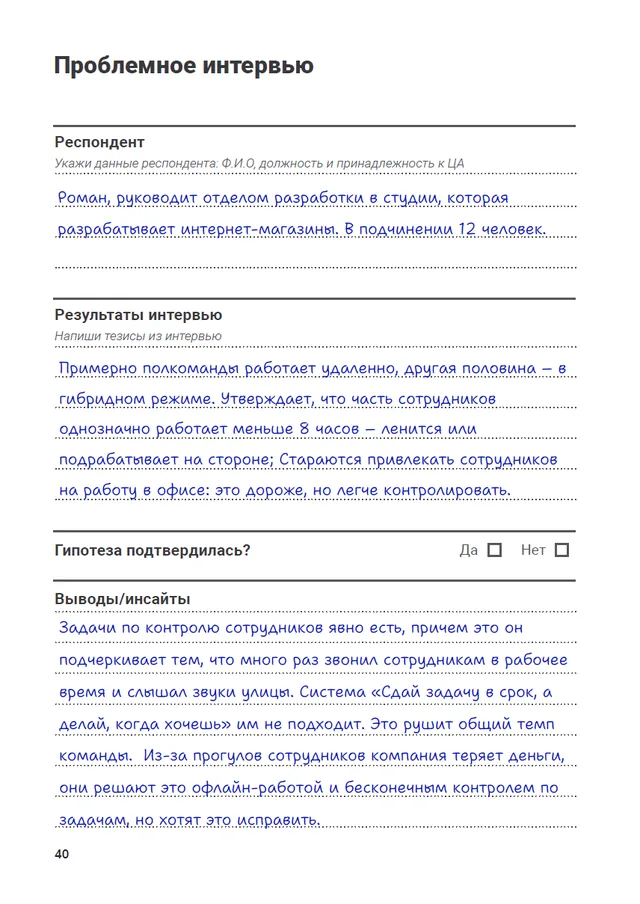
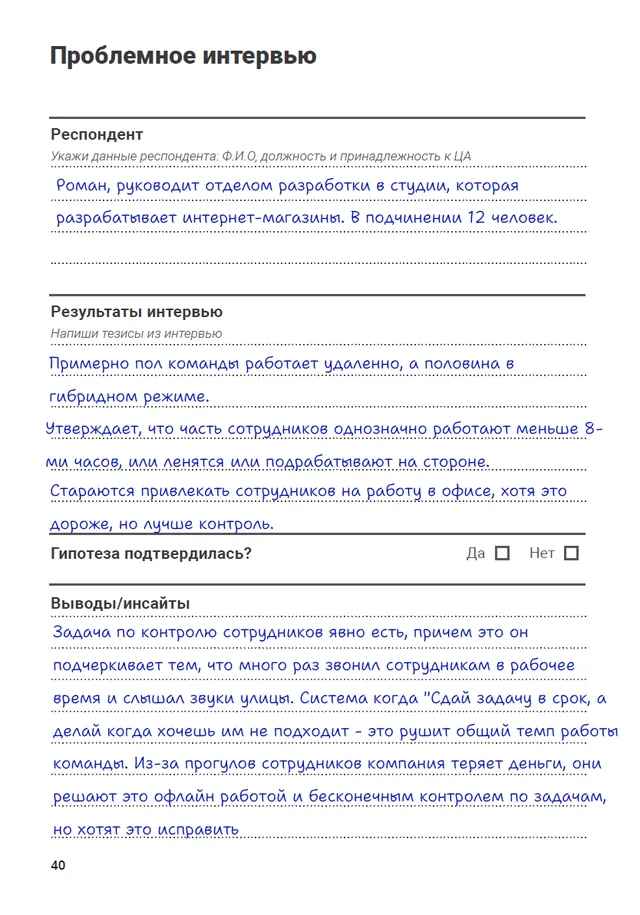
- Note-taking forms: Prepare a place for taking notes and key points. Use pages 40-50 of the planner for this.
- Presentation or prototype: For a solution interview, you may need a visual representation of your solution.
Rules of conduct
- Create a trusting atmosphere: Start with simple questions to make the respondent feel comfortable. You can use small talk, it is important to get the person talking a bit so they do not answer in monosyllables and feel like they are being interrogated.
- Do not interrupt: Let the respondent fully express their thoughts. Your task is not to ask all the questions, but to structure the conversation so that the respondent, without prompts or pressure, tells you about their problems – the more, the better.
- Ask clarifying questions: If something is unclear, ask for clarification. If you see that the person hinted at a “pain”, immediately ask a question containing “Why” to get them talking and clarify emotions.
- Avoid bias: Do not impose your ideas and do not steer the respondent in the direction you want. It is important not to apply pressure, as many people easily succumb to it and will start saying what you want to hear. For example, if you asked: “Tell us about the problems when buying tickets,” that is pressure. The respondent will want to answer you and will invent problems or “inflate” them, and you will get incorrect information. Check all questions for neutrality. About tickets, it is correct to ask “Tell us about your past experience buying airline tickets.” And if the person does not mention problems or difficulties in their answer, then they did not exist.
- Record key moments: Record your meeting with a voice recorder. Do not take notes during the interview – it will distract you. After the meeting, be sure to listen to and analyze the interview. If there is no recording of the interview, it cannot be considered.
- Ask only about experience: Questions should only be about actions the person has already taken. There should be no questions about imagination or the future. The person should talk about processes that have occurred in their life, and the “fresher” the better; if someone bought tickets 7 years ago, that experience is irrelevant.
- Work only one-on-one: Do not conduct interviews when there are two or more respondents. You also come alone. If there are two respondents, one may pressure the other. An employee will not highlight problems in their work in front of their manager. If there are several people on your side, it will be uncomfortable for the respondent. This applies not only to who is sitting at the table, but if you understand that other people can hear them and it might interfere, then such an interview should not be considered. Make sure the person is in an environment where they can answer honestly.
- Do not reveal your hand too early: Do not talk about your project until you have finished the problem interview. You can talk about your product as part of a solution interview, but make sure you have already asked all the questions about problems and pains. The results of such an interview should be interpreted separately, as two conducted – one problem and one solution – and it is better to clearly understand where you transition from one to the other.
Task
First, let's find a list of respondents and fill out the template. For each hypothesis being tested, we need 10 interviews, so do not be lazy and find 10 respondents. You can only conduct an interview with one person once.
Example of filling
FAQ
What if I didn't record the interview?
As one advertisement said, “If you didn't post it, it didn't happen.” It is very important to separate the processes of conducting the interview and analyzing the results. Sometimes during the interview it may seem that the person is confirming all hypotheses, but when we listen to the recording, we realize that in reality, due to emotions, it seemed the hypothesis was confirmed, but there are actually no statements in the respondent's speech. Therefore, if the recording was not made, the interview does not count, and the respondent is “spoiled”; you cannot conduct a second interview with them.
I accidentally told about our product at the very beginning, what should I do?
You can not drag out the interview, but conduct it so as not to offend the respondent. But it is better not to consider the results of such an interview.
The respondent does not open up and answers in monosyllables, what should I do?
Stop and do not follow the script first of all, make sure you are not asking closed questions. Try to understand what is limiting the person – maybe an inconvenient time, they are tired, or scared of the recording, or maybe they just do not like phone conversations. If you cannot get the person to communicate with small talk or atmosphere, you can try to reschedule the conversation, as there will be no benefit from a closed or irritated interlocutor.
Should I talk about anything other than the process and experience?
I always “relax” the interlocutor at the beginning of the interview – I thank them for agreeing to come and taking the time. I ask a little about the company, about the city they are from, I can ask about the weather, if possible I insert jokes. The beginning of the conversation, especially the first minutes, is never about the interview. The goal is to create a trusting atmosphere.
Comments
0No comments yet.
Sign in to join the discussion.