


Finding investors for a startup is an important and complex process that requires time, effort, and careful preparation. Finding the right investor can be a decisive factor for the success of your business. In this guide, we will look at the key steps that will help you find and attract investments.
Step 1: Determine the Right Type of Investor
First, determine what type of investor you need. Here are the main categories:
- Angel Investors: Private individuals who invest their own money in startups at early stages. Ideal for startups that are just starting out and need initial investments for product development and market entry. View list
- Venture Capital Funds: Organizations that invest in startups with high growth potential. Suitable for startups that already have initial success and are looking for significant investments to scale the business. View list
- Crowdfunding/Crowdinvesting: Raising funds from a large number of people through online platforms. An excellent choice for startups with innovative products or ideas that can attract mass interest and public support. View list
- Corporate Investors: Large companies that invest in startups related to their core business. Suitable for startups that can offer strategic benefits or synergy with the activities of a large company. Most often, support comes through accelerators. View list
Step 2: Search for Potential Investors
- Networks and Events: Participate in startup events, hackathons, and business incubators. These are great places for startups that want to establish personal contacts and get instant feedback from investors.
- Online Platforms: Use platforms like AngelList, Crunchbase, and LinkedIn to find investors. Ideal for startups that want to quickly find and connect with a wide range of investors worldwide.
- Professional Connections: Reach out to your mentors, colleagues, and acquaintances to learn about potential investors. A good option for startups that can leverage existing contacts and recommendations.
Step 3: Prepare for Interviews and Pitch
- Research Investors: Learn as much as possible about each potential investor. What projects have they supported? What are their priorities and interests?
- Develop a Pitch Presentation:Introduction: Briefly introduce your company and the problem you are solving.Solution: Describe your product or service and explain how it solves the problem.Market: Show the market size and your potential customers.Competition: Indicate who your competitors are and how you differ from them.Finances: Provide key financial metrics and forecasts.Team: Introduce key team members and their experience.
- Practice the Pitch: Practice in front of friends, colleagues, or mentors. Get feedback and improve the presentation.
- Prepare for Questions: Think about what questions investors might ask and prepare answers. Here are a few examples:How do you plan to use the funds raised?What are your plans for the next 6-12 months?What risks do you see and how do you plan to deal with them?
Step 4: Conduct Meetings and Collect Feedback
Conduct meetings with investors, present your idea, and collect feedback. Do not be discouraged if you do not get a positive response immediately. Use the comments you receive to improve your proposal.
Step 5: Negotiate and Close the Deal
If an investor is interested, start negotiating the terms of the deal. Discuss the equity stake, financing terms, and other important aspects. It is recommended to involve a lawyer to ensure everything is properly documented.
Conclusion
By following these steps, you will be able to find suitable investors and successfully attract investments for your startup. This process requires time, persistence, and careful preparation, but the result is worth the effort. Good luck in finding investors and developing your business!
Task
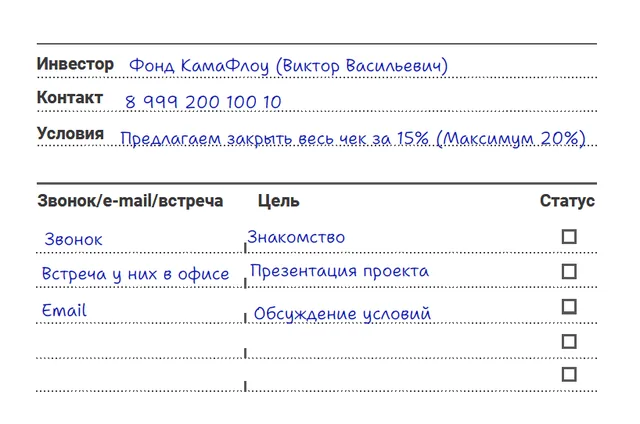
Work out an investment attraction plan. Do not look at how much you can raise or what terms investors offer, but first formulate what you need for the proper growth and development of your business. Then look for the investor you need based on these criteria, not the other way around. Fill in all the blocks on pages 85-86. After that, you can open the lists of investors and select suitable ones. You can first enter them into a general list on pages 108 of the notes, but it is better to use the templates on pages 87-93. Do not fill in everyone at once. Indicate the first two, contact them, get feedback, and then adjust the criteria by which you select investors.
Example of Filling


FAQ
What factors should be considered when choosing between angel investors and venture capital funds?
When choosing between angel investors and venture capital funds, it is important to consider the stage of your startup, the amount of funding needed, and the type of support you require. Angel investors typically invest their personal funds and can offer more flexible terms, which is ideal for early-stage startups. Venture capital funds, on the other hand, invest larger amounts and provide strategic support for scaling the business, which is suitable for more mature startups with a proven business model and significant growth potential.
How to effectively use crowdfunding to attract investments?
To effectively use crowdfunding, start by creating a compelling story and presentation of your project. Explain what problem you are solving and how your product or service will improve people's lives. Prepare high-quality visual materials and videos to attract the attention of potential investors. Actively promote your crowdfunding campaign through social media and other channels to attract as much attention and support as possible. Finally, set realistic funding goals and offer attractive rewards for those who support your project.
How to deal with rejections from investors and use feedback to improve your proposal?
Rejections from investors are part of the investment search process. It is important not to take them as personal failures, but to use them as an opportunity to improve your proposal. After each meeting with investors, collect feedback and analyze the comments. Identify common themes and areas that need improvement. This may include refining the business model, improving financial forecasts, or strengthening the team. Continue to improve your presentation and strategy based on the feedback received, and over time your proposal will become more compelling to potential investors.
Comments
0No comments yet.
Sign in to join the discussion.