
Business Model Canvas: What It Is and How to Fill It
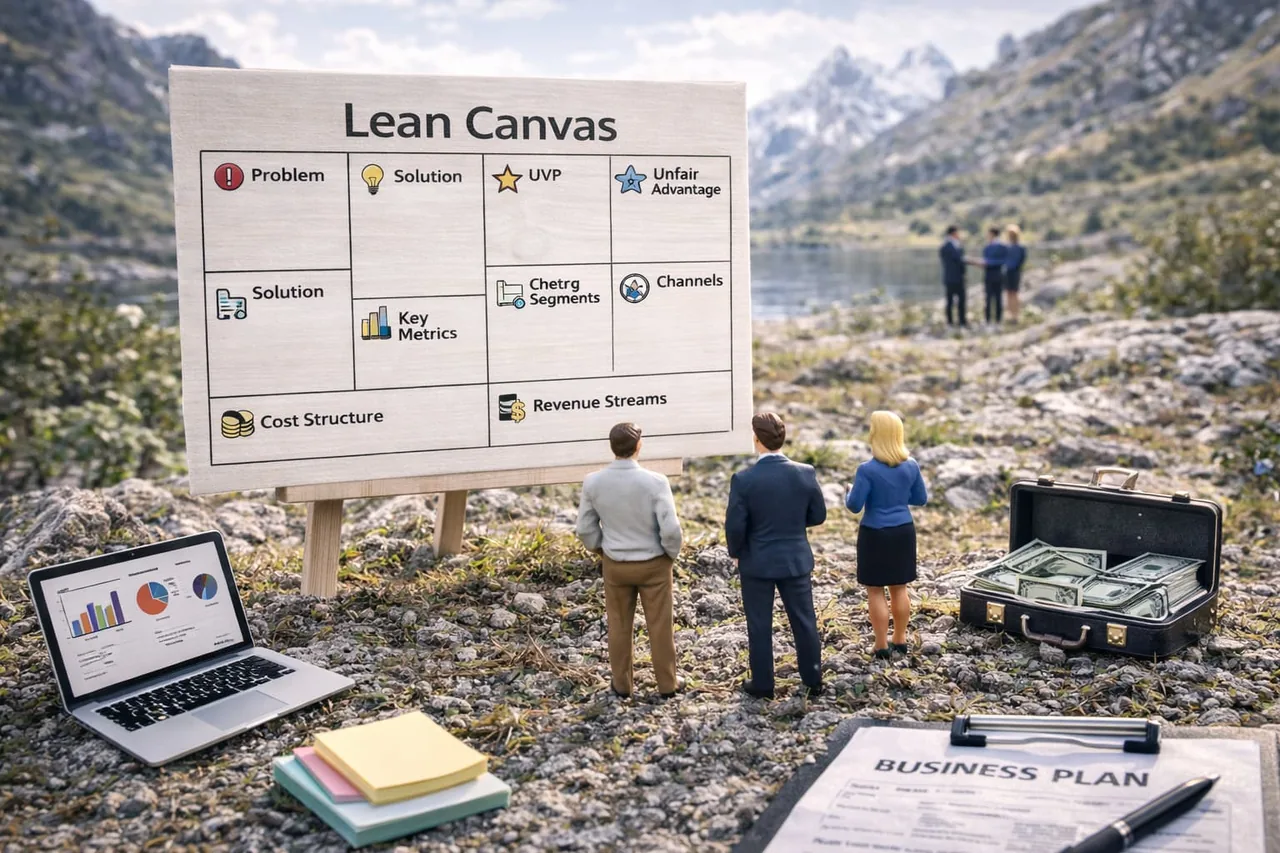
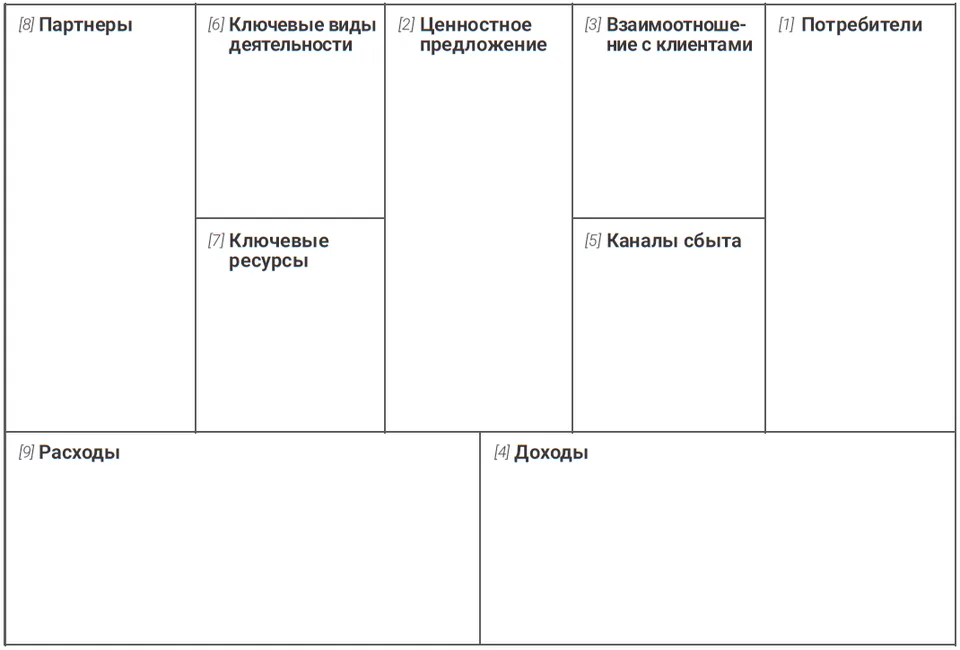
The Business Model Canvas is a visual tool for developing and describing business models. It allows you to systematize and structure key aspects of a business on a single sheet. This tool includes nine blocks, each describing an important component of your business. It is a basic template that you are asked to fill out in any accelerator, incubator, or educational program aimed at growing entrepreneurial skills. But usually, filling it out becomes the goal itself, and what to do next and why we are doing it is unclear. Let's figure it out. In general, there are only two goals — to check if the model works and to find optimal conditions for its operation.
First, let's understand what a model is. A model is a system that attempts to recreate a process. In our case, we are trying to model a business, a startup idea. We do this to formulate hypotheses and check if our business model works. To do this, we fill out all nine blocks and build hypotheses.
To begin with
1. Customer Segments
This block describes the different groups of people or organizations you aim to reach and serve.
Example 1: Shtab.app
- Customer Segment 1: Small and medium-sized enterprises in need of project and task management. These companies often face challenges in coordinating team work and meeting deadlines. Shtab.app provides them with a convenient tool for task planning, resource allocation, and progress tracking.
- Customer Segment 2: Freelancers and individual entrepreneurs who want to improve their work organization. These users value mobility and integration with other services such as Google Calendar, Slack, and Trello, allowing them to manage their projects more efficiently.
Example 2: Chemical composition for protecting tubing from corrosion
- Customer Segment 1: Oil and gas companies operating wells. These companies seek solutions to extend the service life of pipelines and reduce costs for repair and equipment replacement.
- Customer Segment 2: Manufacturers and suppliers of equipment for the oil and gas industry. They are interested in providing their clients with high-quality and durable solutions for protecting pipelines from corrosion.
2. Value Propositions
This block describes the value you provide to your customers and the problems you solve.
Example 1: Shtab.app
- Value 1: A simple and intuitive project management platform. Users can easily create tasks, assign performers, and track their completion.
- Value 2: Integration with popular tools and services. Shtab.app supports integrations with Google Calendar, Slack, and Trello, making it convenient for users already using these services.
Example 2: Chemical composition for protecting tubing from corrosion
- Value 1: Extending the service life of pipelines through effective corrosion protection. The product reduces the corrosion rate, allowing companies to decrease the frequency of pipe replacements and avoid accidents.
- Value 2: Reducing costs for repair and equipment replacement. Using the chemical composition allows oil and gas companies to significantly save on pipeline repair and maintenance.
3. Customer Relationships
This block describes how you will build and maintain relationships with customers.
Example 1: Shtab.app
- Relationship 1: Personal support via online chat. Users can reach out for help at any time and receive a prompt response from the support team.
- Relationship 2: Webinars and training materials for users. Regular webinars and video tutorials help users quickly master the platform's functionality and use it most effectively.
Example 2: Chemical composition for protecting tubing from corrosion
- Relationship 1: Technical support and consultations on product use. Clients can receive professional advice and recommendations on applying the chemical composition.
- Relationship 2: Regular meetings and presentations for key clients. Company representatives hold meetings with major clients, demonstrating the product's advantages and discussing possible improvements.
4. Revenue Streams
This block describes how your business will earn money.
Example 1: Shtab.app
- Revenue 1: Subscription for premium account. Users can choose different pricing plans based on their needs and gain access to additional features.
- Revenue 2: One-time payments for additional features. Clients can purchase individual features or modules not included in standard plans.
Example 2: Chemical composition for protecting tubing from corrosion
- Revenue 1: Product sales in volume. Clients purchase the chemical composition in large quantities for use at their facilities.
- Revenue 2: Licensing fees for using the formula. Companies using the formula in their products pay licensing fees for the right to use it.
5. Customer Relationships
This block describes how you will deliver your value to customers.
Example 1: Shtab.app
- Relationship 1: Personal support via online chat. Users can reach out for help at any time and receive a prompt response from the support team.
- Relationship 2: Webinars and training materials for users. Regular webinars and video tutorials help users quickly master the platform's functionality and use it most effectively.
Example 2: Chemical composition for protecting tubing from corrosion
- Relationship 1: Technical support and consultations on product use. Clients can receive professional advice and recommendations on applying the chemical composition.
- Relationship 2: Regular meetings and presentations for key clients. Company representatives hold meetings with major clients, demonstrating the product's advantages and discussing possible improvements.
6. Key Activities
This block describes the main actions required to implement your value proposition.
Example 1: Shtab.app
- Activity 1: Software development and updates. Continuous improvement of functionality and addition of new features.
- Activity 2: Marketing and customer acquisition. Advertising campaigns and product promotion in the market.
Example 2: Chemical composition for protecting tubing from corrosion
- Activity 1: Production and quality control of the product. Thorough control at all stages of production to ensure high quality.
- Activity 2: Research and development of new compositions. Continuous improvement of the formula and development of new solutions for corrosion protection.
7. Key Resources
This block describes the resources needed to implement your value proposition.
Example 1: Shtab.app
- Resource 1: Team of developers and engineers. Qualified specialists develop and maintain the platform.
- Resource 2: Servers and IT infrastructure. Reliable servers and data storage systems ensure uninterrupted platform operation.
Example 2: Chemical composition for protecting tubing from corrosion
- Resource 1: Research laboratory. Modern equipment and laboratory tests ensure high product quality.
- Resource 2: Patents and licenses for the formula. Legal protection of intellectual property guarantees the uniqueness and competitiveness of the product.
8. Key Partners
This block describes the network of partners and suppliers that will help you implement your business.
Example 1: Shtab.app
- Partner 1: Online payment platforms. Partnership with payment systems allows users to conveniently pay for subscriptions.
- Partner 2: Marketing agencies. Joint advertising campaigns and product promotion in the market.
Example 2: Chemical composition for protecting tubing from corrosion
- Partner 1: Manufacturers of chemical reagents. Reliable suppliers of raw materials ensure high quality of the final product.
- Partner 2: Oil and gas companies for product testing. Partners provide sites for testing and product implementation.
9. Cost Structure
This block describes the main costs associated with running your business.
Example 1: Shtab.app
- Cost 1: Employee salaries. Payroll for developers, marketers, and other employees.
- Cost 2: Operational expenses for servers and hosting. IT infrastructure support and server rental.
Example 2: Chemical composition for protecting tubing from corrosion
- Cost 1: Raw materials for producing the chemical composition. Procurement of necessary components for production.
- Cost 2: Laboratory testing and quality control. Expenses for conducting tests and ensuring compliance with standards.
The Business Model Canvas is a powerful tool for structuring and analyzing your business. Using the examples of Shtab.app and the chemical composition for protecting tubing from corrosion, you can see how different types of businesses can use this tool for their growth and development.
Task
You need to fill out the business model and build hypotheses for testing if you are on page 21, and a near-final version if you are on page 65. We have made two places to fill out, because after the first fill you will build hypotheses and test them, meaning the numbers will be refined, theses will change, and the value proposition will be heavily adjusted. Therefore, we fill out the model at the beginning, based on your idea, then go through checks, and after that record the final result, maybe several, and possibly go through this several times. (For this, pages 65-67 contain three business model templates).
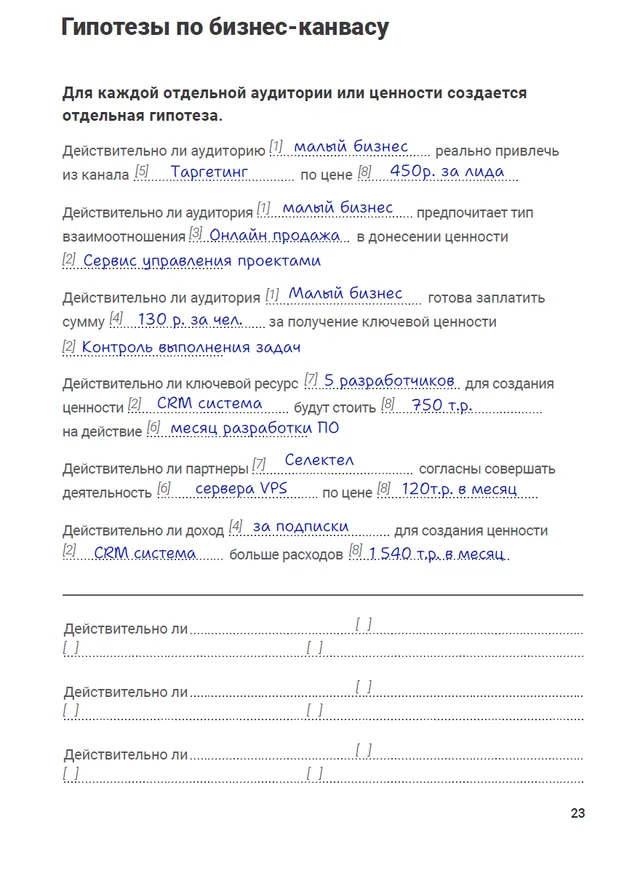
After filling out the model, build hypotheses on pages 23-25. These pages do not need to be filled out all at once; first, write down the main and most risky ones, those you are most unsure about. After testing them, write the next block and test.
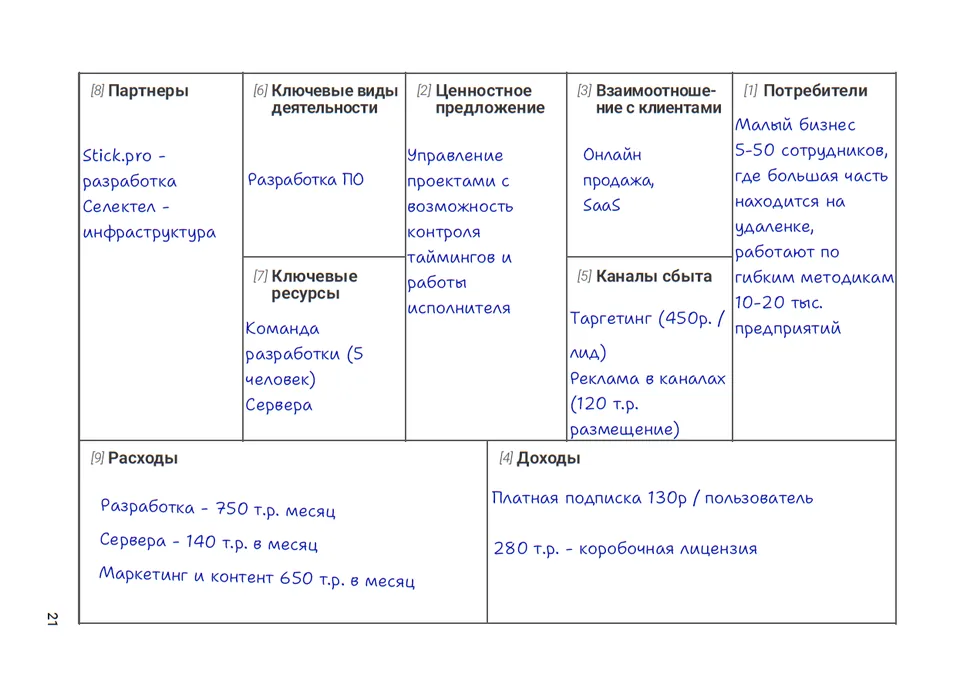
Example of Filling
FAQ
How to use the Business Model Canvas to attract investors?
The Business Model Canvas helps visualize and structure your business plan, making it more understandable for investors. To attract investors, it is important to present the Canvas with clear and substantiated data, including potential revenue streams, market assessment, and go-to-market strategy. Investors also want to see that you have a clear understanding of your customer segments, value propositions, and competitive advantages. Additionally, including calculations and profit forecasts will help investors assess the potential profitability of your business.
Do I need to include numbers and calculations in the Business Model Canvas?
Including numbers and calculations in the Business Model Canvas helps make the model more substantiated and convincing. In the "Revenue Streams" block, you can indicate expected sources of income and projected amounts. In the "Cost Structure" block, add the main expense items and their estimates. It is also important to include market data, such as the size of the target market and the share you plan to capture. For the "Key Resources" and "Key Activities" blocks, specify budgets for development, marketing, and operational expenses. The numbers should be supported by research and real data to demonstrate the realism of your forecasts.
How often should I update the Business Model Canvas?
The Business Model Canvas should be updated regularly, especially in dynamic and rapidly changing industries. It is recommended to review the Canvas with every significant market change, after receiving important customer feedback, or when developing new strategies. This will help you adapt your business model to current conditions and maintain competitiveness. Quarterly or semi-annual reviews can be useful for most startups to stay relevant and effective.
How many value propositions and customer segments should I add to the Business Model Canvas?
You should add as many value propositions and customer segments to the Business Model Canvas as you can verify and calculate. It is important not to strive for redundancy; focus on the main segments and key propositions that are truly important for your business. For startups, 1-2 main customer segments and corresponding value propositions are usually sufficient. If you have a more complex business with different products and services for various audiences, more segments and propositions may be needed. The main thing is that each added element is clearly justified and brings value to your business.
Comments
0No comments yet.
Sign in to join the discussion.