
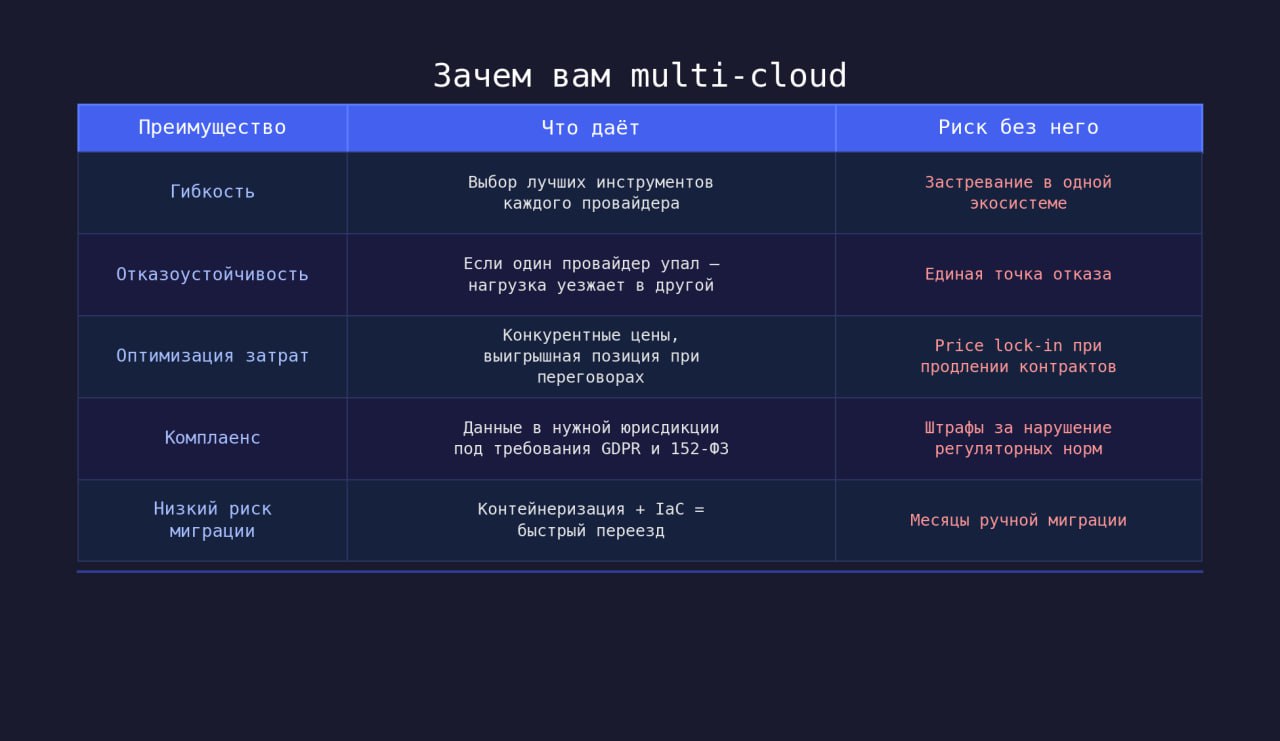
🌐 Multi-Cloud Strategy: Freedom of Choice for Every Service
When your business lives in a single cloud, you're not a client—you're a hostage. According to the Parallels 2026 State of Cloud Computing Survey, 94% of organizations are concerned about vendor lock-in, and 93% of enterprise companies already operate in multi-cloud environments. Let's explore why and how.
⚠️ The Problem with a Single Cloud:
🔒 Vendor lock-in — switching providers costs months of work and millions of rubles.
📉 Limited flexibility — you are forced to use one provider's tools, even when a competitor offers a better and cheaper solution.
💰 Price lock-in — 81% of companies cite cost optimization as the main driver for moving to multi-cloud, but only 25% believe they are getting full ROI from their cloud investments.
✅ Solution: Multi-Cloud Approach
The essence is simple — each service lives in the cloud where it performs best:
☁️ Yandex Cloud → ML in Russia, services subject to various compliance requirements.
☁️ AWS → ML/AI environments
☁️ Google Cloud → Analytics and BigData (BigQuery + Vertex AI)
☁️ Azure → For Windows-oriented infrastructures (native integration with Active Directory, Office 365, Power BI)
☁️ Local clouds → For hypersensitive data
🛠 Tools to Help You Work with Multi-Cloud
☝️ Crossplane — manage resources across all clouds via Kubernetes API. Uses YAML and continuous reconciliation: if someone manually changes a resource, Crossplane automatically restores it to the desired state. Ideal for teams deeply embedded in K8s.
☝️ Terraform — Infrastructure as Code using HCL. Supports 3000+ providers, from AWS to custom on-prem solutions. The gold standard for IaC, especially if you need broad coverage.
☝️ kubectl — manage multiple K8s clusters via contexts. One command kubectl config use-context production-west switches between clusters in different clouds.
Crossplane and Terraform work great together. Terraform for initial infrastructure provisioning, Crossplane for Kubernetes-native lifecycle management.
🚀 How to Start Your Move to Multi-Cloud?
1. Audit your services.
Divide your services into categories: compute, bigdata, ML/AI, infrastructure-heavy services, compliance-bound services, etc. Determine which provider is best suited for each.
2. Start with a "second arm"
Don't migrate everything — add one provider for the category identified in step one, or for a new project. This ensures the safest separation. Try to choose a category with the least vendor lock-in.
3. Implement IaC
Terraform or Crossplane — it doesn't matter, the key is: no manual resource creation. Infrastructure as Code equals portability.
4. Unified visibility.
Set up centralized monitoring and logging across all clouds. Without a single pane of glass, multi-cloud turns into chaos.
5. FinOps practices
Implement FinOps to control costs across all providers. Without this, multi-cloud will cost more than a single cloud.
6. Zero Trust Security
Don't forget security. Implement Zero Trust Security for all cloud services.
#MultiCloud #CloudStrategy #VendorLockIn #IT #DigitalTransformation #DevOps #Kubernetes #Terraform #Crossplane
Comments
0No comments yet.
Sign in to join the discussion.