

Today I will tell you about an unusual animated project that will soon be seen in cinemas (from July 30).
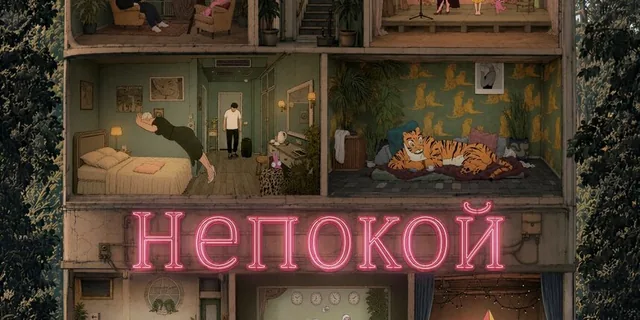
Leonid Shmelkov's "Unrest" is an animated film that is hard to call just a cartoon. It is a viscous, disturbing and mesmerizing movie, more like a surreal thriller or a dream from which you cannot wake up. The creator of the viral "Andrei's Blue Dog" presented an adult, philosophical work that will surely divide viewers into those who succumb to its magic and those who remain in some bewilderment.
The plot is deceptively simple: the main character Yasha and his apathetic friend Bernard lose their way and stop at the dilapidated hotel "Rosa" amidst endless fields. In the morning, it turns out that leaving is impossible — all roads lead back. A strange series of events occurs in the hotel: guests, including a smoking tiger and a man turning into a pyramid, begin to disappear one by one. The director himself describes his film as a mix of David Lynch's aesthetics with "Groundhog Day".
The main advantage of "Unrest" is its unique visual and sound atmosphere. The film was created using rotoscoping technique: live actors were filmed on video, and then animators redrew the material frame by frame, creating a simultaneously realistic and distorted picture. This method gives the characters and their movements that very, slightly wrong, dreamlike plasticity. To some extent, in terms of atmosphere and style, the film resembles the "Mozharovo" series from the anthology of Russian horror, which once impressed viewers.
"Unrest" is not an easy mood film, not a classic movie story with a clear plot. The director deliberately leaves room for interpretation and the viewer's imagination, drawing inspiration from Cortázar's magical realism and in a sense reinterpreting the myth of Odysseus. The hotel here appears as a metaphor for a borderline state, a purgatory where the characters go through their fears and desires, but without the possibility of escaping from there.
However, one should be prepared for the fact that the film does not give clear answers. It leaves rather an aftertaste than clarity. And therefore do not be surprised if the deliberate lack of logic and fixation on images may tire you. But those who appreciate auteur cinema and like to delve into the multilayeredness that appears on the screen, are ready to immerse themselves in the subconscious and are not afraid of complex metaphors, "Unrest" will surely captivate and not let go until the very end, forcing them to seek their own meaning in this somewhat Lynchian labyrinth.
Comments
0No comments yet.
Sign in to join the discussion.