
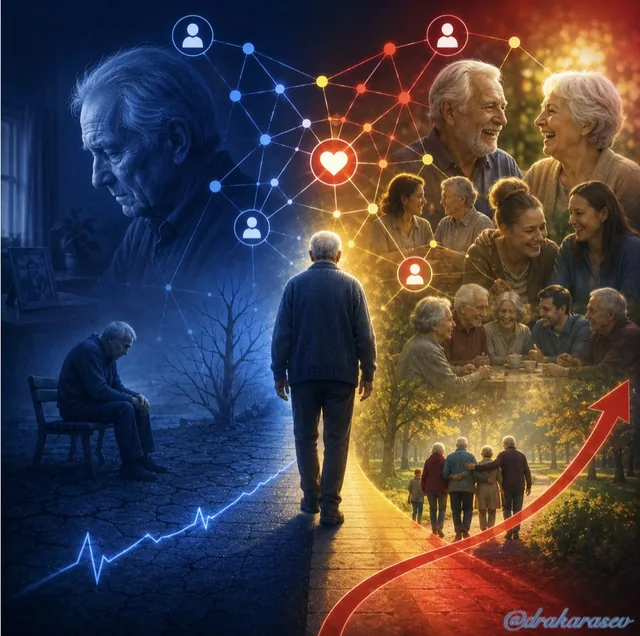
In 2010, an important meta-analysis was published in the authoritative journal PLoS Medicine. It has been cited more than 12,000 times.
Scientists from Brigham Young University (USA) systematized data from 148 independent prospective studies that tracked the relationship between people's social relationships and their mortality. In total, the analysis covered 308,849 participants from North America, Europe, Asia, and Australia, who were followed for an average of 7.5 years. The average age of participants at baseline was 64 years, with roughly equal numbers of men and women.
🔬 Main result
People with strong social ties have a 50% higher probability of survival during the follow-up period compared to those with weak or absent social relationships.
These figures were obtained after adjusting for age, sex, baseline health status, cause of death, and duration of follow-up — the effect persisted independently of these factors.
📊 What mattered most? Not all types of social ties affect survival equally. Complex multicomponent social integration involving group participation, close relationships, and a sense of community nearly doubles the chance of survival. If a person only lives not alone, the reduction in mortality risk is less significant — odds ratio 1.19 compared to those living alone.
⚖️ Comparison with other risk factors The authors compared their result with the effects of known mortality factors using data from other meta-analyses. In terms of impact on survival, social ties were comparable to quitting smoking and exceeded factors such as obesity, low physical activity, and even some medical interventions (e.g., drug therapy for hypertension in the elderly). This does not mean that smoking is "safe" if you have many friends. It means that social isolation is as powerful a predictor of mortality as many well-studied biomedical factors.
🧩 Why do social ties affect survival?
The article relies on two main theoretical models:
Buffering model ("stress-buffering") — social ties help cope with stress, mitigating its physiological consequences.
Direct effects model — social integration itself promotes healthy habits (better sleep, dietary control, fewer bad habits), provides a sense of meaning and self-esteem. The authors emphasize that the effect is not explained solely by behavior: even after statistical control for smoking, physical activity, and other factors, the association persisted.
Conclusions: to assess real risk, it is not enough to ask "do you live alone?". A comprehensive assessment is needed — involvement in communities, presence of close relationships, sense of belonging. If an elderly person becomes socially isolated, the risk of death increases; immediate engagement in their social life is necessary.
Do not leave your parents alone; take them on trips, create conditions for communication.
They forgot to ask Karasev
Comments
0No comments yet.
Sign in to join the discussion.