

For the past month, I've been trying to do something that, as it turned out, is much harder than writing code.
Come up with a good product.
Not just an interesting idea that seems cool to a developer, but a product for which there is a real market and people are willing to pay.
And the longer I think about it, the more I become convinced: writing an MVP is often easier than understanding what exactly needs to be written.
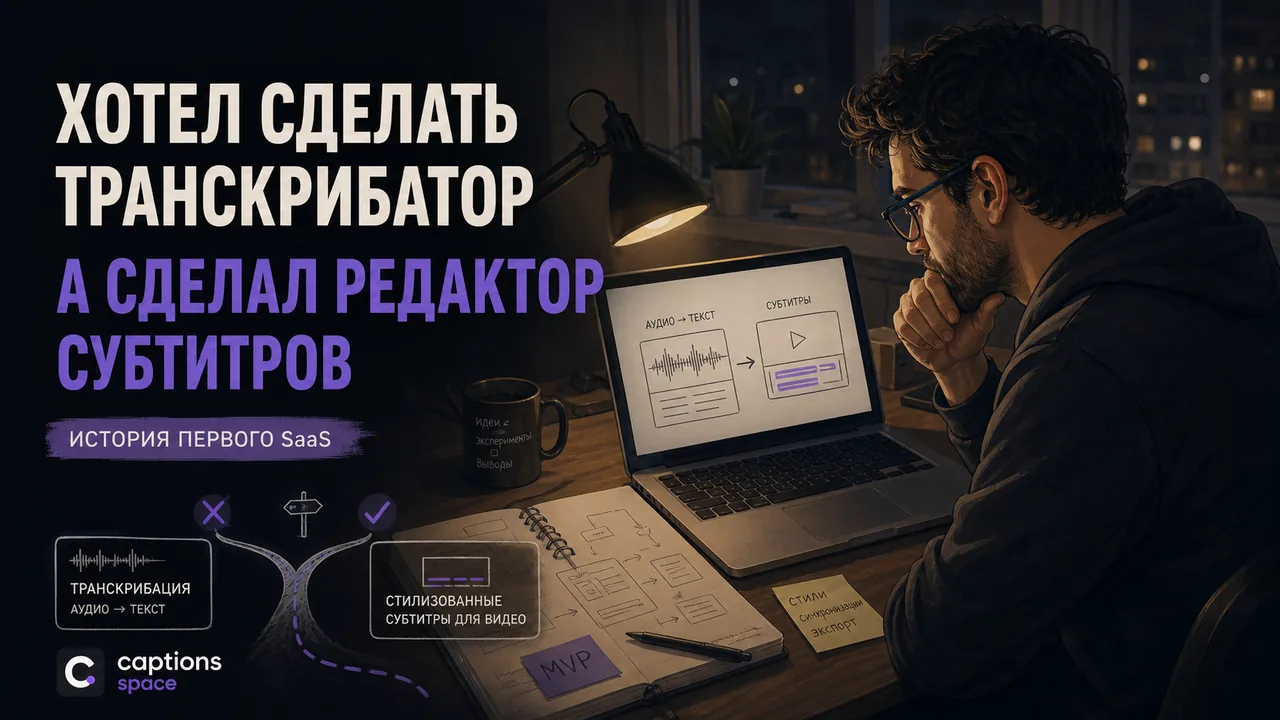
It All Started with Transcription
Initially, I wanted to make a service for transcribing audio and video.
The idea seemed quite logical: upload a video, get a text transcript in a convenient format, and then with one button make a brief summary of the content.
Especially since there is indeed demand for such a service. For example, the query "video to text" in Yandex Wordstat shows about 30 thousand queries per month.
I even managed to vibe-code the first MVP: I made a website, backend, and connected my neural networks.
It seemed like — here it is, the product.
But when I started looking at the market more closely, I got the feeling that I was a bit late. There are already a huge number of transcription services, and many of them do roughly the same thing.
And I began to ask myself a rather unpleasant question:
Why would anyone need another transcriber?
You can make the interface prettier, add another neural network, or come up with a few extra features. But all this was starting to look like an attempt to justify the chosen idea, rather than a search for a real need.
From Text Transcription to Short Videos
At some point, I started thinking not about transcription itself, but about what people do with the resulting text next.
That's how I came to short videos.
Reels, Shorts, TikTok, and other vertical formats have long turned subtitles into a separate design element. It's no longer just text at the bottom of the screen.
Big words, highlighting individual phrases, animation, changing size and color, placing text next to objects in the frame — all this helps to hold the viewer's attention.
So the idea came up to make a service not for transcription, but for creating and editing eye-catching subtitles for short videos.
And that's a completely different product.
At first, the idea seemed simple: recognize speech, get timestamps, and give the user a convenient editor.
But the more I thought about it, the more possibilities appeared:
- detect objects in the frame and not overlap them with subtitles;
- automatically highlight important words;
- add animations;
- choose styling to match a specific video;
- find moments that are worth visually emphasizing.
And then the developer's imagination starts to run wild: B-roll, automatic editing, lip sync, working with the audio track, video editing with an AI agent.
At some point, I realized that this is a very easy way to come up with a product five years ahead.
So I decided to stop and start with a much simpler thing:
Make a proper subtitle editor.
What Came Out of It
That's how my first SaaS came to be — Captions Space.
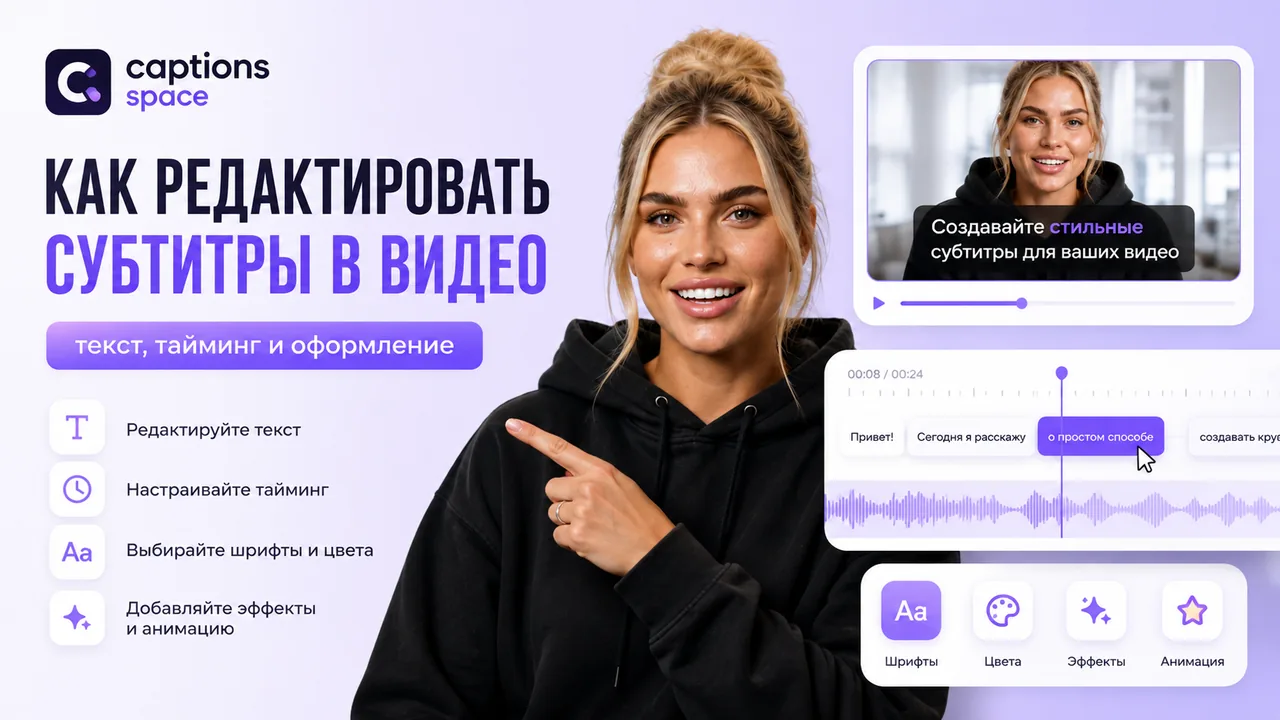
The main idea of the service is simple: upload a video, automatically get subtitles, and quickly bring them into a proper form.
The service recognizes speech and creates subtitles with timestamps. After that, the video can be opened in the editor.
If the recognition made a mistake somewhere, the text can be corrected right away. If a subtitle appears too early or too late, you can change the timing.
In other words, AI does the routine part of the work, and a person quickly checks and edits the result.
And for me, this is a rather important product principle:
AI doesn't necessarily have to do everything on its own. Sometimes it's more useful to automate 80% of the boring work and leave the last 20% to a human, where control and decision-making are needed.
Why a Plain Text Editor Isn't Enough
A separate part of the project is styling.
If you look at popular Reels and Shorts, it becomes noticeable that subtitles there are often a full-fledged part of the video's visual style.
So it's not enough to just give the user the ability to correct the text.
You need to control the font, size, color, word highlighting, background, outline, number of lines, and text placement. At the same time, hardly anyone wants to configure everything from scratch for each video.
So I added ready-made styles:
- Minimal — a simple minimalist option;
- Beauty — a more expressive style;
- Business — a restrained design for business content.
You choose the appropriate option, change something if necessary, and you can continue working.
As a result, the basic scenario looks like this:
Video → recognition → subtitles → editing → styling → finished video.
The Hardest Part Is Knowing When to Stop
So far, this is just the first version of the product.
I deliberately try not to turn it into a combine harvester of a hundred AI features, although the temptation is very strong.
If you start looking at video as a dataset, the possibilities are truly enormous:
- analyze not only speech but also the image;
- understand what is in the frame;
- determine the position of a person;
- choose free space for subtitles;
- take into account the context of what is said;
- change the styling depending on the content;
- find important moments;
- add B-roll.
In the future, you could even abandon the classic video editor and give the user the ability to simply write:
"Make this video into a dynamic Reels in the style of my channel."
And then get the finished result.
But that's the next stage.
Right now, I'm much more interested in testing a simpler hypothesis:
Do people need a convenient tool for creating and editing subtitles?
Because that's where the real product begins. Not with the number of AI features, but with whether it solves a specific problem and whether people are willing to come back to it again.
So for now, I'm just doing, trying, and seeing what comes of it.
This is my first independent SaaS, and I'm interested in going through the whole journey myself: from idea and first lines of code to first users and, possibly, first money.
If you've built your own SaaS or launched an MVP, tell us in the comments: how did you understand that you found a real need, and not just an idea that was interesting to you?
You can follow the project's development in my Telegram channel: @imironov
The project itself: Captions Space
Comments
0No comments yet.
Sign in to join the discussion.