

"Big Pharma" is one of the most notable Russian series projects of the outgoing summer, and the first episodes confirm that the interest in it is not accidental. It is a solid family drama with a medical undertone, combining a tense plot, worthy visual aesthetics, and a serious cast. Of course, there are some rough edges, but the overall level of execution commands respect.
The plot revolves around a classic conflict: scientists create a breakthrough drug, after which the invention becomes a bone of contention for pharmaceutical corporations. The setup is quite predictable for the genre, but the script holds attention due to clearly defined character motivations and the absence of obvious plot holes. The question of whether society is ready for a panacea and what is more economically profitable—to treat or to cure—is presented without excessive moralizing, though also without deep philosophical novelty.

One inevitably draws a comparison with the recent hit "Golden Bottom," where family relationships were shown as a relentless war for resources and power, where close people are ready to step over each other for money.
In "Big Pharma," the authors offer a fundamentally different model: the Gireyev family is not an arena for settling scores, but a living organism united by a common cause and a sincere desire to benefit people. Their discovery is perceived not as a tool for enrichment, but as a mission. The problem is that this family structure collides with the outside world of big pharmaceutical business, where the rules of the game are dictated solely by profit, and morality and human life become bargaining chips. It is this contrast—internal unity against external ruthlessness—that constitutes the main dramatic nerve of the series, making it not just a medical thriller, but a story about how difficult it is to maintain a human face when you are surrounded by a corporate machine that recognizes no limits.

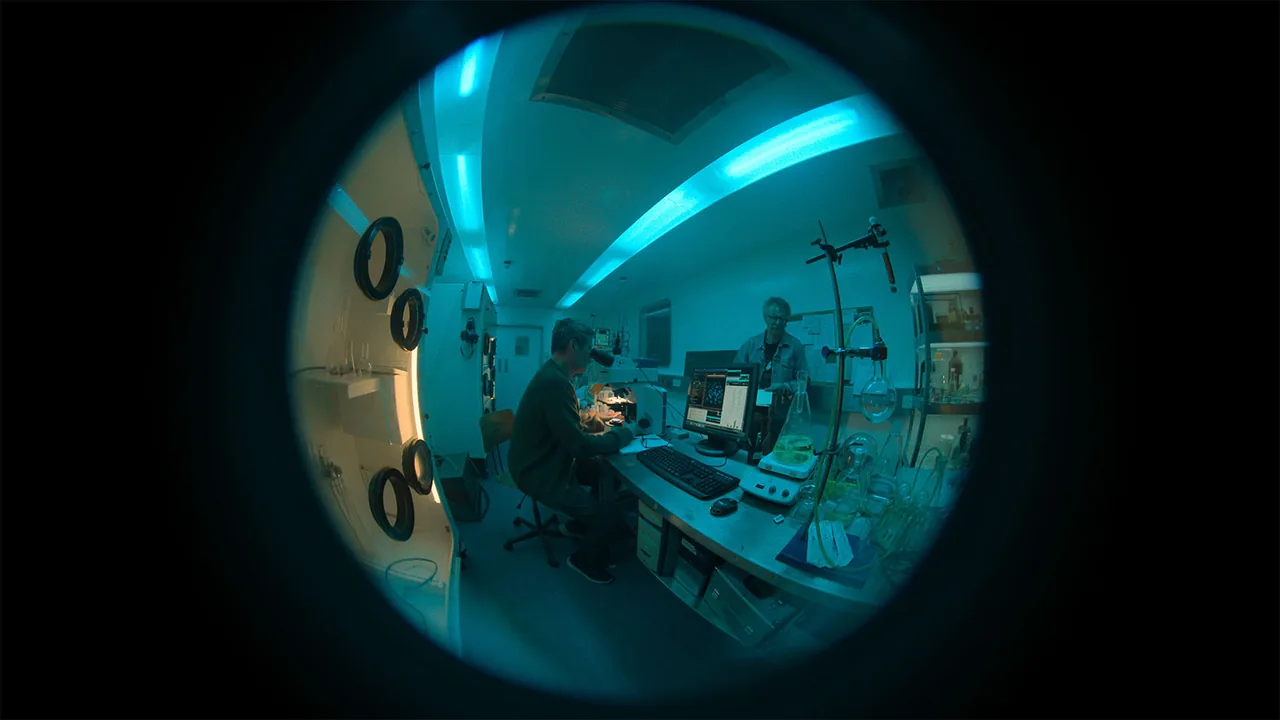
The visual aspect deserves special mention. The camera work is done at a high professional level, with a clear orientation towards Western standards—cold color palette, tense editing, and unconventional angles create a persistent feeling of nervousness and uncertainty, even when everything is heading towards success.
At the same time, the picture is sometimes deliberately blurred, as if the viewer is looking at what is happening through a microscope lens, which further immerses one in the world of laboratory research and medical discoveries, although at times this technique seems excessive and begins to compete with the plot for the viewer's attention.
The cast is well chosen. Igor Gordin looks organic in the role of the father-scientist, torn between scientific duty and family obligations. Sergei Goroshko and Olga Lerman handle their roles without noticeable failures, although their characters are not yet fully revealed, but a great inner drama is already felt, which, with great hope, will unfold at the end. Svetlana Khodchenkova as a representative of the pharma business adds the necessary sharpness to the story, but her antagonist so far looks more schematic than voluminous.

Overall, "Big Pharma" leaves the impression of a solid, conscientiously made series that does not try to appear as something it is not. It does not revolutionize the genre, but it demonstrates a steady growth in quality standards in Russian series production. If the first episodes do not cause delight, they at least do not disappoint and give reason to watch the further development of events.
Comments
0No comments yet.